How often should I feed my reptile?
Short answer
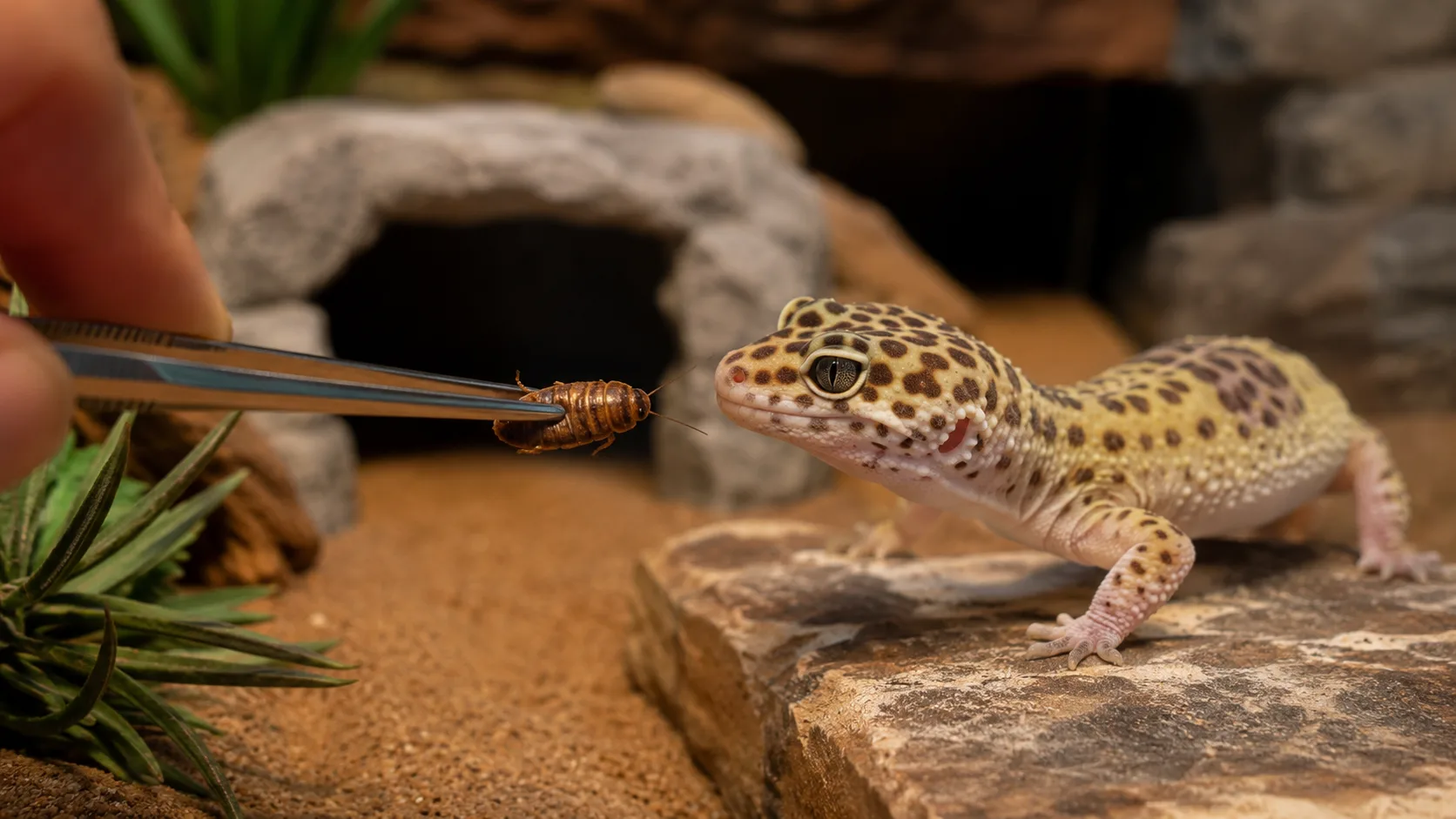
Reptile feeding cadence depends on species and age. Juvenile bearded dragons need insects daily plus greens. Adult bearded dragons eat greens daily and insects 2–3 times a week. Adult ball pythons eat one appropriately-sized rodent every 10–14 days. Adult leopard geckos eat insects 2–3 times a week. Hatchlings of most species eat more often than adults; over-feeding adults is a common problem.
- Author
- Reptimo Editorial
- Updated
- Updated
- Reading time
- 6 min read
Why feeding cadence varies so much
Pet reptiles include obligate carnivores (snakes), insectivores (leopard gecko, chameleon), omnivores that shift toward herbivory (bearded dragon, slider), and primary frugivores on commercial diets (crested gecko). Their metabolic rates, prey digestion times and life-stage requirements all differ — which is why "how often should I feed my reptile?" has a different answer depending on which reptile.
The Merck Veterinary Manual identifies nutritional disorders — both over- and under-feeding — as a major preventable category in pet reptiles. Most cases trace to schedules misaligned with species and age.
Feeding schedules by species
Care parameters
Adult feeding cadence — common pet species
| Parameter | Recommended value | Notes |
|---|---|---|
| Bearded dragon — adult | Greens daily, insects 2–3×/week | Juvenile: insects daily plus greens |
| Leopard gecko — adult | Insects every 2–3 days | Juvenile: daily |
| Crested gecko — adult | CGD (commercial diet) 3×/week, insects optional | Juvenile: CGD daily |
| Ball python — adult | 1 rodent every 10–14 days | Juvenile: every 5–7 days; subadult: every 7–10 days |
| Corn snake — adult | 1 rodent every 7–14 days | Hatchling: every 5–7 days |
| Veiled chameleon — adult | Insects every 2–3 days, ~3–6 items | Juvenile: insects daily |
| Red-eared slider — adult | Greens daily, pellets/protein 3×/week | Juvenile: pellets/protein daily plus greens |
Species-specific deep dives: bearded dragon, leopard gecko, ball python, corn snake, red-eared slider.
The two universal rules
Two principles cut across every species:
- Juveniles eat more often than adults. Faster metabolism, active growth, smaller fat reserves. A juvenile bearded dragon needs daily insects to fuel growth; a 2-year-old adult on the same schedule will be obese within a year.
- Larger meals less often beat small meals daily for snakes. Snakes evolved to swallow prey larger than their head and digest it over days. Constant small meals stress the gut and don't fit biology. Insectivorous lizards are different — small frequent meals match how they hunt.
Prey size
Universal sizing rules across reptiles:
- Insects — no wider than the gap between the reptile's eyes. Length less important than width.
- Rodents for snakes — roughly the width of the snake's widest body section. The "soft bump" that's barely visible after feeding.
- Greens for omnivores — chopped to bite-size; mixed leafy varieties.
Oversized prey causes regurgitation in snakes (a significant stress event, can take weeks to resume eating). Undersized prey under-fuels — especially in juveniles. When in doubt, slightly under-size for snakes; insects sized correctly is more critical.
Calcium dusting and gut-loading
Two complementary practices for insectivorous and omnivorous species:
Dusting — coat feeder insects with a calcium/vitamin powder immediately before offering. Frequency by life stage:
Care parameters
Supplementation cadence — insectivorous and omnivorous lizards
| Parameter | Recommended value | Notes |
|---|---|---|
| Juvenile — calcium with D3 | Most feedings (3–5×/week) | |
| Juvenile — multivitamin | 1–2× weekly | |
| Adult — calcium with D3 | 2–3× weekly | |
| Adult — plain calcium | On additional dustings | |
| Adult — multivitamin | Every 1–2 weeks |
Gut-loading — feeding feeder insects a high-quality diet for 24–48 hours before they're offered. Gut-load on calcium-rich leafy greens (collard, mustard, dandelion), dark fruits (papaya, berries), and commercial gut-load powders. An insect that's been on dry oats for two days is a poor calcium source even when dusted; gut-load fixes that.
Snakes don't need dusting — whole rodents come pre-loaded with calcium and other nutrients.
Over-feeding is the quiet problem
The ReptiFiles bearded dragon care guide and most modern care sheets converge on a key point: over-feeding adult reptiles is one of the most common preventable health issues in the hobby. The clinical pattern:
- Adult bearded dragons fed juvenile-frequency insects: obesity, hepatic lipidosis, reduced lifespan.
- Adult ball pythons fed weekly instead of every 10–14 days: too fast growth, organ stress, shorter lifespan.
- Adult leopard geckos fed daily: obesity (waddle visible from above), fatty deposits visible behind the eyes ("fat pads").
The fix is calibrating the schedule to age, not feeding the way the animal acts hungry. Most adult reptiles will accept a meal whenever offered — accepting doesn't mean needing.
Under-feeding — the rarer case
Less common but real:
- Juveniles cut too aggressively — well-meaning keepers worried about obesity reduce hatchling feeds before the animal's done growing. The result is poor body condition.
- Insectivores fed only mealworms — low calcium, hard chitin, poor variety. Switch to varied feeders (dubia, crickets, BSF larvae, occasional waxworms).
- Slow-feeding chameleon under-fed because keeper assumes refusal means uninterested. Chameleons are slow eaters with picky preferences; persistence matters.
Track weight weekly and the under-feeding pattern shows up as sustained slow weight loss with otherwise correct husbandry.
Natural fasts
Almost every reptile species has seasonal or cyclical fasts:
- Brumation in bearded dragons (Oct–March in cooler households) — see bearded dragon brumation.
- Winter slowdown in ball pythons (Oct–March) — refusals of 2–4 months are routine with stable weight.
- Pre-shed refusal in most species — 5–10 days off feed before shedding.
- Post-meal rest in snakes — 5–14 days between meals is the normal cadence.
- Rehoming stress — 1–4 weeks off feed in a new enclosure is common, especially in ball pythons.
The diagnostic question is always: stable weight + correct husbandry
- recognisable seasonal/behavioural pattern = normal fast. Weight loss + any other warning sign + no seasonal pattern = vet visit. See "is my reptile sick?".
Using reminders
Per-species feeding cadence becomes invisible drift without reminders — especially adult ball pythons (every 10–14 days) and adult bearded dragons (insects 2–3×/week). A simple structured reminder set:
- Insectivores: every-2-day reminder, with a weekly note for multivitamin.
- Adult bearded dragons: Monday/Wednesday/Friday insects, daily greens.
- Adult snakes: every-10-day rolling reminder; reset on every accepted meal.
- Crested geckos: Monday/Wednesday/Friday CGD refresh.
For app-side reminder workflows, see reptile feeding reminders. For the broader why-track conversation, see the husbandry log primer.
What to do when feeding goes wrong
The umbrella troubleshooting for "my reptile won't eat" is "why won't my reptile eat?" — same diagnostic logic across species. Species-specific walkthroughs live in ball python, leopard gecko, bearded dragon.
Frequently asked questions
Why do reptile feeding schedules differ so much by species?
How big should a prey item be?
Are reptiles supposed to eat every day?
What happens if I over-feed a reptile?
What happens if I under-feed?
What does gut-loading insects mean?
Should I dust insects with calcium every feed?
Do reptiles fast naturally?
Can I use reminders to keep track of feeding?
Sources
- Reptile Care for Beginners · PetMD
- Disorders and Diseases of Reptiles · Merck Veterinary Manual
- Bearded Dragon Care Guide · ReptiFiles
Quick check
Test what you just learned
A short quiz, just for you. Pick an answer to get instant feedback — there's no pass mark, this is for your benefit.
Quiz questions and answers
What's the right feeding cadence for an adult ball python?
Correct answer: One appropriately-sized rodent every 10–14 days
Adult ball pythons eat one appropriately-sized rodent every 10–14 days — sometimes less in winter. Daily feeding is for juvenile insectivorous lizards; monthly feeding under-fuels. Cadence reflects species metabolism and the digestion time of the prey item.
What does 'gut-loading' a feeder insect mean?
Correct answer: Feeding feeder insects a high-quality diet for 24–48 hours before offering them, so the nutrition passes through
Gut-loading is feeding crickets/roaches/mealworms a calcium-rich diet (leafy greens, dark fruit, commercial gut-load) for 24–48 hours before they're offered. The insect's gut contents pass nutrition through. Without gut-loading, even dusted insects are a poor calcium source — gut-load is the missing leg.
Why is over-feeding adult reptiles a real problem?
Correct answer: Obesity, fatty liver disease, reduced lifespan, reproductive issues — especially in adult bearded dragons fed juvenile-frequency insects
Adult reptiles fed juvenile-frequency diets routinely develop obesity, hepatic lipidosis and shortened lifespans. Bearded dragons are especially vulnerable — they need to transition to mostly-greens with insects 2–3 times a week, not the daily insect feeding their juvenile self enjoyed. Cadence has to drop with age.