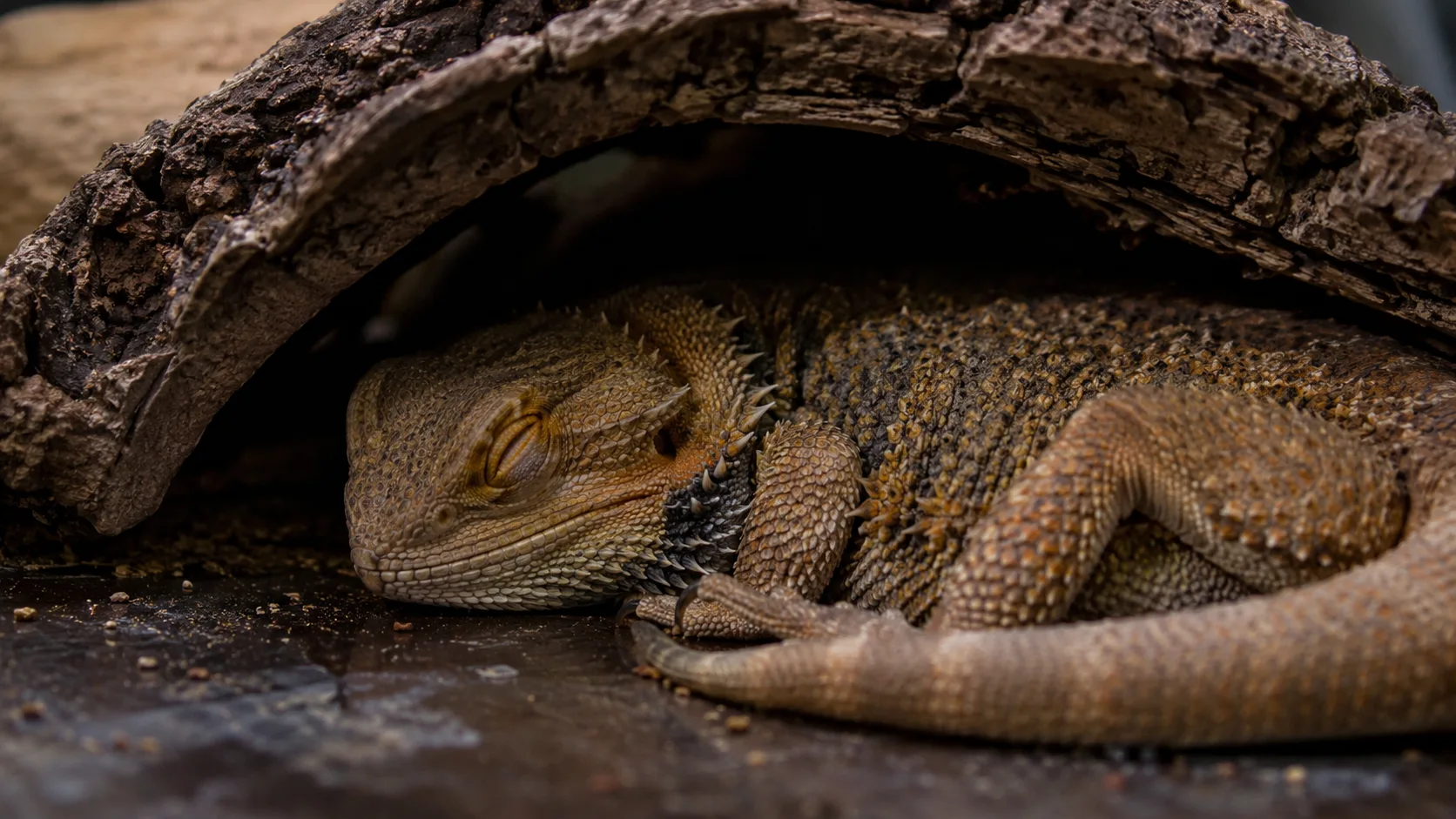
Why is my bearded dragon not eating in winter?
Short answer
Healthy adult bearded dragons often enter brumation in autumn and winter — a hibernation-like slowdown lasting weeks to months. They sleep longer, refuse food, and hide in cooler corners. Brumation is normal in adults over 12 months if weight stays stable. It is NOT normal in hatchlings under 12 months, or when paired with weight loss, sunken eyes, or mucus — those need a vet.
- Author
- Reptimo Editorial
- Updated
- Updated
- Reading time
- 5 min read
What brumation is
Brumation is the reptile equivalent of hibernation — a state of reduced metabolic activity triggered by shortening day length and cooler temperatures in autumn and winter. In bearded dragons (Pogona vitticeps) it presents as:
- Sleeping for longer stretches, often in dark corners or burrowed under substrate.
- Refusing food, sometimes for weeks or months.
- Reduced basking — the dragon ignores the basking lamp even when it's on.
- Reduced defecation (less food in = less out).
- Slight muting of color in some individuals.
Per ReptiFiles' brumation explainer and consistent guidance from BeardedDragon.org's brumation guide, captive brumation varies enormously between individuals: some dragons brumate deeply every winter, some skip years, some never brumate at all. All three patterns are normal.
When brumation is normal — and when it isn't
The normal pattern:
- Age 12+ months (preferably 18 months when growth has plateaued).
- Autumn or winter onset triggered by shortening photoperiod and ambient temperature drops.
- Otherwise healthy dragon — clear eyes, normal urate color (white tip), no mucus, no dark sustained beard, stable weight.
- Gradual onset and resolution over days to weeks at each end.
The not-normal pattern (audit husbandry, see a vet):
- Hatchling or juvenile under 12 months — see next section.
- Sudden onset rather than gradual decline.
- Sunken eyes — dehydration, not brumation.
- Sustained dark beard through the day — stress or illness.
- Significant weight loss (>10 % of body weight).
- Mucus, open-mouth breathing, swelling — respiratory infection or other illness. See "is my reptile sick?".
- Year-round refusal — not seasonal, not brumation.
Hatchlings should not brumate
A hatchling or juvenile bearded dragon (under 12 months, sometimes under 18 months for slow growers) should not brumate. They're still in their primary growth phase and need consistent food and calcium intake to develop bone density and reach healthy adult size.
If a young dragon shows brumation-like behaviour:
- Audit husbandry first. Verify basking surface 40–43 °C (104–110 °F) with an IR temperature gun (see temperature guide), UVB at UVI 4–6 at basking with a Solarmeter (see UVB guide), correct calcium-with-D3 dusting on insects most feedings.
- Track weight weekly. A young dragon losing weight or failing to gain is a same-week reptile vet appointment.
- Watch for illness signs. Sunken eyes, mucus, sustained lethargy at basking temperature — all warrant a vet visit.
What to do during brumation
For a healthy adult that's brumating:
- Keep heat and UVB on during the day. Either at normal 12-hour photoperiod or slightly reduced (10 hours) to mirror seasonal light. Do NOT turn everything off — that's chronic under- husbandry, not brumation support.
- Continue to offer food every 7–14 days even if refused. Some brumating dragons take occasional small meals. Remove uneaten food after a few hours.
- Weigh weekly. A simple digital kitchen scale catches weight trends early. Log the numbers — see the husbandry log guide.
- Offer a shallow bath in lukewarm water once every 1–2 weeks for 10–15 minutes. Many brumating dragons drink during the bath even though they ignore the water dish.
- Don't force-feed. A healthy brumating dragon doesn't need feeding; force-feeding can cause regurgitation and stress.
- Minimal handling. Brumating dragons want to sleep. Don't wake them for cuddles. Daily 30-second visual check is enough.
Care parameters
Healthy bearded dragon brumation — at-a-glance
| Parameter | Recommended value | Notes |
|---|---|---|
| Duration | 2 weeks – 3+ months | Most captive dragons: 4–10 weeks |
| Age | 12+ months | Hatchlings should NOT brumate |
| Season | Autumn / winter | Triggered by photoperiod and temperature |
| Weight change | Under 5 % loss | 10 %+ loss = NOT healthy brumation |
| Feeding | Refused or minimal | Keep offering every 7–14 days |
| Bath / hydration | Once every 1–2 weeks | Lukewarm shallow soak 10–15 min |
| Heat & UVB | Keep on, normal or 10-h photoperiod | Dragon ignores them by choice |
| Handling | Minimal — visual check daily |
Coming out of brumation
In late winter or early spring, the dragon emerges gradually as photoperiod naturally increases. Signs of waking:
- Resumed basking under the lamp.
- Active during light hours instead of asleep.
- Occasional defecation as gut activity resumes.
- Eventually accepting offered food.
Resume normal feeding:
- First week: offer greens daily, insects every 2–3 days as appetite returns.
- Week 2–4: normal adult schedule — greens daily, insects 3–5 times per week (see the diet guide).
- Weigh weekly for the first month post-brumation to confirm normal weight trajectory.
Some dragons take 2–4 weeks to fully resume normal eating. If your dragon hasn't resumed any feeding 3–4 weeks after photoperiod normalises and basking activity resumes, that's a vet visit — what looked like brumation may have been the start of an illness.
When to involve a vet
Brumation does NOT need a vet visit for a healthy adult. These signs DO:
- Hatchling or juvenile (under 12 months) showing brumation-like behaviour.
- Weight loss exceeding 10 % of body weight.
- Sunken eyes, sustained dark beard, mucus, open-mouth breathing.
- Refusing food past 4 weeks after expected emergence.
- Any sign that combined with refused food doesn't fit a normal pattern.
The broader husbandry context is in the pillar care guide; the temperature setup is in the temperature guide; the not-eating diagnostic walkthrough is in the not-eating guide.
Frequently asked questions
What is brumation in bearded dragons?
Do all bearded dragons brumate?
How old should a bearded dragon be before brumation?
How long does bearded dragon brumation last?
Is it OK if my bearded dragon doesn't drink during brumation?
Should I turn off the heat and UVB during brumation?
How much weight should a bearded dragon lose during brumation?
How do I tell brumation from illness?
What should I do when my bearded dragon comes out of brumation?
Sources
- Bearded Dragon Care Sheet · PetMD
- Bearded Dragon Brumation · ReptiFiles
- Bearded Dragon Brumation Guide · BeardedDragon.org
- Disorders and Diseases of Reptiles · Merck Veterinary Manual
Quick check
Test what you just learned
A short quiz, just for you. Pick an answer to get instant feedback — there's no pass mark, this is for your benefit.
Quiz questions and answers
When is brumation NORMAL in a bearded dragon?
Correct answer: Adults over 12–18 months in autumn and winter, with stable weight
Brumation is normal in adults over 12–18 months during autumn and winter, with stable weight and otherwise healthy signs. Hatchlings and juveniles should not brumate — they need consistent food for growth.
How much weight should a bearded dragon lose during healthy brumation?
Correct answer: Under 5 % of body weight over 2–3 months
Healthy brumation involves minimal weight loss — under 5 % of body weight. A dragon losing 10 % or more, with sunken sides or other illness signs, is NOT in healthy brumation. Vet appointment.
Your hatchling bearded dragon stops eating in November. What does that mean?
Correct answer: It's NOT brumation — hatchlings shouldn't brumate. Audit husbandry and consider a vet visit
Hatchlings under 12 months should not brumate. If a young dragon stops eating, audit temperature, UVB, basking surface and supplementation first; if husbandry checks out and the dragon is still off food, see a reptile vet.
Should you turn off heat and UVB during brumation?
Correct answer: Keep heat and UVB on during day at normal or slightly reduced photoperiod; the dragon will sleep through it if it wants
Modern guidance: keep heat and UVB on at normal-to-slightly-reduced photoperiod. The dragon sleeps in cooler dark corners by choice. Turning everything off for months is chronic under-husbandry, not brumation support.