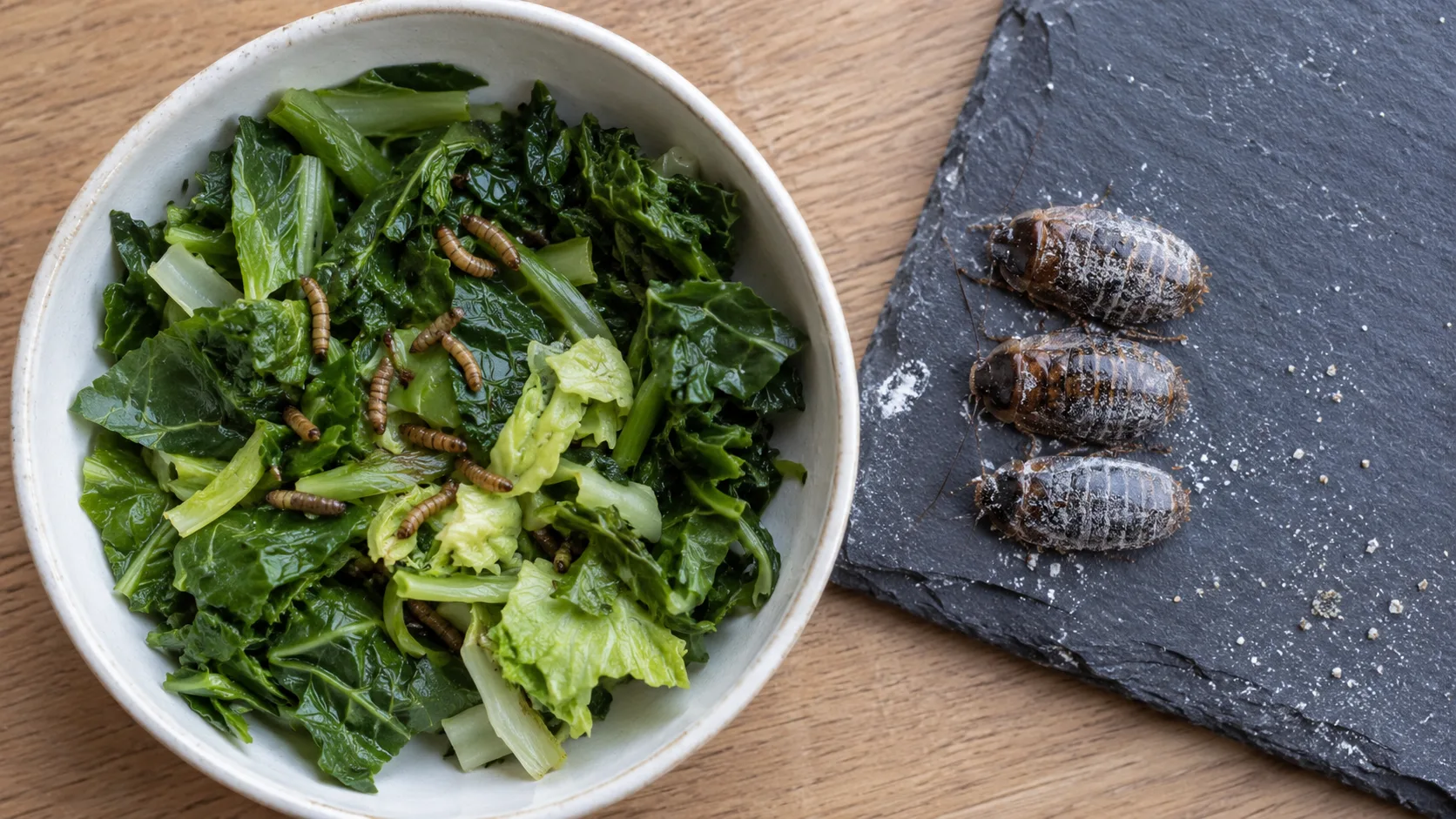
What do bearded dragons eat?
Short answer
Adults eat roughly 70 % fresh leafy greens (collard, mustard, dandelion, escarole) and 30 % live insects (dubia roaches, BSFL, crickets) dusted with calcium with vitamin D3. Hatchlings invert this — about 70 % insects fed multiple times daily, with greens always available. Avoid iceberg lettuce, spinach long-term, and pinky mice as staples.
- Author
- Reptimo Editorial
- Updated
- Updated
- Reading time
- 5 min read
Diet by life stage
Bearded dragons (Pogona vitticeps) are omnivores whose diet shifts dramatically with age. Hatchlings need protein for fast growth; adults need fibre and calcium-rich greens to avoid obesity and fatty liver. The split that contemporary care guides converge on, per PetMD's care sheet and ReptiFiles' diet guide:
Care parameters
Bearded dragon feeding by life stage
| Parameter | Recommended value | Notes |
|---|---|---|
| Hatchling (0–4 months) | Insects 2–3×/day + greens always available | Diet ~70 % insects, 30 % greens |
| Juvenile (4–12 months) | Insects 1×/day + greens always available | Diet ~50/50 |
| Adult (12 months+) | Greens daily + insects 3–5×/week | Diet ~70 % greens, 30 % insects |
| Calcium + D3 dust | 4–5 of 7 meals (juv) / 3 of 7 (adult) | |
| Multivitamin | Every 2 weeks | Repashy Supervite, Arcadia EarthPro-A or similar |
Staple greens and vegetables
Daily-safe leafy greens for the everyday bowl:
- Collard greens — the modern gold standard, high in calcium, low in oxalates.
- Mustard greens — excellent calcium:phosphorus ratio.
- Dandelion greens — wild-pulled if pesticide-free, or store- bought.
- Turnip greens — good calcium content, mild flavour.
- Escarole — accepted by most dragons.
- Watercress — variety rotation.
- Endive — variety rotation.
Occasional / limited:
- Romaine lettuce — OK as filler 1–2 times/week (not a staple, low nutrition).
- Bok choy — fine in rotation, not daily.
- Kale — limit to 1–2 times/week; high in oxalates that bind calcium long-term.
- Arugula — small amounts in rotation.
Vegetables (1–2 times per week as variety):
- Squash (butternut, acorn, summer)
- Bell pepper (chopped fine)
- Sweet potato (lightly grated, raw or steamed)
- Cucumber, carrot — small amounts, mostly water
- Green beans, snap peas — chopped
Staple insects
Modern care literature, especially BeardedDragon.org's care guide, converges on a small set of staples:
- Dubia roaches (Blaptica dubia) — high protein, easy calcium absorption, low fat, gut-load well, don't smell, can't climb glass, don't fly. Modern gold standard.
- Black soldier fly larvae (BSFL / "calciworms") — naturally high in calcium, soft body, accepted by most dragons.
- Crickets — fine nutritionally but loud, smelly, escape and bite resting dragons. Remove uneaten ones within 15 minutes.
Variety rotation (1–2 times per week as treats / dietary diversity):
- Hornworms — water-rich, large, calcium-rich; good for slightly underweight dragons.
- Silkworms — soft, calcium-rich, expensive.
Treats only (max once per week):
- Mealworms / superworms — too fatty as staples, hard chitin shell is harder to digest. Fine occasional.
- Wax worms — dessert. Dragons love them and refuse better food afterwards.
Never as a staple:
- Pinky mice — too fatty, unnecessary. Reserve for breeders or recovering underweight dragons under vet guidance.
- Wild-caught insects — pesticides, parasites, predator signatures.
- Fireflies — lethal. Never feed.
For prey sizing — the same rule as other lizards — see the leopard gecko feeding guide section on insect width.
Gut-loading: the invisible feeding
What you feed the insect is what the dragon eats. Feed feeder insects for 24–72 hours before offering them to the dragon:
- Fresh greens (collard, dandelion, mustard greens).
- Diced squash, carrot, sweet potato.
- Commercial dry gut-load (Repashy Bug Burger, Zoo Med Cricket Crack, Mazuri Better Bug Diet).
- Fresh water from a small sponge or gel cubes (insects drown in open water).
Insects starved in a tub for three days are nutritionally hollow no matter what supplement you dust them with.
Calcium, D3 and multivitamin schedule
Per the Merck Veterinary Manual, metabolic bone disease in captive bearded dragons is almost always preventable with the combination of correct UVB and correct calcium-with-D3 supplementation:
- Calcium with vitamin D3 dusted on insects immediately before
feeding:
- Hatchlings/juveniles: 4–5 of every 7 meals.
- Adults: 3 of every 7 meals.
- Plain calcium (no D3) for occasional extra dustings beyond the D3 schedule.
- Multivitamin (Repashy Supervite, Arcadia EarthPro-A) — once every 2 weeks for everyone. Covers vitamin A, E and trace minerals.
Dusting must accompany correct UVB — the two work together. Detail in the UVB guide and recognition of deficiency in the MBD signs guide.
What to skip
The reliable "do not" list:
- Toxic: avocado, rhubarb, onion, garlic, chives, citrus, fireflies/lightning bugs.
- Avoid as staples: iceberg lettuce (nutritionally empty), spinach long-term (oxalates bind calcium), kale daily (oxalates), fruit as a regular food (high sugar, loose stools).
- Pet-store starter mistakes: wax worms as main food, pinky mice as regular food, "all-mealworm" diet.
- Wild-caught insects of any kind — pesticide contamination, parasite carriers, fireflies can be lethal.
When the dragon refuses food
A bearded dragon that suddenly stops eating is almost always an environmental signal, not a diet problem. Check temperature first — the basking surface must be 40–43 °C (104–110 °F) for adults; below that, digestion slows and feeding response weakens. Detailed diagnostic walkthrough in the not-eating guide. The broader pillar care context is in the care guide.
Frequently asked questions
What do adult bearded dragons eat?
What do baby and juvenile bearded dragons eat?
How often should I feed my bearded dragon?
What greens can bearded dragons eat every day?
What insects should I feed my bearded dragon?
What can bearded dragons NOT eat?
Can bearded dragons eat fruit?
How big should the feeder insects be?
How much should a bearded dragon eat per meal?
Sources
- Bearded Dragon Care Sheet · PetMD
- Bearded Dragon Diet & Nutrition · ReptiFiles
- Bearded Dragon Care Guide · BeardedDragon.org
- Disorders and Diseases of Reptiles · Merck Veterinary Manual
Quick check
Test what you just learned
A short quiz, just for you. Pick an answer to get instant feedback — there's no pass mark, this is for your benefit.
Quiz questions and answers
What's the right diet ratio for an ADULT bearded dragon?
Correct answer: ~70 % fresh greens daily, ~30 % insects 3–5 times per week
Adults invert the hatchling ratio — about 70 % fresh leafy greens daily and 30 % live insects 3–5 times per week. All-insect adult diets cause obesity and fatty liver; fruit-heavy diets cause loose stools and dental problems.
Which of these is NOT a safe daily green for bearded dragons?
Correct answer: Iceberg lettuce
Iceberg lettuce is nutritionally empty (~96 % water, almost no nutrients) and shouldn't be a staple. Collard greens, mustard greens, dandelion greens, escarole and turnip greens are the daily-safe rotation.
What's the best staple feeder insect for a bearded dragon?
Correct answer: Dubia roaches or BSFL — both nutritious, gut-loadable, and easy to source
Dubia roaches and black soldier fly larvae (BSFL/calciworms) are the modern gold standard — high protein, easy calcium absorption, low fat. Wax worms are dessert. Pinky mice are unnecessary and too fatty for regular feeding.
How often do you dust insects with calcium-with-D3 for an ADULT bearded dragon?
Correct answer: 3 of every 7 insect feedings
Adults: 3 of every 7 meals get calcium-with-D3 dust. Hatchlings/juveniles need more (4–5 of 7). Multivitamin every 1–2 weeks. Daily dusting with D3 over-supplements adults.