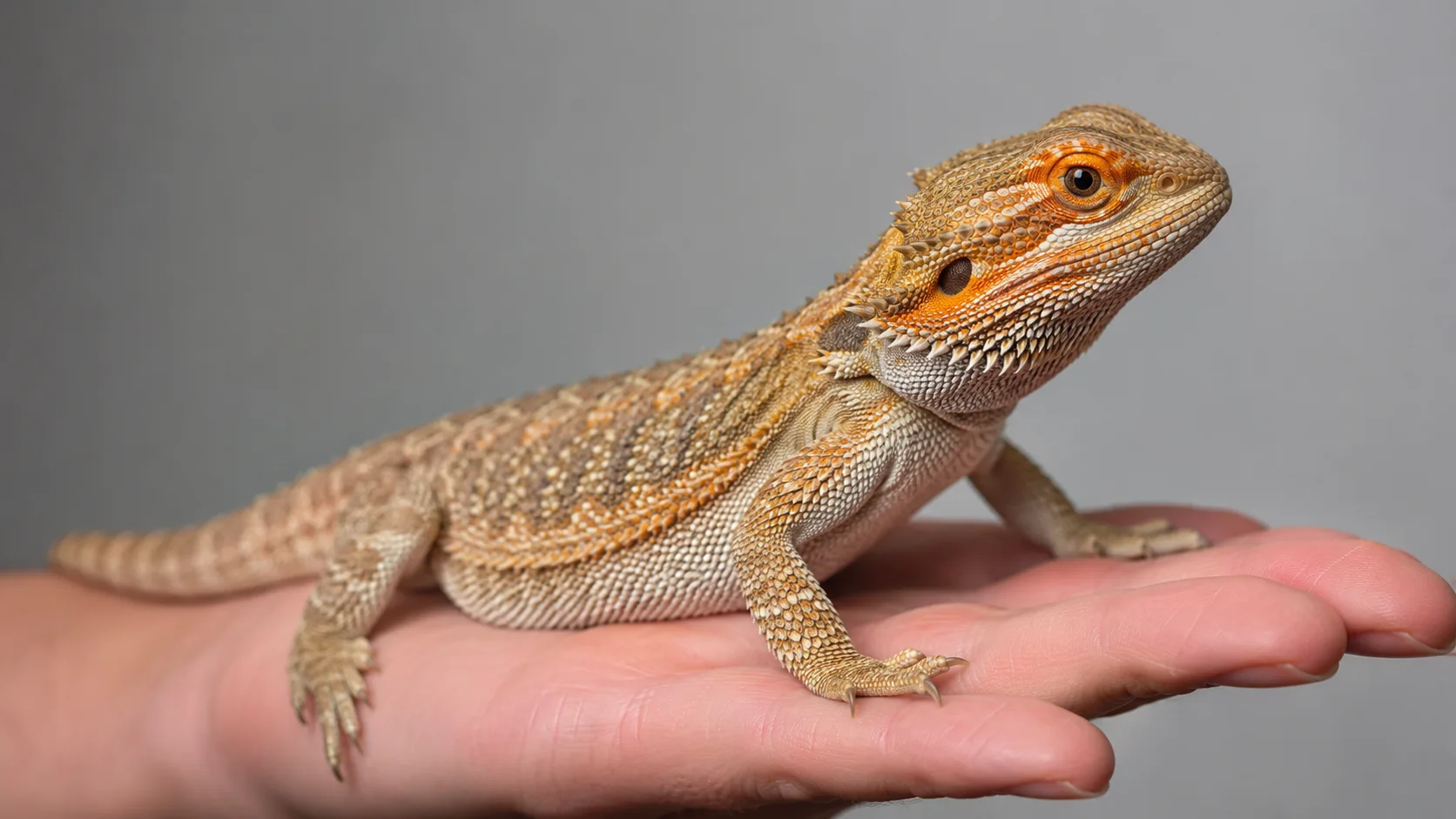
What are the signs of metabolic bone disease in a bearded dragon?
Short answer
Tremors or twitching in the legs and face, weakness or partial paralysis of the back legs, a soft "rubber" lower jaw, swollen limbs or jaw, kinked spine or tail, and reluctance to climb are signs of metabolic bone disease in a bearded dragon. MBD is a veterinary emergency — book a reptile vet within days. The root cause is almost always inadequate UVB or calcium-with-D3 supplementation.
- Author
- Reptimo Editorial
- Updated
- Updated
- Reading time
- 5 min read
YMYL note: this is veterinary territory
Metabolic bone disease (MBD) in bearded dragons is a serious veterinary condition with real welfare and mortality consequences. This article covers recognition and the husbandry corrections that prevent recurrence — it is not a substitute for a reptile-experienced vet, and nothing here is treatment advice. If your dragon shows any of the signs below, book a vet within 1–3 days, sooner if possible. Bring a written husbandry log including UVB type, install date, distance from basking, and supplementation routine.
What MBD looks like — the signs
Per PetMD's MBD reference and the Merck Veterinary Manual, captive bearded dragons present a recognisable progression:
Early signs (catch them here):
- Tremors or twitches in the legs, face or jaw, especially when the dragon is otherwise still.
- Weakness in the hind legs — the dragon drags or struggles to push up onto a basking spot.
- Reluctance to climb previously normal terrain.
- Subtle "rubber" feel to the lower jaw when palpated very gently.
- Slow growth in a juvenile that should be putting on size fast.
Moderate signs (urgent now):
- Soft, deformable jaw ("rubber jaw") — bone bends under gentle pressure.
- Swollen, lumpy or thickened limbs.
- Kinked spine or tail — visible curvature where there should be straight bone.
- Partial paralysis of the hind legs — dragon drags itself with the front legs only.
Advanced signs (emergency):
- Spontaneous fractures from minor movement.
- Complete paralysis.
- Seizures or twitching from low blood calcium.
- Refusing food entirely, severe lethargy.
A reptile in pain hides it. By the time visible signs appear, bone density is already significantly compromised. Treat any early signs as urgent.
What causes MBD
MBD is calcium deficiency, but calcium intake alone doesn't fix it — the dragon also needs vitamin D3 to absorb dietary calcium into bone. Bearded dragons synthesise D3 in their skin under UVB, which is why correct UVB is non-negotiable for this species. The cascade:
- Insufficient UVB at the basking surface (wrong bulb, too far, blocked by glass/mesh, expired tube) → low D3 synthesis.
- Insufficient calcium-with-D3 supplementation → low dietary D3 to back up reduced skin synthesis.
- Resulting D3 deficiency → calcium can't be absorbed into bone.
- Body pulls calcium from bone to maintain blood calcium for muscle and nerve function → bones progressively demineralise.
- Eventually: rubber jaw, fractures, paralysis, seizures.
Contributing factors that don't usually drive MBD on their own:
- High-oxalate diet (spinach, kale long-term) binds calcium and reduces absorption.
- High-phosphorus diet (excess mealworms, pinky mice) skews the Ca:P ratio (target 2:1).
- Inadequate basking temperatures — slow metabolism slows everything including bone deposition.
- Chronic illness or parasite load.
The two top fixes — correct UVB and correct dusting — eliminate most of the deficiency pathway. See the UVB guide for bulb choice, distance and replacement, and the cross-species UVB guide for the Ferguson zone framework.
What to do RIGHT NOW
If you suspect MBD:
- Book a reptile-experienced vet within 1–3 days. Same-day for any moderate or advanced sign (rubber jaw, paralysis, swelling). General-practice vets often lack reptile dosing experience; find an exotics specialist.
- Handle the dragon gently and minimally. Don't let it climb or right itself unaided — bones may already be fragile and fracture easily.
- Photograph the symptoms. Limb position, jaw, posture. Vets find this useful at appointment.
- Bring a written husbandry log. Include:
- UVB tube brand, model, install date, distance to basking
- Calcium-with-D3 brand and dusting frequency
- Multivitamin brand and frequency
- Basking surface temperature (IR gun reading)
- Diet (foods, frequency, gut-load)
- Don't self-treat. Calcium drops without veterinary supervision can mask progression and don't address D3 absorption or pain.
A vet will typically: examine and possibly X-ray the dragon, give calcium injections (calcium gluconate), prescribe D3 supplementation (stoss or oral), manage pain (reptile-appropriate analgesia), and review your husbandry. Treatment runs weeks; some bone deformities remain permanently even after recovery.
How to prevent MBD
The husbandry baseline that prevents nearly every case:
Care parameters
Bearded dragon MBD prevention — non-negotiables
| Parameter | Recommended value | Notes |
|---|---|---|
| UVB tube | T5 HO linear | Arcadia Dragon 12 % or Zoo Med ReptiSun 10.0 |
| UVI at basking | 4.0–6.0 | Verified with Solarmeter 6.5 |
| Tube length | ≈ ⅔ of enclosure length | Mounted inside, no glass/mesh barrier |
| Replacement | Every 12 months | Log install date; UV drops before visible light |
| Calcium + D3 dust | 4–5 of 7 meals (juv) / 3 of 7 (adult) | |
| Multivitamin | Every 2 weeks | Repashy Supervite or equivalent |
| Basking surface | 40–43 °C / 104–110 °F | Hatchlings 43–46 °C |
| Avoid as staples | Spinach, kale, mealworms | OK occasionally; not as the base diet |
The single most overlooked item is UVB tube replacement on schedule. T5 HO tubes look fine for years but UV output collapses 9–14 months after install. Write the install date directly on the tube with a permanent marker. A Solarmeter 6.5 verifies the UV Index at the basking surface — the only reliable way to confirm a bulb is still in range.
What other illnesses look like MBD
A reptile vet will distinguish MBD from these conditions that share symptoms:
- Nerve injury or trauma — sudden onset, often a single limb.
- Renal disease — also affects calcium handling and shows weakness; bloodwork distinguishes.
- Infection (septic arthritis) — swelling localised to a joint, often with discoloration.
- Heavy parasite load — generalised weakness and weight loss.
This is why the diagnosis belongs to a vet, not a forum search. The cross-species early-warning patterns are in "is my reptile sick?"; the broader husbandry baseline for bearded dragons is in the pillar care guide.
Frequently asked questions
What does metabolic bone disease look like in a bearded dragon?
What causes metabolic bone disease in bearded dragons?
Can MBD be reversed in a bearded dragon?
How quickly does MBD develop?
What UVB does a bearded dragon need to prevent MBD?
How much calcium does a bearded dragon need?
What should I do if I think my bearded dragon has MBD?
Is metabolic bone disease painful?
Can I treat MBD at home with calcium drops?
Sources
- Metabolic Bone Disease (MBD) in Reptiles · PetMD
- Disorders and Diseases of Reptiles · Merck Veterinary Manual
- Bearded Dragon Temperatures & UVB · ReptiFiles
- What Are Ferguson Zones? · Zen Habitats
Quick check
Test what you just learned
A short quiz, just for you. Pick an answer to get instant feedback — there's no pass mark, this is for your benefit.
Quiz questions and answers
What's a classic EARLY sign of metabolic bone disease?
Correct answer: Tremors in the limbs and face, or weakness in the back legs
Limb tremors and weakness in the hind legs are textbook early MBD. By the time you see them, bone density is already compromised. Same-week reptile-vet appointment is the right response.
What's the root cause of MBD in most captive bearded dragons?
Correct answer: Inadequate UVB lighting and/or insufficient calcium-with-D3 supplementation
Per the Merck Veterinary Manual and consistent care literature, the dominant root cause is too little UVB (wrong bulb, expired bulb, glass barrier, too far from basking spot) or missing calcium-with-D3 dusting on insects — usually both.
Your bearded dragon's lower jaw bends slightly under gentle pressure. What does that suggest?
Correct answer: 'Rubber jaw' — advanced MBD, urgent reptile-vet appointment
A jaw that bends under gentle pressure is 'rubber jaw' — a classic sign of advanced calcium deficiency. The bone has demineralised. Same-day or next-day reptile-vet appointment; do not delay.
Can MBD be treated at home with calcium drops from the pet store?
Correct answer: No — home calcium can't address the D3 deficiency, doesn't manage pain, and masks progression. Reptile vet needed
MBD treatment is a veterinary protocol: injectable calcium, prescribed D3 supplementation, pain management for fractures, and a husbandry overhaul. Home calcium drops alone don't solve the underlying problem and let internal damage continue.