What UVB bulb does my reptile need?
Short answer
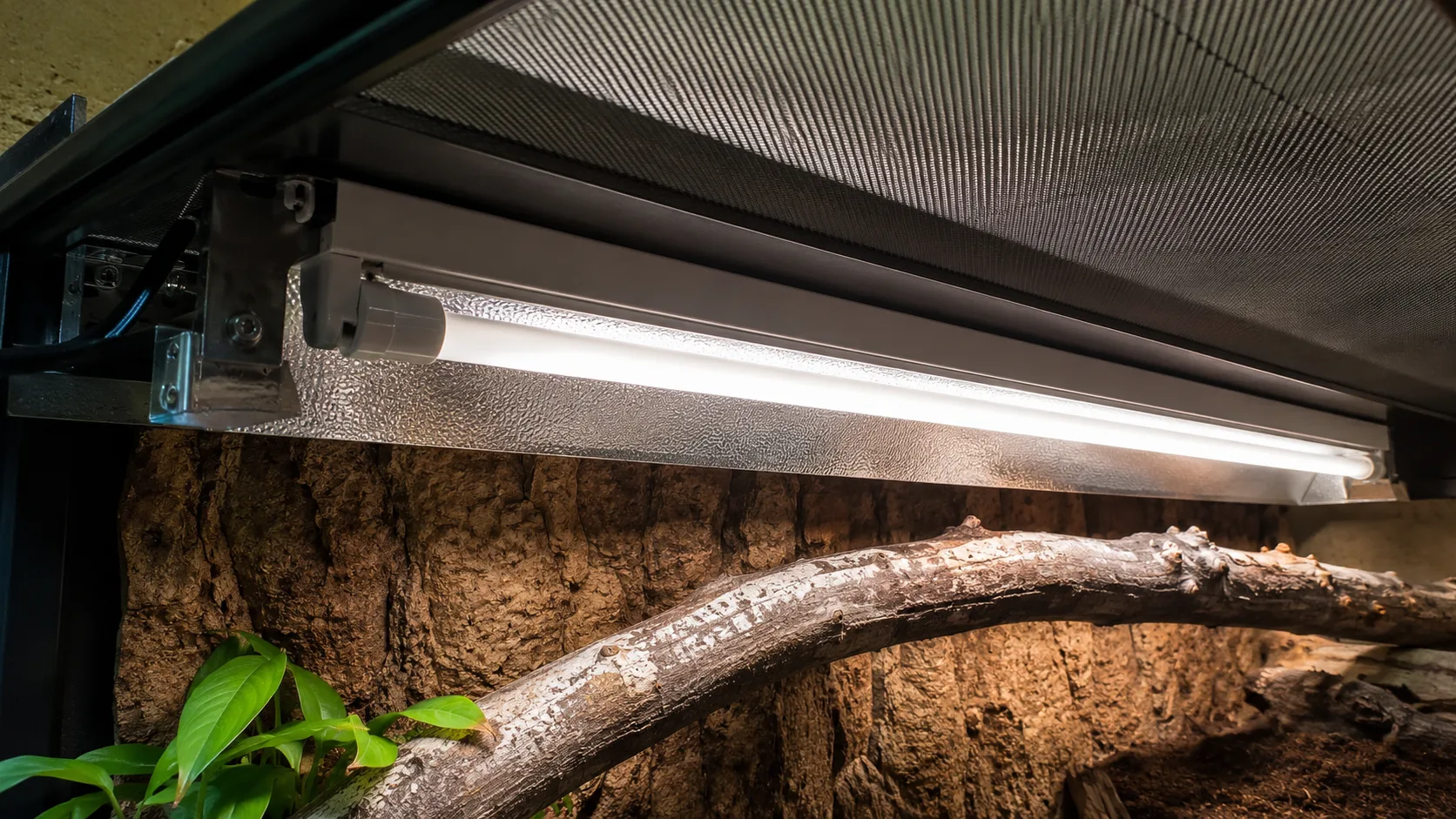
Match the species to its Ferguson zone, then pick a bulb that delivers the right UV Index at the basking surface. Open-sun baskers (bearded dragons, sliders) need T5 HO tubes giving UVI 4–6; partial-sun species (corn snakes, ball pythons) need UVI 1–2; cathemeral / shade dwellers (crested geckos) need UVI 0.5–1.0. Mount inside, no glass, replace every 12 months.
- Author
- Reptimo Editorial
- Updated
- Updated
- Reading time
- 5 min read
Why UVB matters across species
Reptiles synthesise vitamin D3 in their skin under UVB exposure, and D3 is what lets them absorb dietary calcium into bone. Without enough UVB, calcium goes uncirculated — the body pulls calcium from bone to maintain blood levels, and bone progressively demineralises. The clinical outcome is metabolic bone disease (MBD), the most common preventable health problem in captive reptiles per PetMD's MBD reference.
Different species evolved under different UV intensities. A bearded dragon basks in mid-day Australian sun; a crested gecko hides in New Caledonian forest understory. Their UVB needs differ by an order of magnitude. Matching the bulb to the species — not "more is better" — is the whole framework.
Match species to Ferguson zone
Dr Gary Ferguson classified reptiles into four zones based on UV exposure in the wild. The framework, summarised at Zen Habitats' Ferguson zones explainer, gives a target UV Index (UVI) at the basking surface for each zone:
Care parameters
Ferguson zones — UVI targets and example species
| Parameter | Recommended value | Notes |
|---|---|---|
| Zone 1 — Shade dweller | UVI 0.0–0.7 | Crested gecko, day gecko, some chameleons; low ambient UVI |
| Zone 2 — Partial sun / occasional basker | UVI 0.7–1.5 | Ball python, corn snake, leopard gecko (low end), some skinks |
| Zone 3 — Open / partial sun basker | UVI 1.0–2.6 ambient, 4.0–6.0 basking peak | Bearded dragon, blue-tongue skink, savannah monitor |
| Zone 4 — Mid-day full sun | UVI 4.0–8.0+ basking peak | Uromastyx, desert iguana, chuckwalla |
Pick the bulb
For each zone, the modern T5 HO linear tubes that meter accurately:
- Zone 1 / 2 (low UVI): Arcadia ShadeDweller (7 %), Zoo Med ReptiSun 5.0, Arcadia ReptiSun 6 %. For a typical 30 cm enclosure height these deliver UVI ~1 at the basking spot 25–30 cm from the tube.
- Zone 3 (bearded dragon / blue-tongue / slider): Arcadia Dragon 12 %, Zoo Med ReptiSun 10.0. Deliver UVI 4–6 at 30–40 cm from a reflector. Detailed in the bearded dragon UVB guide.
- Zone 4 (uromastyx / chuckwalla): Arcadia Desert 14 %, Zoo Med Powersun mercury vapour, or T5 HO 12 % closer to the basking spot. These species need genuine high-desert intensity.
Compact "twist-in" UVB coils consistently underperform in independent meter testing. Mercury vapour combo bulbs (basking + UVB in one) work for some species but constrain bulb placement and run hot. T5 HO linear tubes are the cross-species default for a reason.
Mounting the tube correctly
Per ReptiFiles' UVB explainer and consistent guidance across modern care sheets:
- Inside the enclosure, not on top of glass. Glass blocks ~95 % of UVB; even fine mesh blocks 30 %. The rated UVI assumes nothing between bulb and reptile.
- With a reflector. Without one, half the bulb's UV output is wasted upward. Use the manufacturer's fixture or a quality T5 HO reflector.
- Covering ⅓ to ⅔ of the enclosure length. Gives a real UVI gradient — high under the basking spot, lower across the rest of the enclosure. The reptile self-regulates exposure by moving.
- At the right distance for the bulb and species. Zone 3 species need 30–40 cm from a 10.0/12 % tube; Zone 1/2 species 25–30 cm from a 5.0/7 % tube. Verify with a Solarmeter 6.5.
For aquatic / semi-aquatic species (sliders, mata mata), mount above the basking platform with the same rules — never submerge.
Replacement schedule
T5 HO tubes keep emitting visible light for years, but useful UV output collapses 9–14 months after install. The Merck Veterinary Manual and every reputable care sheet converge on:
- T5 HO tube — every 12 months
- T8 tube (older, lower output) — every 6 months
- Mercury vapour combo bulb — every 12 months
- Compact UVB coil — every 6 months (consider switching to T5)
Write the install date on the bulb itself with a permanent marker, or log it in Reptimo and set a 12-month reminder. A Solarmeter 6.5 verifies the UV Index at the basking surface — replace the bulb when UVI drops below the zone target.
Calcium and D3 supplementation
UVB and dietary supplementation work together; one isn't a substitute for the other:
- Calcium with vitamin D3 dusted on insects/greens — covers cases when UV gets temporarily disrupted (expired bulb, mounting change).
- Plain calcium (without D3) for additional dustings beyond the D3 schedule.
- Multivitamin every 1–2 weeks covers vitamin A, E and trace minerals.
For species that explicitly cannot have UVB (rack-housed snakes for welfare-justified reasons), strong calcium-with-D3 supplementation becomes the main D3 source. For high-UVI species (bearded dragons, sliders, uromastyx), there is no supplement that replaces correct UVB — these animals MUST have it.
If you're worried about an existing reptile that may already be deficient, see the species-specific recognition guides — for example bearded dragon MBD signs — and the cross-species "is my reptile sick?" checklist.
Frequently asked questions
Do all reptiles need UVB?
What is a Ferguson zone?
What's the difference between UVA and UVB?
How do I measure UVB?
What's the best UVB bulb for a reptile?
How often should I replace a UVB bulb?
Can UVB pass through glass or mesh?
What if I can't use UVB (e.g., my snake is in a rack)?
Is sunlight through a window enough?
Sources
- What Are Ferguson Zones? · Zen Habitats
- Disorders and Diseases of Reptiles · Merck Veterinary Manual
- Bearded Dragon Temperatures & UVB · ReptiFiles
- Metabolic Bone Disease (MBD) in Reptiles · PetMD
Quick check
Test what you just learned
A short quiz, just for you. Pick an answer to get instant feedback — there's no pass mark, this is for your benefit.
Quiz questions and answers
What UVI does a bearded dragon (Ferguson Zone 3) need at the basking surface?
Correct answer: 4.0–6.0
Bearded dragons sit in Ferguson Zone 3 (open and partial sun basker). The target at basking is UVI 4–6, measured with a Solarmeter 6.5. Lower causes MBD over months; sustained above 7 is unnecessary.
How often should you replace a T5 high-output UVB tube?
Correct answer: Every 12 months, logged from install date
T5 HO tubes lose most of their UV output 9–14 months after install but keep emitting visible light for years. Log the install date and replace on schedule, or your reptile develops MBD silently.
Why can't a UVB bulb work through glass?
Correct answer: Glass blocks roughly 95 % of UVB wavelengths
Standard glass blocks about 95 % of UVB; fine mesh blocks ~30 %. Always mount the tube inside the enclosure with nothing between the bulb and the reptile.