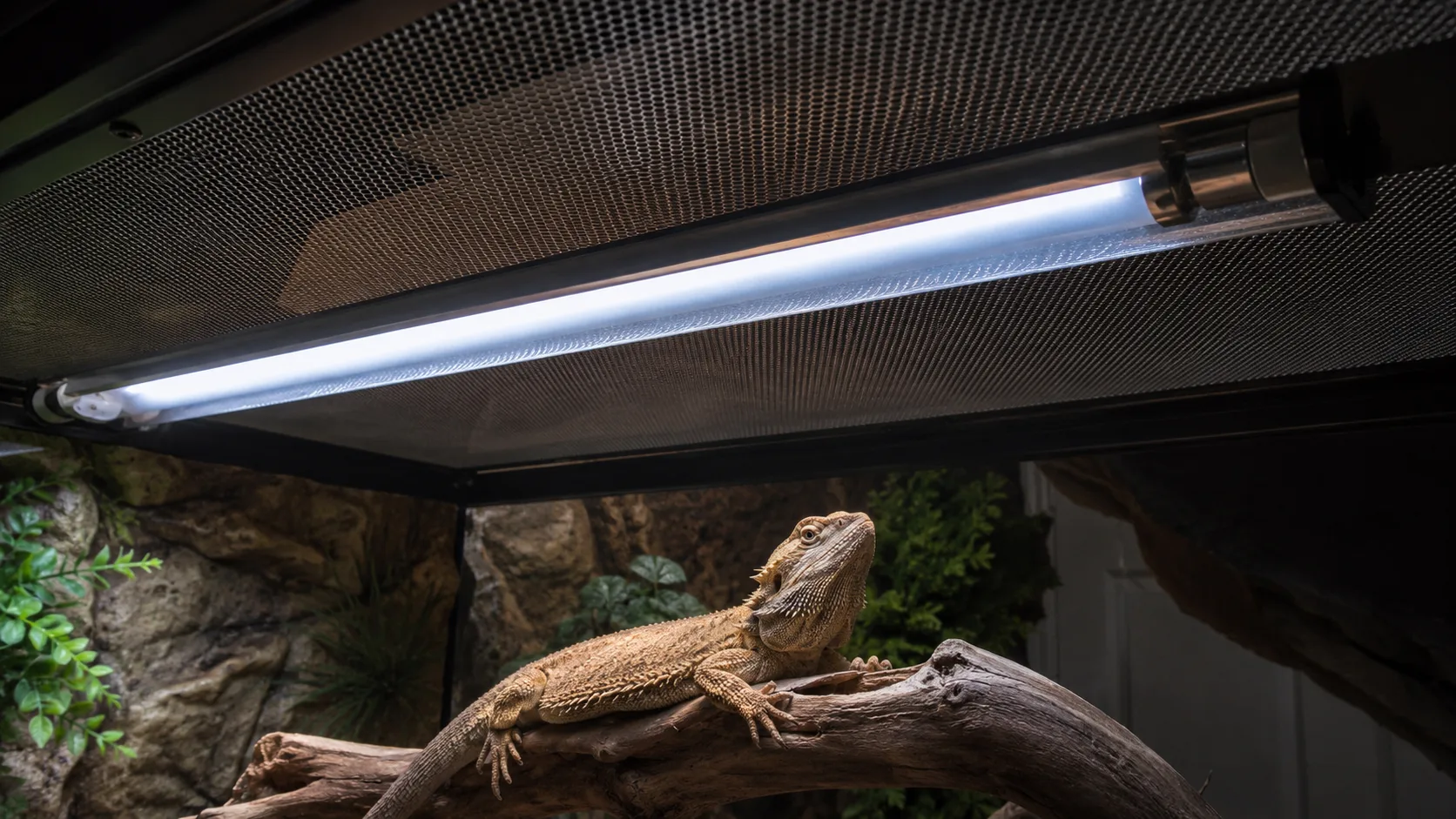
What UVB bulb does a bearded dragon need, and how far away?
Short answer
Bearded dragons need a T5 high-output UVB tube — Arcadia Dragon 12 % or Zoo Med ReptiSun 10.0 — covering two-thirds of the enclosure length and mounted inside without glass or mesh between bulb and dragon. Aim for a UV Index of 4.0–6.0 at the basking surface (typically 30–40 cm from the tube). Replace every 12 months.
- Author
- Reptimo Editorial
- Updated
- Updated
- Reading time
- 5 min read
What UVI does a bearded dragon need?
Bearded dragons are open-sun-basking desert lizards from inland Australia, classified as Ferguson Zone 3 in the system most modern care guides now use. The target at the basking surface is a UV Index of 4.0–6.0, measured with a Solarmeter 6.5 — the only widely-available meter that reads UVI accurately, per Zen Habitats' Ferguson zone explainer.
Below UVI 3.0 sustained, vitamin D3 synthesis is too weak to maintain calcium absorption and metabolic bone disease develops within months. Above UVI 7.0 sustained, the dragon usually retreats permanently — that's wasted heat and risk of eye irritation. The 4–6 band gives reliable D3 production plus enough gradient that the dragon can self-regulate exposure.
Care parameters
Bearded dragon UVB — target values
| Parameter | Recommended value | Notes |
|---|---|---|
| UVI at basking | 4.0–6.0 | Solarmeter 6.5 reading on the basking spot |
| Bulb type | T5 HO linear tube | Arcadia Dragon 12 % or Zoo Med ReptiSun 10.0 |
| Tube length | ≈ ⅔ of enclosure length | 86 cm in a 4 ft tank; 117 cm in a 5 ft tank |
| Distance to basking | 30–40 cm / 12–16 in | From reflector to dragon's back |
| Replacement | Every 12 months | Log install date; UV drops before visible light |
| Photoperiod | 12 h on / 12 h off | Mechanical timer; no UVB at night |
Which bulb to buy
Two T5 HO tubes have years of meter data behind them and are the modern default:
- Arcadia Dragon 12 % T5 HO — popular in the UK and EU, high UV output, pairs with the Arcadia Pro T5 reflector fixture.
- Zoo Med ReptiSun 10.0 T5 HO — common in North America, paired with the Zoo Med T5 HO fixture.
Both produce the right UVI for a bearded dragon at the standard 30–40 cm distance with a reflector. The 5 % / 6 % variants of the same lines are for lower-Ferguson-zone reptiles (crested geckos, ball pythons) and are underpowered for bearded dragons.
Mercury vapour combo bulbs (basking + UVB in one) are still sold and work, but they constrain bulb placement — you can't move the basking spot independently of UVB. They also need replacing every 12 months and run hotter; most modern keepers prefer a separate halogen flood + T5 HO tube setup.
How to mount UVB correctly
Glass blocks roughly 95 % of UVB; fine mesh (1×1 mm) blocks about 30 % and coarser mesh blocks more. That makes mounting the most underrated decision in a bearded dragon setup. The ReptiFiles UVB guide and the BeardedDragon.org UVB setup guide are aligned on the rules:
- Mount the tube inside the enclosure, on the basking side.
- Use a reflector — without one, half the bulb's UV output is wasted.
- Position the bulb so the closest basking surface sits 30–40 cm (12–16 in) below the reflector. For a 30 cm tall enclosure with the bulb on the top, that means the basking branch needs to be high enough that the dragon's back reaches into that band when it lies down.
- Cover two-thirds of the enclosure length so a real UVI gradient exists.
When to replace the bulb
T5 HO tubes keep emitting visible light for years, but useful UV output collapses long before that. The Zen Habitats lighting guide and every reputable care sheet agree on the schedule:
- T5 HO tube — every 12 months
- T8 tube (older, lower output) — every 6 months
- Mercury vapour combo bulb — every 12 months
- Compact UVB coil — every 6 months (and consider replacing with a T5)
Write the install date on the bulb itself with a permanent marker, or set a 12-month reminder the day you fit it. A Solarmeter 6.5 is the surest way to catch a tube that's failed early — if UVI at the basking surface drops below 3.5, replace the bulb regardless of age.
What to skip
Most starter kits and pet-store recommendations get UVB wrong in one of three ways:
- Compact "twist-in" UVB bulbs — too narrow a beam, too short an output life, occasionally cause eye burns in older models.
- Glass lid between bulb and dragon — kills 95 % of UVB.
- No UVB at all, "she gets sunlight through the window" — window glass blocks effectively all UVB; this is the fastest path to MBD.
- Coloured night UVB bulbs — not a category that exists; UVB is invisible to humans, and bearded dragons need a real dark night.
For the broader enclosure context that UVB fits into — including basking temperature, substrate and night setup — see our bearded dragon tank setup checklist.
Symptoms of weak UVB
Underpowered or expired UVB rarely shows up as one dramatic event. It shows up over weeks as quietly worsening signs:
- Loss of appetite — see our food refusal guide; weak UVB is one of the top five causes.
- Lethargy, more time hiding, less time basking.
- Pale or chalky-looking colouration.
- Soft jaw, tremors in the limbs, weak grip — late-stage MBD.
Calcium powder with vitamin D3 dusted on insects 3–5 times a week is the companion to UVB, not a substitute. Dragons with strong UVB still benefit from dusting; dragons without UVB cannot eat their way out of D3 deficiency because dietary D3 alone doesn't fully replicate skin-synthesised D3 in desert reptiles.
Frequently asked questions
What's the best UVB bulb for a bearded dragon?
How far should a UVB bulb be from a bearded dragon?
Do bearded dragons need UVB at night?
How often should I replace a bearded dragon's UVB bulb?
Can a bearded dragon get UVB through glass or mesh?
Is a compact UVB coil bulb OK for a bearded dragon?
How do I know if my UVB is working?
What size UVB tube does my bearded dragon enclosure need?
What is metabolic bone disease and how does UVB prevent it?
Sources
- Bearded Dragon Temperatures & UVB · ReptiFiles
- Bearded Dragon Complete Lighting & Heating Guide · Zen Habitats
- What Are Ferguson Zones? · Zen Habitats
- Bearded Dragon UVB Lighting Setup · BeardedDragon.org
Quick check
Test what you just learned
A short quiz, just for you. Pick an answer to get instant feedback — there's no pass mark, this is for your benefit.
Quiz questions and answers
What UV Index should a bearded dragon's basking surface measure?
Correct answer: 4.0–6.0 (open sun basker)
Bearded dragons sit in Ferguson Zone 3 (open and partial sun basker). The target at basking is UVI 4–6, measured with a Solarmeter 6.5. Lower values cause MBD over months; sustained values above 7 are unnecessary and uncomfortable.
How often should you replace a T5 high-output UVB tube?
Correct answer: Every 12 months, logged from install date
T5 HO tubes lose most of their UV output 9–14 months after install — but they keep emitting visible light for years. Log the install date and replace on schedule, or your dragon develops MBD silently before any visible warning.
Where should you mount the UVB tube?
Correct answer: Inside the enclosure with no glass or mesh between bulb and dragon
Glass blocks ~95 % of UVB and mesh blocks 30 % or more. Always mount the tube inside the enclosure (in an in-cage fixture with a reflector) on the basking side, with nothing between the bulb and the dragon's back.