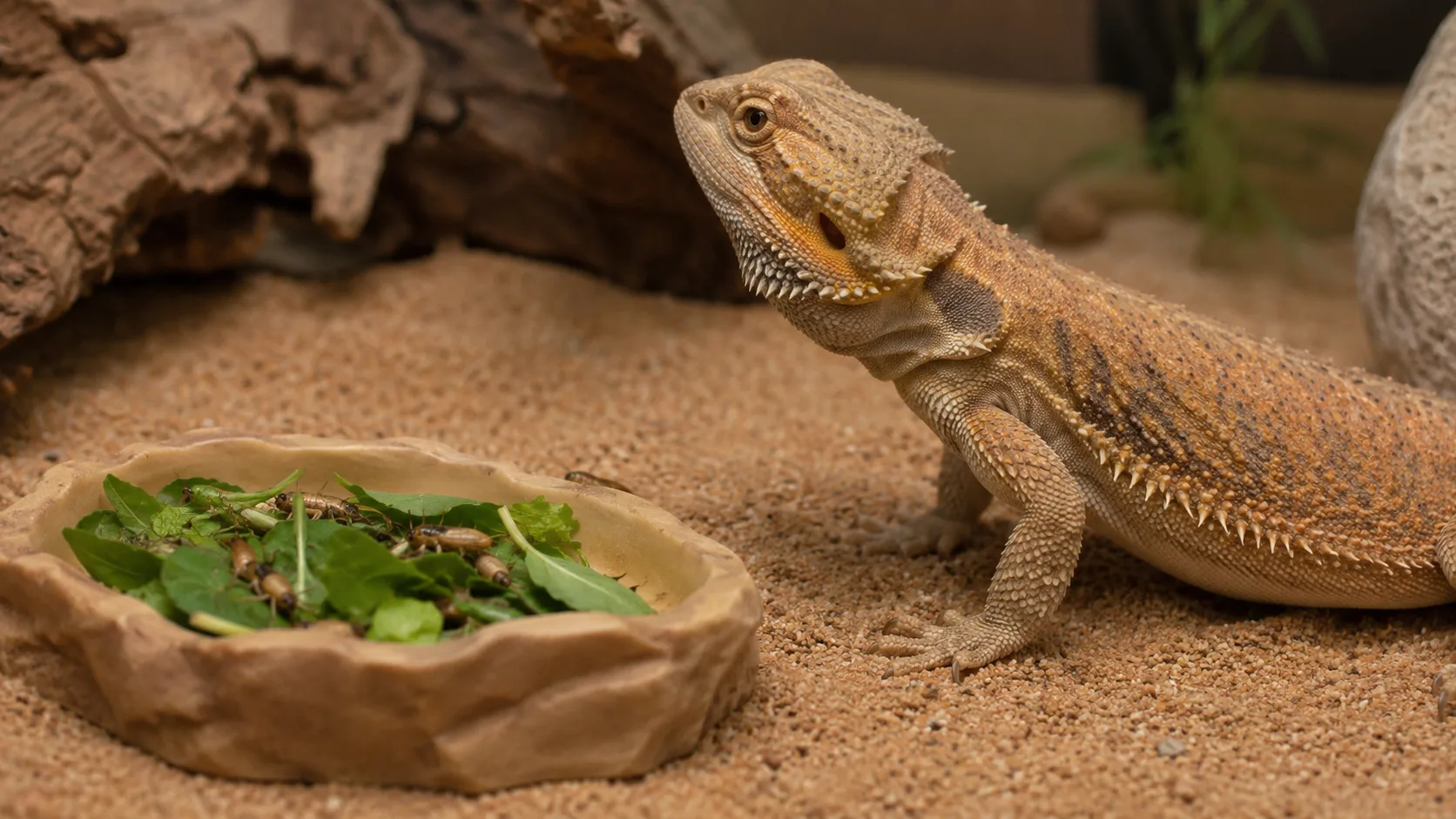
Why is my bearded dragon not eating?
Short answer
Most bearded dragons refuse food because of one of five fixable causes: basking temperatures below 40 °C (104 °F), weak or expired UVB, a winter brumation slowdown, recent rehoming, or an upcoming shed. Re-check basking, UVI and photoperiod first; weigh weekly. Persistent loss with sunken eyes, black beard or weight loss above 10 % needs a reptile vet.
- Author
- Reptimo Editorial
- Updated
- Updated
- Reading time
- 6 min read
The 30-second triage
A bearded dragon that suddenly stops eating is one of the most common questions new keepers ask, and the cause is almost always husbandry — not illness. The short version: re-check the five enclosure parameters below, give them a week to stabilise, and most dragons resume feeding on their own. Vet attention is the right step only when specific clinical signs appear (covered at the end).
Care parameters
Bearded dragon husbandry — quick check
| Parameter | Recommended value | Notes |
|---|---|---|
| Basking surface | 40–43 °C / 104–110 °F | Adults; hatchlings 43–46 °C / 110–115 °F |
| Cool side | 24–27 °C / 75–80 °F | |
| UVI at basking | 4.0–6.0 | T5 HO tube, replaced every 12 months |
| Humidity | 30–40 % | Below 50 % long-term |
| Photoperiod | 12 h on / 12 h off | Mechanical timer |
Cause 1 — Basking too cool
Bearded dragons digest food through belly heat absorbed under a basking lamp, and the appetite reflex is tied directly to that temperature. The PetMD bearded dragon care sheet and current keeper-facing guides agree: an adult needs a basking surface of 40–43 °C (104–110 °F). Hatchlings sit slightly higher at 43–46 °C (110–115 °F).
Measure with an infrared temperature gun on the spot the dragon actually lies on, not the air around it. A stick-on dial thermometer on the side of the tank gives no useful reading. If basking sits below 38 °C (100 °F), raise wattage (or lower the bulb) and give it a full week before re-offering food — see the full setup logic in our bearded dragon tank setup checklist.
Cause 2 — Weak or expired UVB
Without strong UVB, bearded dragons can't synthesise vitamin D3, can't absorb calcium, and lose both energy and appetite long before classic metabolic bone disease becomes visible. The modern standard is a T5 high-output linear tube covering two-thirds of the enclosure, producing a UV Index of 4.0–6.0 at the basking surface, with no glass or mesh between the tube and the dragon.
Compact "twist-in" UVB coils, mercury vapour combo bulbs and old tubes consistently underperform in independent meter tests. If your UVB is older than 12 months — or if you can't remember installing it — replace it before escalating anywhere else. See our dedicated UVB guide for fixture choice, distances and mounting.
Cause 3 — Brumation
From late autumn through early spring, healthy bearded dragons routinely slow down, sleep more and refuse food for weeks or months. This is brumation — a captive analogue of wild winter dormancy — and it is normal. As ReptiFiles' brumation guide explains, dragons in brumation often accept small meals but eat far less than usual; food that isn't fully digested at lower body temperatures can cause problems, so don't force the issue.
The brumation vs. illness call comes down to weight. Per Zen Habitats' brumation explainer, loss of more than 10 % of starting body weight is the line where assume-the-worst becomes the right call and a vet visit moves up the list. Weigh weekly on a flat digital scale and log every reading; a stable or slowly drifting weight is reassuring, sustained loss is not.
Cause 4 — Recent rehoming or stress
Bearded dragons read their enclosure as territory, and changing it resets their sense of safety. A new tank, a move to a new room, fresh décor or new pets in the household commonly cause 1–2 weeks of suppressed appetite. Add visual cover (cork bark, silk plants, a hide on the cool side), keep handling to a few minutes a day at most, and only re-offer food once the basking spot has fully warmed in the morning.
If a brand-new dragon refuses food entirely, give it a full week of zero handling first. Offering food while the animal is still in fight-or-flight mode trains it that the enclosure is unsafe.
Cause 5 — A shed is coming
Bearded dragons in shed often eat less for several days before and during the event. Signs include dull skin colour, hiding more than usual, and patches of pale, lifted skin around the limbs and tail. Don't peel the shed or soak aggressively — provide a humid hide with damp sphagnum moss, offer shallow lukewarm baths once or twice a week, and wait. Appetite usually returns within 24–48 hours of the shed completing.
Cause 6 — Diet that doesn't suit life-stage
Hatchlings need a heavily insect-based diet (roughly 70–80 % insects, daily, appropriately sized) and pick at greens. Adults flip — about 70–80 % greens and vegetables, with insects 2–3 times a week. Mismatched ratios cause appetite to drop: an adult offered roach-heavy meals every day will refuse in protest; a juvenile offered mostly greens will hunger-strike for insects.
Insect size matters too. The widely-cited rule of thumb is no insect wider than the space between the dragon's eyes — bigger items trigger refusal and, in young animals, are a documented impaction risk.
Cause 7 — Parasites and underlying illness
Internal parasites (pinworms, coccidia and others) are common in captive-bred dragons and can cause chronic appetite loss, weight loss, runny droppings, and lethargy. A faecal exam from a reptile vet — using a fresh stool sample less than 24 hours old — is the only reliable way to confirm. Other causes that warrant veterinary diagnosis include impaction, metabolic bone disease, mouth rot (infectious stomatitis) and respiratory infection.
When to see a vet
Most refusals are husbandry, not illness — but these signs change the calculation:
- Weight loss above 10 % of starting body weight, or any loss in a hatchling.
- Sunken eyes, sticky mucus in the mouth, or audible breathing.
- Sustained black beard outside of normal display contexts.
- Jaw tremors, weak hind legs, or "rubber jaw" — possible metabolic bone disease.
- Runny, bloody or unusually smelly droppings.
- Stargazing, twitching or loss of coordination.
- Refusal lasting more than three weeks with husbandry verified correct.
Bring a husbandry log to the appointment — basking temps, UVI readings, bulb install date, weight history and recent feeding entries. An exotics vet can diagnose far faster from a clean record than from "he hasn't been eating for a while." The same diagnostic logic applies across species; see our explanation of food refusal in ball pythons for the parallel cascade in snakes.
Frequently asked questions
How long can a bearded dragon go without eating?
Is my bearded dragon brumating or sick?
What basking temperature does a bearded dragon need to feed?
Does weak UVB make a bearded dragon stop eating?
Can stress alone cause a bearded dragon to refuse food?
Should I force-feed a bearded dragon that won't eat?
Why is my baby bearded dragon not eating insects?
Could my bearded dragon have parasites?
When should I take a bearded dragon to a vet for not eating?
Sources
- Bearded Dragon Care Sheet · PetMD
- Brumation in Bearded Dragons · ReptiFiles
- Bearded Dragons and Brumation — What to Do · Zen Habitats
- Disorders and Diseases of Reptiles · Merck Veterinary Manual
Quick check
Test what you just learned
A short quiz, just for you. Pick an answer to get instant feedback — there's no pass mark, this is for your benefit.
Quiz questions and answers
What's the correct basking surface temperature for an adult bearded dragon?
Correct answer: 40–43 °C (104–110 °F)
Adults need 40–43 °C (104–110 °F) on the basking surface. Below ~38 °C digestion slows and most dragons stop eating; above 46 °C they retreat permanently to the cool side.
Your healthy adult bearded dragon stops eating in November and sleeps more. Weight is stable. What's the right next step?
Correct answer: Treat as likely brumation — verify husbandry, weigh weekly, keep offering small meals
Stable weight in autumn/winter with reduced activity is classic brumation, not illness. Weigh weekly, leave the basking and UVB on during daytime hours, and re-check temps and UVB — most dragons resume feeding in spring.
Which sign genuinely means 'see a reptile vet now', regardless of feeding?
Correct answer: Sunken eyes, jaw tremors, or weight loss above 10 % of body weight
Sunken eyes, jaw tremors, and significant weight loss point to dehydration, metabolic bone disease, or another condition that needs veterinary diagnosis — not a husbandry tweak.