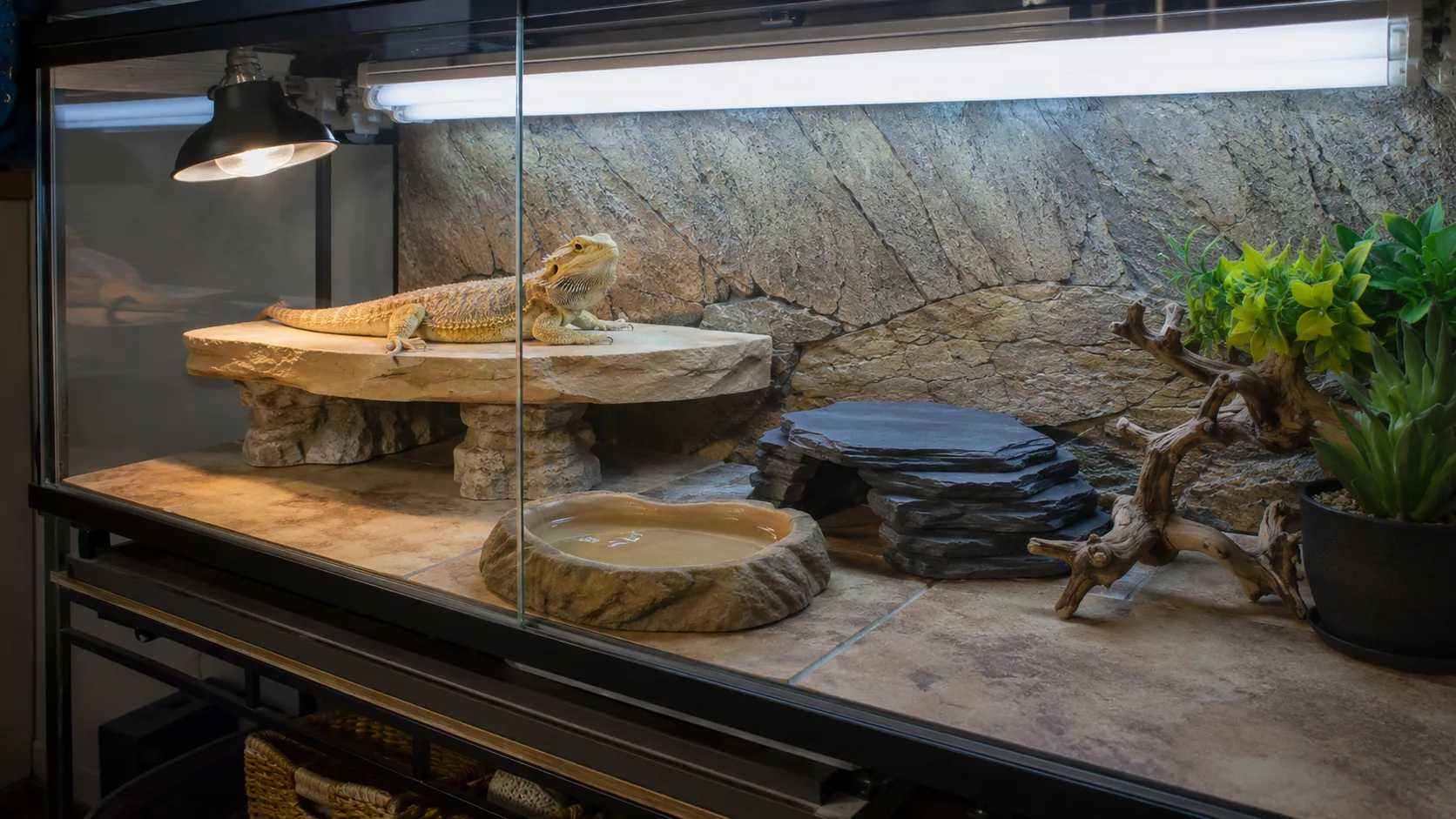
What does a bearded dragon need in its tank?
Short answer
An adult bearded dragon needs at least a 120 cm × 60 cm × 60 cm (4 × 2 × 2 ft) enclosure, a basking surface of 40–43 °C (104–110 °F), a cool side of 24–27 °C (75–80 °F), a T5 high-output UVB tube covering two-thirds of the tank with UVI 4–6 at basking height, a thermostat for the heat source, a shallow water dish, and digestible substrate (tile, slate or a bioactive desert mix).
- Author
- Reptimo Editorial
- Updated
- Updated
- Reading time
- 5 min read
The minimum viable setup
If you're putting a bearded dragon enclosure together for the first time, work to the checklist below and skip the catalogue extras until everything here is in place. Bearded dragons are desert-dwelling diurnal lizards from inland Australia, and their requirements are unforgiving in two areas — UVB and heat — that most starter kits get wrong. Solve those two and most other care problems disappear.
Care parameters
Bearded dragon enclosure — target values
| Parameter | Recommended value | Notes |
|---|---|---|
| Enclosure (adult) | 120 × 60 × 60 cm / 4 × 2 × 2 ft | Minimum; 5 × 2 × 2 ft preferred |
| Basking surface | 40–43 °C / 104–110 °F | Halogen flood + dimming thermostat |
| Cool side air | 24–27 °C / 75–80 °F | |
| Night-time air | 18–22 °C / 65–72 °F | All heat and lights off |
| Humidity | 30–40 % | Below 50 % long-term |
| UVB | UVI 4–6 at basking | T5 HO tube, two-thirds of tank length |
| Photoperiod | 12 h on / 12 h off | On a mechanical timer |
Enclosure — the tank itself
A 4 × 2 × 2 ft (120 × 60 × 60 cm) enclosure is the absolute minimum for an adult bearded dragon. They are surprisingly active, terrestrial lizards that patrol the full length of their territory and need room to thermoregulate between a hot basking zone and a much cooler retreat. PVC-and-wood enclosures (Zen Habitats, Custom Cages) hold heat better than glass and allow proper UVB mounting; glass tanks work but lose heat fast and need larger wattages.
Hatchlings can start smaller but adults grow to 50 cm head-to-tail within 12 months, so most keepers buy the adult tank from day one and use décor to make it feel less overwhelming for a young dragon — cork bark, silk plants and a low ledge break the floor space into "rooms" without restricting movement.
UVB — the non-negotiable
Bearded dragons require strong UVB to synthesise vitamin D3 and absorb calcium. Without it, metabolic bone disease (MBD) develops within months — the single most common preventable cause of bearded-dragon suffering. The modern standard, supported by Zen Habitats' lighting guide and ReptiFiles' UVB explainer:
- T5 high-output linear tube — Arcadia Dragon 12 % or Zoo Med ReptiSun 10.0.
- Length covering two-thirds of the enclosure (e.g., 86 cm tube in a 4 ft tank).
- Mounted inside the enclosure, on the basking side.
- No glass or mesh between the tube and the dragon (glass blocks ~95 % of UVB).
- UV Index 4–6 at the closest basking surface — verified with a Solarmeter 6.5.
Compact "twist-in" UVB bulbs and mercury-vapour combo bulbs are still sold but consistently under-perform in independent testing. Replace T5 tubes every 12 months whether they look bright or not — UV output collapses long before visible light does.
Heat and lighting
Bearded dragons need a sharp temperature gradient: a very hot basking surface for thermoregulating and digesting, and a cool retreat about half that temperature. Achieve it with a halogen flood lamp (50–100 W depending on enclosure depth) on a dimming or pulse-proportional thermostat. Measure the basking surface with an infrared temperature gun on the spot the dragon actually lies on, not the air around it. Coloured "night-glo" bulbs are unnecessary and disrupt sleep — see the next section.
Run a 12-hour photoperiod on a mechanical timer year-round (some keepers adjust seasonally to support brumation). Avoid leaving the basking lamp on late — the photoperiod and the temperature drop together signal night to the dragon's circadian system.
Night temperatures
Bearded dragons need a real night. In the wild, inland Australia drops 15 °C or more overnight, and that drop is part of how they regulate sleep, hormone cycles and seasonal behaviour. In a heated room, switching everything off at night gets you to 18–22 °C (65–72 °F) — exactly right. No red bulbs, no blue moonlight bulbs, no night heat.
The only exception is a room that drops below 15 °C (60 °F): in that case a low-wattage ceramic heat emitter on its own thermostat, set to switch in only at the floor temperature, preserves the cycle without disturbing the dragon with light. For the same nocturnal/diurnal heating logic applied to a nocturnal species, see our leopard gecko temperature guide.
Substrate, hides and water
Pick one of three substrate approaches based on the dragon's age and your experience:
- Tile or slate — totally impaction-safe, easy to clean, holds heat well. Recommended for hatchlings and first-time keepers.
- Sealed wood or reptile carpet — safe but needs frequent washing (carpet traps faeces).
- Bioactive desert mix — 60 % play sand + 40 % organic topsoil, lightly damp at the base, with isopods and springtails as a clean-up crew. Excellent for adults; not recommended for hatchlings under 12 months because they may ingest substrate with prey.
Provide at least one cool-side hide (cave, hollow log, ceramic). Add a humid hide — a small box with damp sphagnum moss — during shed cycles. A shallow, heavy ceramic water dish on the cool side, refilled every 1–2 days, covers hydration during sheds and gives the option of bathing.
What to skip
Most starter kits include something on this list. Skip them and put the money toward UVB and heating instead:
- Coloured night bulbs (red, blue, "moonlight").
- Compact twist-in UVB bulbs.
- Loose calci-sand for hatchlings.
- Glass-lid covers between the dragon and the UVB tube.
- Sticky-strip thermometers (use a digital probe + infrared gun).
- Heat rocks (chronic burn risk).
Once the core setup is in place, the troubleshooting questions almost all disappear. The remaining ones — feeding, brumation, shedding — follow the same diagnostic pattern as for other species: check husbandry first, escalate to a vet on weight loss or specific clinical signs.
Frequently asked questions
What size tank does an adult bearded dragon need?
What UVB does a bearded dragon need?
What's the correct basking temperature for a bearded dragon?
Do bearded dragons need a heat source at night?
What's the safest substrate for a bearded dragon?
Can bearded dragons live on loose sand?
How many hides does a bearded dragon need?
Do bearded dragons need a water dish?
What humidity should a bearded dragon tank be?
How often should I replace the UVB bulb?
Sources
- Bearded Dragon Care Sheet · PetMD
- Bearded Dragon Lighting & Heating Guide · Zen Habitats
- Bearded Dragon Temperatures & UVB · ReptiFiles
- Disorders and Diseases of Reptiles · Merck Veterinary Manual
Quick check
Test what you just learned
A short quiz, just for you. Pick an answer to get instant feedback — there's no pass mark, this is for your benefit.
Quiz questions and answers
What's the minimum enclosure size for an adult bearded dragon?
Correct answer: 120 × 60 × 60 cm (4 × 2 × 2 ft)
120 × 60 × 60 cm (4 × 2 × 2 ft) is the agreed minimum for an adult, with 5 × 2 × 2 ft strongly preferred. Anything smaller leads to obesity and stress behaviours like glass-surfing.
Which UVB setup is correct for a bearded dragon?
Correct answer: A T5 high-output UVB tube spanning two-thirds of the tank, inside without a glass barrier
A T5 HO tube (Arcadia Dragon 12 % or Zoo Med ReptiSun 10.0) covering two-thirds of the tank, mounted inside without glass, gives a UV Index of 4–6 at the basking surface — exactly what a desert lizard needs. Compact coils and window light fall far short.
What's the right night-time strategy?
Correct answer: All heat and light off; only add a ceramic emitter if the room drops below 15 °C (60 °F)
Bearded dragons need a real day-night cycle and a temperature drop overnight. Red night bulbs disturb sleep and add no useful heat. Only escalate to a thermostatted ceramic emitter if the room itself runs very cold.