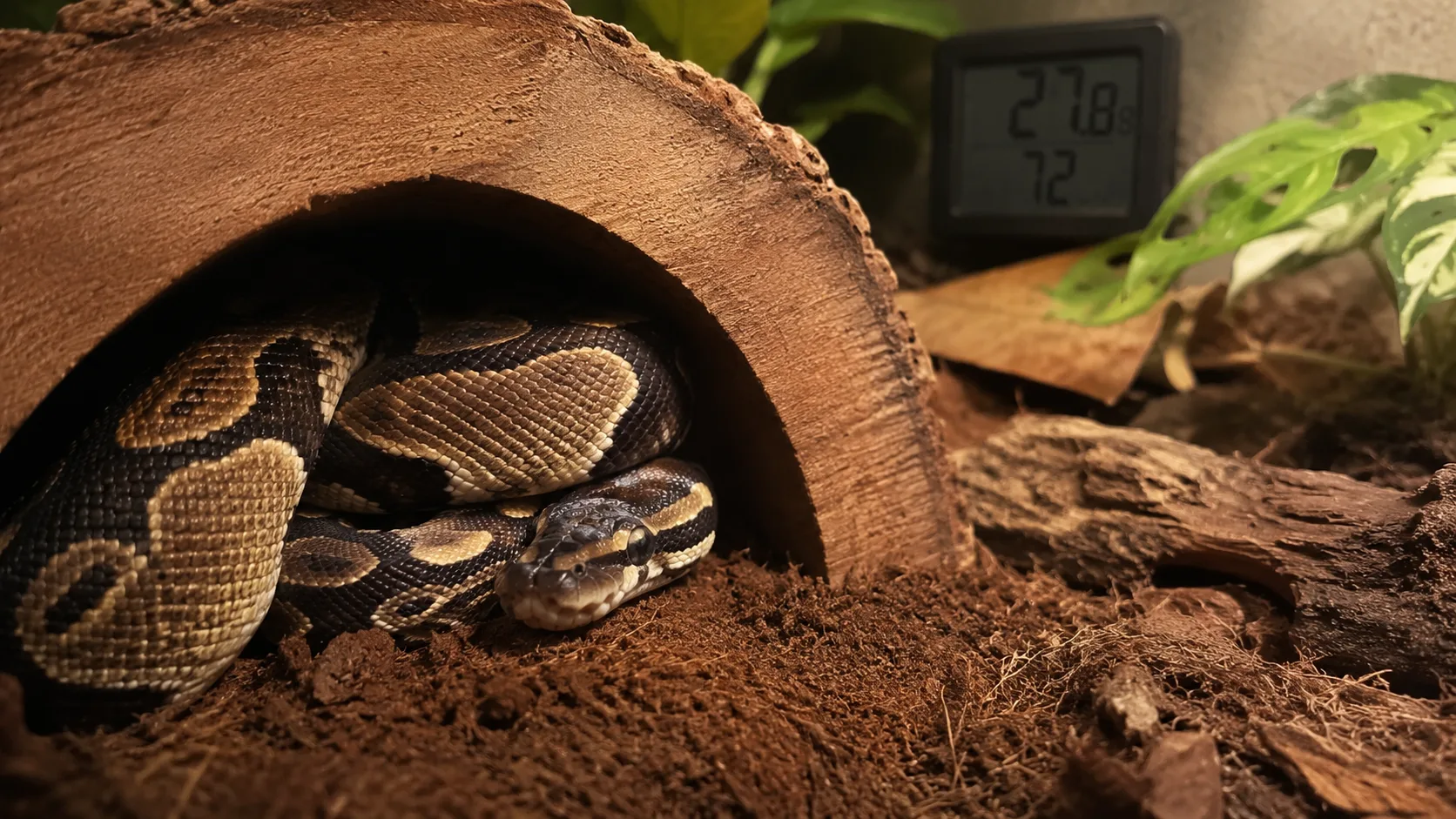
Why is my ball python not eating?
Short answer
Most ball pythons refuse food because of one of five fixable causes: temperatures outside 27–32 °C (80–90 °F), humidity below 55 %, recent rehoming or handling, an upcoming shed, or seasonal winter fasting. A healthy adult can safely skip several months of meals; juveniles are riskier past 3–4 weeks. Re-check husbandry first; consult a reptile vet if weight drops or symptoms appear.
- Author
- Reptimo Editorial
- Updated
- Updated
- Reading time
- 5 min read
The 30-second triage
A ball python that won't eat is the single most common question new keepers ask. The good news: refusing food is almost never an emergency in an adult. The bad news: it's also rarely random — there's a cause, and you can usually find it without a vet visit by checking five things in order. Start with the parameters below; the rest of this article walks each one in detail.
Care parameters
Ball python husbandry — quick check
| Parameter | Recommended value | Notes |
|---|---|---|
| Warm side | 30–32 °C / 86–90 °F | Surface under the basking spot |
| Ambient air | 26–28 °C / 78–82 °F | |
| Cool side | 24–26 °C / 75–78 °F | |
| Humidity (ambient) | 55–60 % | Up to 70 % during a shed cycle |
| Hides | ≥2, snug fit | One on warm side, one on cool — both pitch-black inside |
Cause 1 — Temperatures out of range
Heat drives the entire ball python feeding response: at the wrong temperature they literally cannot smell prey efficiently and won't strike. Per PetMD's ball python care sheet and consistent advice from breeders, the warm side needs to sit at 30–32 °C (86–90 °F) on the surface — not in the air, on the substrate the snake lies on. Use an infrared temperature gun or a digital probe thermometer.
Common heating mistakes that cause hunger strikes:
- An under-tank heater without a thermostat — either too cool or burn-hot.
- A radiant heat panel mounted too high, leaving the substrate at 22–24 °C.
- A bulb on a manual dimmer that drifts as the room temperature changes.
Fix the gradient first, give it 5–7 days to stabilise, then re-offer food. For the broader logic of how reptile body temperature affects appetite, see our explanation of warm and cool sides for leopard geckos — the same principle applies across species.
Cause 2 — Humidity below 55 %
Ball pythons originate from West and Central Africa, where ambient humidity sits in the 55–70 % range. A captive enclosure that runs at 30–40 % humidity puts the snake into chronic mild dehydration: tongue-flicking drops, mucus in the nostrils dries out, and the snake stops eating before any visible problem appears.
Raise humidity by switching to a larger, deeper water bowl positioned over the warm side, swapping a screen lid for a partially-covered one, and choosing a moisture-holding substrate such as cypress mulch or coconut husk chunks. Don't mist heavily every day — soaking the substrate causes scale rot. The goal is a constant 55–60 % reading with brief spikes to 70 % during the shed cycle.
Cause 3 — Recent rehoming, handling or stress
Ball pythons are profoundly territorial and a new enclosure resets their sense of safety. The general guideline supported across reputable breeders and care guides:
- Don't handle for the first 1–2 weeks in a new home.
- Don't offer food for the first 5–7 days.
- After the settle-in window, offer a meal in the evening with the room lights low.
If feeding still fails, check whether anything in the room is generating vibration (subwoofers, washing machines) or whether a cat / dog / child is visible through the glass. Even a sheet of paper taped to one side of the enclosure during feeding can be enough to switch a stressed snake back on.
Cause 4 — A shed is coming
A ball python entering its shed cycle ("in-blue") almost always refuses food for the duration. The signs: dull skin colour, cloudy/blue eyes, hiding more than usual. The shed runs roughly 7–14 days from blue eyes through clear eyes to the actual shedding event. Don't offer food during a shed — wait 24 hours after the shed completes, then try again.
If your snake refused the meal before the shed cycle and the shed has now finished, expect the next 1–3 offerings to land normally. Logging shed dates makes this pattern unmistakable across a year.
Cause 5 — Winter slowdown
This is the cause that scares new keepers most and matters least. From late autumn through early spring, healthy adult ball pythons routinely refuse food for weeks or months, sometimes dropping into a low-activity mode that looks like brumation but isn't true brumation. Multi-month fasts in adult ball pythons are well documented across the hobby and in Reptiles Magazine's explainer.
The rule of thumb: in an otherwise healthy adult with stable weight, a winter fast is normal and not a medical concern. Keep offering at the usual cadence, weigh weekly, and most snakes resume feeding in March–April.
When to see a vet
Most food refusal is husbandry, not illness. But these signs change the calculation:
- Visible spine or sunken sides (significant muscle loss).
- Weight loss over 10 % of body weight, or any loss in a young juvenile.
- Open-mouth breathing, mucus or bubbles at the nostrils, audible wheezing.
- Regurgitation of a previous meal (especially repeated).
- Stargazing or loss of coordination.
- Refusal lasting >3 months in an adult or >4 weeks in a juvenile with correct husbandry already verified.
Book a reptile-experienced vet and bring a weight log and a husbandry record — a clean log of temperatures, humidity, handling and feeding refusals is exactly what an exotics vet wants to see on the first appointment. See our setup checklist for the same logging principle applied to enclosure builds.
Frequently asked questions
How long can a ball python go without eating?
Should I force-feed a ball python that won't eat?
What temperature should a ball python tank be?
Will my ball python eat a thawed mouse if I scent it?
Is my ball python going into brumation?
How often should a ball python be eating normally?
Can stress alone cause a ball python to stop eating?
When should I take a ball python to a vet for not eating?
How should I weigh my ball python to track fasting safely?
Sources
- Ball Python Care Sheet · PetMD
- Reasons a Ball Python Won't Eat · Reptiles Magazine
- Disorders and Diseases of Reptiles · Merck Veterinary Manual
Quick check
Test what you just learned
A short quiz, just for you. Pick an answer to get instant feedback — there's no pass mark, this is for your benefit.
Quiz questions and answers
What's the warm-side temperature a ball python needs to feed reliably?
Correct answer: 30–32 °C (86–90 °F)
Ball pythons need a warm side of 30–32 °C (86–90 °F). Below ~27 °C feeding response drops sharply — temperature is the first thing to check on any food refusal.
Your healthy adult ball python hasn't eaten for 8 weeks but weight is stable. What's the right next step?
Correct answer: Re-check temperatures, humidity, hides and handling, then keep offering every 7–14 days
Stable weight + correct husbandry = a normal voluntary fast. Force-feeding is harmful and vet-only. Review husbandry, log weight weekly, keep offering at the usual cadence.
Which symptom genuinely means 'see a reptile vet now', regardless of feeding?
Correct answer: Open-mouth breathing, mucus, or audible wheezing
Open-mouth breathing, bubbles or mucus around the nostrils, and audible wheezing point to a respiratory infection — a YMYL emergency that needs a vet, not husbandry tweaks.