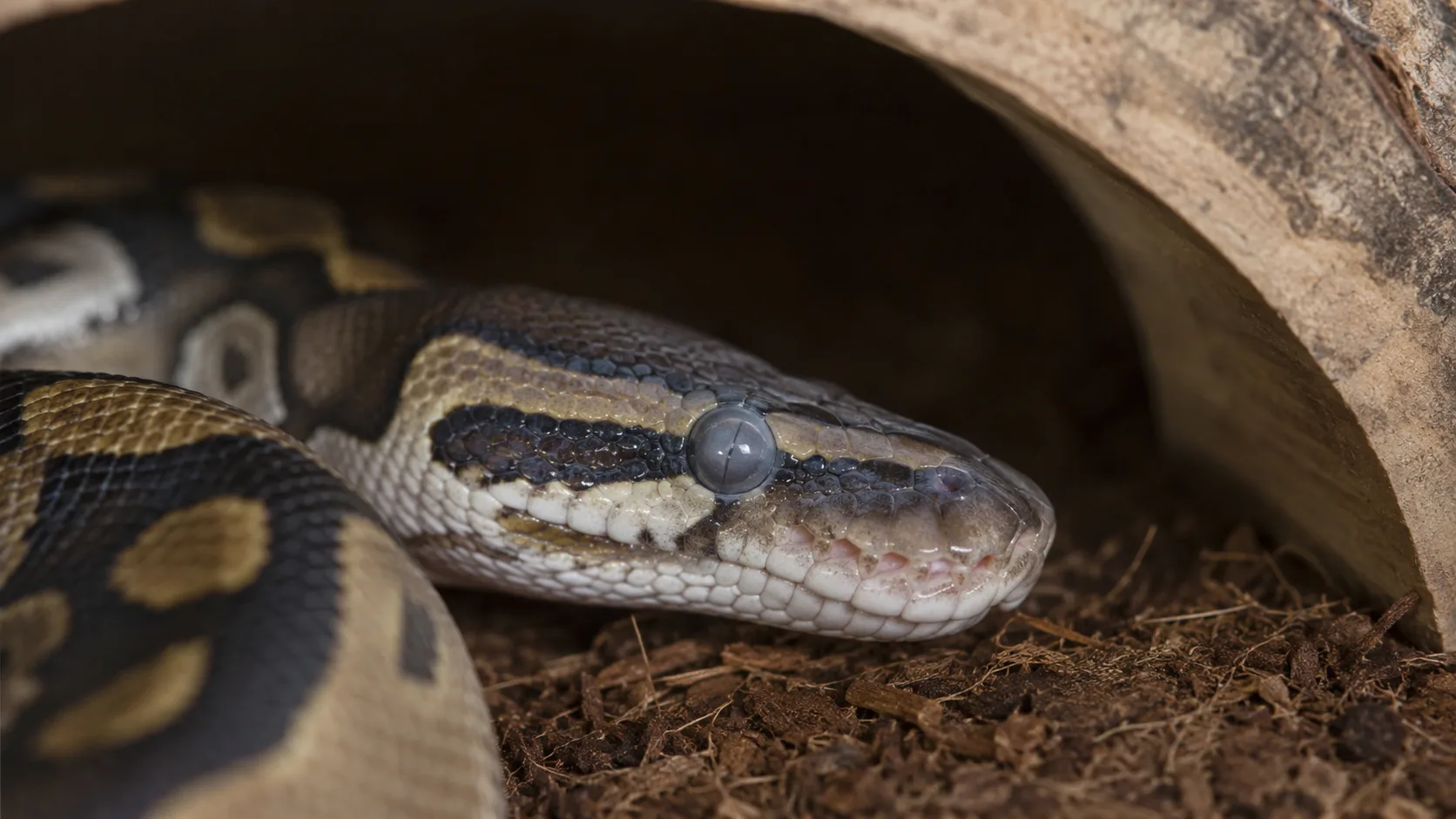
Why won't my ball python eat after shedding or in winter?
Short answer
Ball pythons often skip several meals after a shed cycle while their scales harden and they recover from the shed-related fast. Winter refusals lasting weeks to months are normal in healthy adults responding to seasonal cues. Both patterns are concerning only if the snake also loses weight, shows other illness signs, or refuses past spring without explanation.
- Author
- Reptimo Editorial
- Updated
- Updated
- Reading time
- 5 min read
Post-shed refusal
A ball python (Python regius) that just completed a shed often refuses 1–3 meals before resuming normal feeding. The pattern is well-documented across reptile literature:
- Scales need time to harden after a shed; new skin is fragile for several days.
- Scent perception is briefly altered — the heat-sensing pits recalibrate.
- Body is in slight recovery from the metabolic effort of the shed cycle.
What's normal:
- Snake completed a clean shed (one full piece, eye caps off).
- Refused the meal offered 5–10 days after the shed.
- Otherwise alert, active at night, normal posture.
- No other concerning signs.
Try again at the next regular feeding date. Most snakes accept the second or third offered meal post-shed. Per Reptiles Magazine's guidance, post-shed refusal is one of the most common harmless reasons ball pythons skip meals.
Winter slowdown
The seasonal pattern that scares new keepers most:
From October through March in the Northern Hemisphere, healthy adult ball pythons routinely refuse food for weeks or months. The mechanism, per consistent guidance across PetMD's care sheet and ReptiFiles' care guide:
- Shortening photoperiod triggers seasonal hormones, especially in males during the natural breeding window (Nov–Feb).
- Slight ambient temperature drops even in heated homes act as cues.
- Wild ball pythons fast in dry season — the captive pattern mirrors this evolved biology.
What's normal during winter slowdown:
- Adult snake (typically 2+ years).
- Refuses food from late autumn through early spring.
- Weight stable (under 5 % loss over 3+ months).
- Otherwise alert, active at night, normal posture.
- Resumes feeding gradually in February–April.
Documentation across the hobby of multi-month adult ball python fasts of 6+ months with no health consequences is widespread. 9-month fasts in adult males are not unusual during seasonal slowdown.
When refusal becomes illness
The line between normal seasonal refusal and illness sits with other signs, not the duration of refusal alone. Per the Merck Veterinary Manual:
Worrying signs to combine with refusal:
- Open-mouth breathing or audible wheezing (respiratory infection — see the RI guide).
- Mucus or bubbles at the nostrils.
- Sunken sides or visible spine.
- Weight loss exceeding 10 % of body weight in a few months.
- Lethargy AT warm-side temperatures (slow, unresponsive, doesn't tongue-flick).
- Regurgitation of a previous meal.
- Tiny black/red specks on scales, persistent water-bowl soaking — mites.
Two or more of these together with refusal = vet appointment within 1–3 days, regardless of season.
How to monitor a fast
Weekly weight tracking is the single best discriminator of normal seasonal refusal vs developing problem:
Care parameters
Monitoring a fasting ball python
| Parameter | Recommended value | Notes |
|---|---|---|
| Frequency | Weekly | Same day of the week for trend clarity |
| Scale | Digital, 1 g precision | Kitchen scale is fine |
| Container | Snake-safe tub, taped lid if active | Tare scale or subtract container |
| Expected loss (adult, winter fast) | Under 5 % over 3+ months | Healthy |
| Concerning loss | 10 %+ in a month, OR sustained progressive loss | Vet appointment |
| Juvenile (under 200 g) | Should NOT fast over 4 weeks | Husbandry review and vet sooner |
A simple log (paper, spreadsheet, or app) captures the trend. See the husbandry log guide for format options. Reptimo's weight tracking auto-graphs the trend against species norms.
What to do — and what not to do
Do:
- Re-check husbandry with proper tools every few weeks. Warm-side surface 30–32 °C (86–90 °F) verified with IR gun on the substrate. Humidity 55–60 %. See the temperature guide and the humidity guide.
- Keep offering at the normal cadence — every 10–14 days for an adult. Don't pause offerings during winter; you'll miss the moment when the snake decides to resume.
- Weigh weekly and log the number.
- Reduce handling to the minimum needed — fasting snakes prefer to be left alone.
- Try variation if appropriate — slightly different prey presentation, freshly thawed and warm, scenting techniques.
Don't:
- Force-feed a healthy fasting snake. Force-feeding causes regurgitation, stress, oesophageal damage, and rarely solves the underlying refusal.
- Increase temperatures above the normal range hoping to trigger feeding. Snakes don't strike better at 36 °C than at 31 °C; they retreat from too-hot warm sides.
- Panic at week 4. Multi-month adult ball python fasts are documented and normal.
- Try a thousand different prey types in quick succession. Each refusal is a small stress event; a relaxed snake on a regular schedule is more likely to feed than one being constantly tempted.
When to see a vet — anyway
Even with all the "this is probably normal" caveats, some situations need a vet:
- Juvenile (under 200 g) refusing for more than 4 weeks.
- Any adult losing more than 10 % of body weight.
- Any of the illness signs from the section above paired with refusal.
- Refusal persisting through April–May without resumption.
- You're not sure — a quick wellness check costs less than a delayed diagnosis.
Bring a written husbandry log and weight trend. The full diagnostic walkthrough for ball python food refusal sits in the not-eating guide; the broader cross-species warning patterns are in "is my reptile sick?"; the pillar care context is in the pillar care guide.
Frequently asked questions
Is it normal for a ball python to skip meals after shedding?
Why does my ball python stop eating in winter?
How long can a ball python safely go without eating?
Should I force-feed a fasting ball python?
What's the difference between a normal post-shed refusal and illness?
How do I tell my snake is about to shed?
Why does my ball python eat better in spring?
Should I change the prey type when my ball python isn't eating?
How often should I weigh a fasting ball python?
Sources
- Ball Python Care Sheet · PetMD
- Reasons a Ball Python Won't Eat · Reptiles Magazine
- Ball Python Care Guide · ReptiFiles
- Disorders and Diseases of Reptiles · Merck Veterinary Manual
Quick check
Test what you just learned
A short quiz, just for you. Pick an answer to get instant feedback — there's no pass mark, this is for your benefit.
Quiz questions and answers
Is it normal for a healthy adult ball python to skip meals for months in winter?
Correct answer: Yes, if husbandry is correct and weight is stable
Multi-month winter fasts are normal in healthy adult ball pythons with correct husbandry and stable weight. The pattern is triggered by photoperiod and seasonal cues. Force-feeding or panic isn't needed — re-check husbandry, weigh weekly.
When does a post-shed refusal stop being normal and become concerning?
Correct answer: When also paired with weight loss, lethargy, mucus, or sunken sides
1–3 skipped meals after a clean shed in an otherwise active, healthy snake is normal. Refusal becomes concerning when paired with weight loss, lethargy, open-mouth breathing, mucus, or other illness signs. Two or more = vet within days.
What's the SINGLE most important number to track during a long fast?
Correct answer: Weight trend, logged weekly
Weekly weight tracking is the gold standard for monitoring a fasting snake. Healthy adults stay within 5 % of starting weight over a 3-month winter fast. Sustained drop is the warning sign — not the number of days since the last meal.
Should you force-feed a healthy adult ball python that's been fasting 8 weeks?
Correct answer: No — force-feeding is harmful; re-check husbandry, weigh weekly, keep offering
Force-feeding a healthy fasting adult ball python is harmful — it causes regurgitation, stress, and oesophageal damage. Assist-feeding is reserved for significant weight loss in juveniles or vet-supervised interventions, not as a response to seasonal refusal.