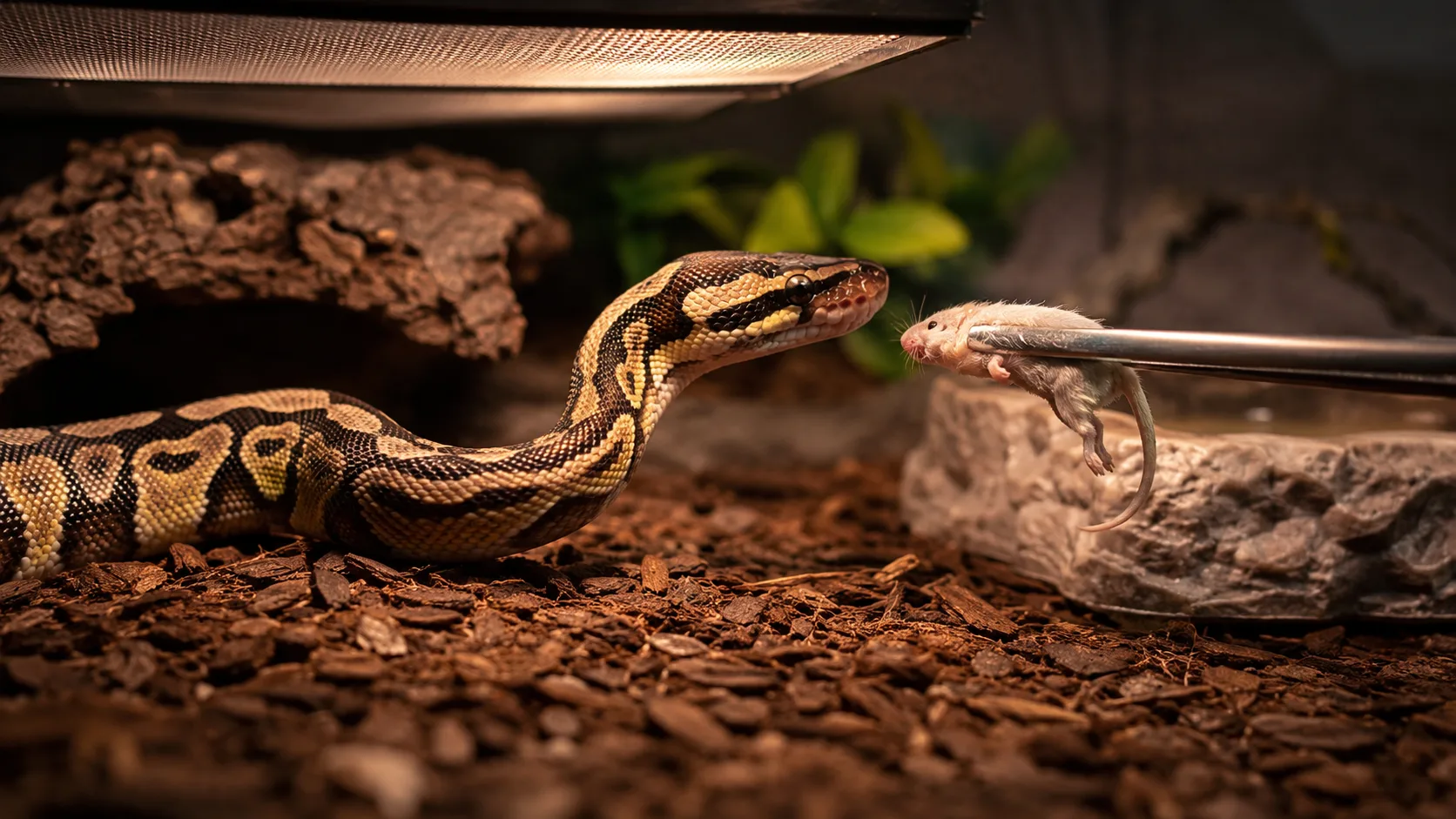
How often should I feed my ball python?
Short answer
Hatchlings (under 200 g): a hopper mouse every 5–7 days. Juveniles (200–500 g): an adult mouse every 7–10 days. Sub-adults (500 g – 1 kg): a weaned rat every 10–14 days. Adults (over 1 kg): a small-to-medium rat every 10–14 days, sometimes longer in winter. Prey diameter should match the snake's thickest body section. All frozen-thawed, never live.
- Author
- Reptimo Editorial
- Updated
- Updated
- Reading time
- 5 min read
Feeding schedule by life stage
Ball pythons (Python regius) are constrictors whose feeding schedule slows dramatically with age. A hatchling needs a meal every week; a full adult needs a meal less often than once a fortnight. Per PetMD's care sheet and consistent guidance across ReptiFiles:
Care parameters
Ball python feeding schedule by life stage
| Parameter | Recommended value | Notes |
|---|---|---|
| Hatchling (0–6 months, under 200 g) | Hopper mouse every 5–7 days | |
| Juvenile (6–18 months, 200–500 g) | Adult mouse every 7–10 days | |
| Sub-adult (18–36 months, 500 g – 1 kg) | Weaned rat every 10–14 days | |
| Adult (over 1 kg, especially females) | Small to medium rat every 10–14 days | |
| Adult winter (Oct–Mar) | Skipped meals normal | Weight should stay stable |
Prey size
The sizing rule across reputable care guidance — including Reptiles Magazine: prey diameter matches the snake's thickest body section, not its head. The snake's jaw stretches; the gut needs to digest. Same width = safe; narrower is fine; wider risks regurgitation.
Practical sizes:
- Hatchling (under 200 g): hopper mouse (10–15 g).
- Juvenile (200–500 g): adult mouse (20–30 g) — one or two depending on snake size.
- Sub-adult (500 g – 1 kg): weaned rat (30–50 g).
- Adult female (1.5+ kg): small rat (50–80 g) — one meal every 10–14 days.
- Adult male: small-to-medium rat (40–60 g) less often.
Length is secondary — a slightly longer prey item of the right diameter is fine. The "two small prey instead of one big one" approach also works and some keepers prefer it for juveniles.
Frozen-thawed — the modern standard
F/T rodents are the universal recommendation across modern care literature. Reasons:
- No injury risk to the snake. A defensive live rat — or even a cornered mouse — can bite a snake that doesn't strike immediately, sometimes causing serious wounds.
- Easier to source and store — buy in bulk, keep in a freezer.
- Welfare-friendly — rodents are humanely culled before freezing.
- No disease transmission from prey to snake.
Live prey is unnecessary for ball pythons. The "they need to hunt" argument doesn't apply — ball pythons are ambush predators that strike anything warm and moving, including a thawed rat dangled realistically from tongs.
Thawing prey correctly
The right sequence:
- Move from freezer to fridge for 24 hours (overnight). Slow thaw protects internal organs.
- Warm the rodent by placing it sealed in a plastic bag, immersed in warm (not hot) water for 15–30 minutes until it feels warm throughout. Target surface temperature ~38–40 °C (100–104 °F).
- Verify temperature with an infrared temperature gun if available — the heat-sensing pits on the snake's face read 38 °C prey as "live warm prey" and trigger the strike response.
- Pat dry briefly so the prey isn't dripping wet.
- Offer with long feeding tongs — never bare-handed; a striking ball python can mistake your hand for prey.
Never microwave. It cooks the inside, kills any heat signal the snake recognises, and can rupture internal organs that contaminate the meal.
When the snake refuses
Ball python refusal is so common it has its own diagnostic walkthrough — see the not-eating guide. Quick triage:
- Verify temperature with an IR gun on the warm-side substrate (target 30–32 °C). Cold snakes don't feed. See the temperature guide.
- Verify humidity (target 55–60 %, briefly 65–70 % in shed). See the humidity guide.
- Check for shed signs — cloudy eyes, dull skin = wait until shed completes plus 24 h.
- Check the calendar — autumn/winter refusals are normal for healthy adults.
- Recent stress? — new home, new room, frequent handling, construction noise. Give space.
If all of these check out and the snake is losing weight or showing illness signs, that's a vet appointment, not a feeding tweak.
The winter slowdown
The seasonal pattern that scares new keepers most:
From October through March in the Northern Hemisphere, healthy adult ball pythons routinely refuse food for weeks or months at a time. They become less active, spend more time in the warm hide, and may go through a full meal cycle without eating. This is normal seasonal biology, not a problem — as long as:
- The snake's weight stays stable (weigh weekly).
- There are no signs of illness (open-mouth breathing, mucus, lethargy, sunken sides).
- Husbandry is correct (temperature, humidity verified with proper tools, not just stick-on dials).
Keep offering at the usual cadence. Most snakes resume feeding in March or April. Force-feeding a healthy fasting snake harms the animal and gains nothing — the documented rule across breeders and keepers.
Switching prey types
Most ball pythons start on mice and graduate to rats around the 500–800 g body weight range. The transition can be smooth or stubborn. Techniques that work:
- Scenting — rub the thawed rat on a thawed mouse before offering, transferring mouse scent.
- Braining — break the rat's skull slightly to release scent (uncomfortable but routine for stuck eaters).
- Live demonstrate — wiggle the prey realistically with tongs; ball pythons often respond to movement and warmth.
- Patience — most snakes transition within 2–4 offerings; some take longer. Don't force-feed.
For broader feeding-refusal logic that applies across snake species, see the parallel reasoning in the pillar care guide.
Frequently asked questions
How often should I feed a ball python?
How big should the prey be?
What's the difference between live and frozen-thawed prey?
How do I thaw frozen rodents safely?
Why won't my ball python eat?
Is it normal for a ball python to skip meals for months?
Should I handle my ball python before feeding?
What's the right temperature for feeding?
Can I switch a ball python from mice to rats?
Sources
- Ball Python Care Sheet · PetMD
- Ball Python Husbandry · Reptiles Magazine
- Ball Python Care Guide · ReptiFiles
Quick check
Test what you just learned
A short quiz, just for you. Pick an answer to get instant feedback — there's no pass mark, this is for your benefit.
Quiz questions and answers
How often should you feed an ADULT ball python (over 1 kg)?
Correct answer: Every 10–14 days, sometimes longer in winter
Adults: every 10–14 days, with extended fasts in winter (weeks to months) acceptable if the snake is healthy. Daily or every-few-days feeding of an adult causes obesity and fatty liver disease.
How big should ball python prey be?
Correct answer: Same diameter as the snake's thickest body section
Prey diameter matches the snake's thickest body section — not its head. Same width = safe; narrower is fine; wider risks regurgitation. Length matters less than girth.
Should you feed your ball python live or frozen-thawed prey?
Correct answer: Frozen-thawed — no injury risk, easier, welfare-friendly
Frozen-thawed (F/T) is the modern standard. Live prey carries real injury risk — a defensive rat or mouse can bite a snake that doesn't strike immediately, sometimes causing serious wounds. F/T is easier to source, store, and welfare-friendly.
Your healthy adult ball python hasn't eaten for 8 weeks but weight is stable. What should you do?
Correct answer: Re-check husbandry (temperature, humidity, hides), keep offering at the normal cadence, weigh weekly
An 8-week winter fast in a healthy adult ball python is normal. Force-feeding harms the snake; an emergency vet visit isn't warranted without weight loss or other illness signs. Re-check husbandry, weigh weekly, keep offering.