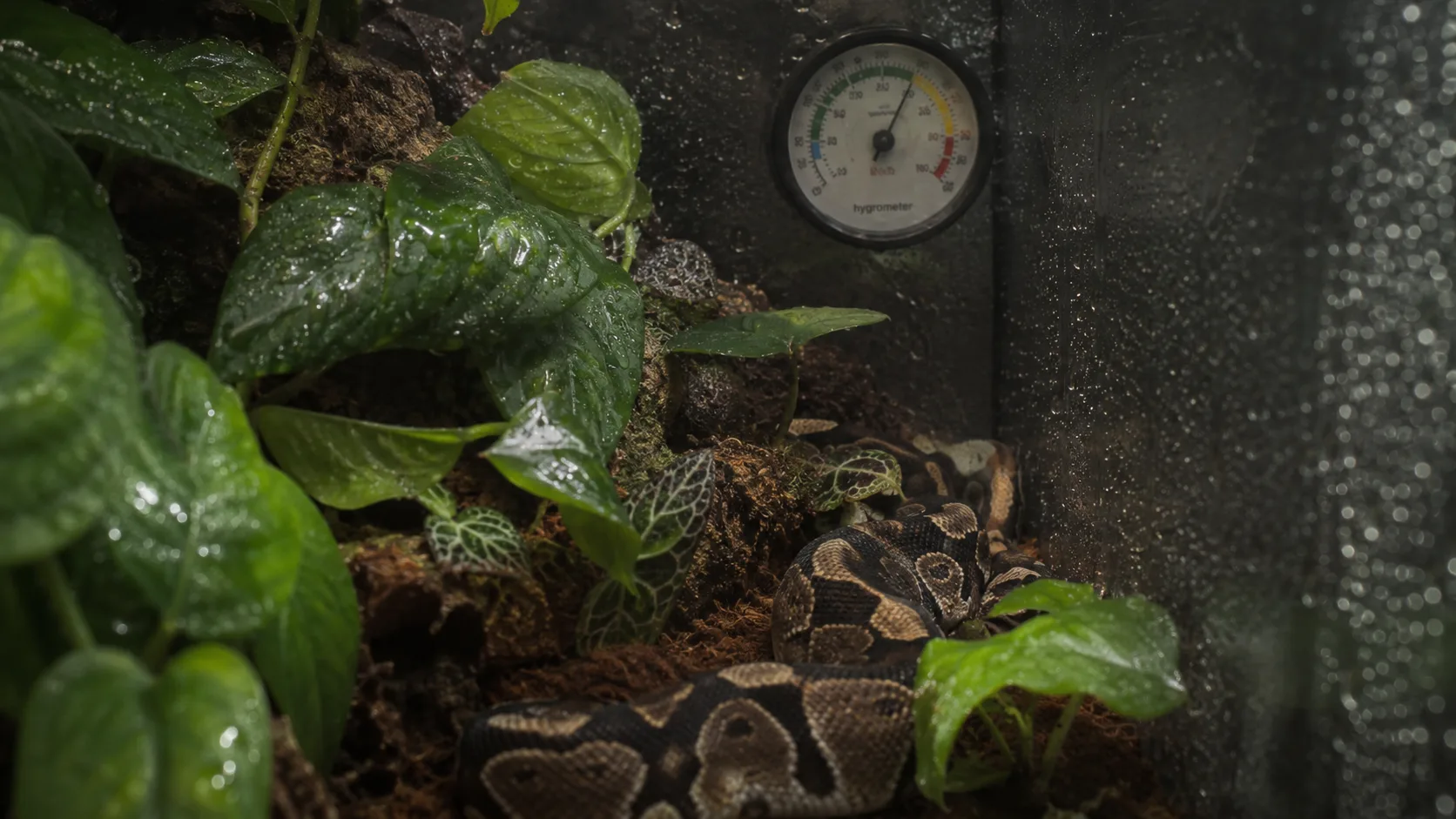
What humidity does a ball python need?
Short answer
Ball pythons need ambient humidity of 55–65 % most of the time, spiking to 70–80 % during the shed cycle. Raise it by switching to a moisture-holding substrate (cypress mulch, coconut husk) 5–8 cm deep, moving the water bowl to the warm side, and partially covering the screen lid. Sustained humidity above 75 % causes scale rot and respiratory infection.
- Author
- Reptimo Editorial
- Updated
- Updated
- Reading time
- 6 min read
What humidity does a ball python actually need?
Ball pythons (Python regius) come from the savannas and forest edges of West and Central Africa, where they shelter in burrows that stay substantially more humid than the surface air. In captivity, the modern care consensus from the PetMD care sheet, the ReptiFiles humidity guide and The Bio Dude care guide is the same: ambient humidity of 55–65 % most of the time, spiking to 70–80 % during the shed cycle.
Care parameters
Ball python humidity — target values
| Parameter | Recommended value | Notes |
|---|---|---|
| Ambient (year-round) | 55–65 % | Measured at mid-height, digital probe |
| Shed cycle spike | 70–80 % | From cloudy eyes through 24–48 h after shed |
| Substrate depth | 5–8 cm / 2–3 in | Moisture-holding type |
| Water bowl placement | Warm side | Larger bowl = more evaporation |
| Long-term ceiling | 75 % | Above this drives scale rot, RI risk |
Below 50 % long-term, sheds come off in patches, eye caps stick, and the snake spends extra time soaking. Above 75 % long-term, blisters appear on the belly scales — the early stage of scale rot.
How to raise humidity
Order of impact, biggest first:
-
Substrate. Cypress mulch and coconut husk chunks are the two industry standards. Both hold moisture for days and look natural. 5–8 cm (2–3 in) depth is the sweet spot: deep enough to hold water, not so deep it stays waterlogged at the base. Aspen shavings and paper towels hold almost no moisture and shouldn't be paired with a ventilated enclosure.
-
Water bowl placement. A water bowl on the warm side evaporates substantially faster than the same bowl on the cool side. The warm side is also where the bulb's heat drives convection through the enclosure, pulling humid air across the snake's resting area.
-
Bowl size. A larger surface area on the bowl pushes more moisture into the air. A bowl the snake can curl up in is good for soaking behaviour during sheds; a bowl that's too small means you'll need other tricks.
-
Partially cover a screen lid. Mesh tops are the default cause of low humidity in PVC and glass enclosures. Cover 60–80 % of the screen with foil, plexiglass, or a wood/HDPE panel — leave a strip for ventilation but stop the convection chimney that dries everything out.
-
Humid hide. A small box with damp sphagnum moss on the warm side gives a localised microclimate the snake can opt into without raising the whole enclosure's humidity.
Shed-cycle spikes
When a ball python enters "in-blue" (cloudy eyes, dull colour), raise humidity to 70–80 % for the duration. Once the eyes clear and the snake sheds (typically 7–14 days from blue eyes through to peeling), give it 24–48 hours and return to 55–65 %.
How to spike, briefly:
- Add fresh damp sphagnum moss to the humid hide.
- Light misting of the substrate once a day (do not soak).
- Check water bowl is full — evaporation is doing most of the work.
A clean shed should come off in one piece, including the eye caps. A patchy shed with retained skin around the eyes or vent points to humidity that didn't spike high enough during the cycle. For the parallel shedding-problem logic in a different species, see our leopard gecko stuck shed guide.
Why is my ball python soaking?
A ball python that spends hours in its water bowl is signalling something. The three usual causes, in order of frequency:
- Humidity too low. Check with a digital hygrometer. If ambient is below 50 %, raise it using the steps above and watch behaviour change over 3–5 days.
- Warm side too hot. A surface temperature above 33 °C (92 °F) pushes the snake to the cool side or into water. Verify with an infrared temperature gun.
- Mites. Tiny black specks around the eye, chin pits, or floating as white grit in the water after a soak. Mites drive snakes to soak for the cooling and the partial drowning effect. Mites need veterinary or specialist treatment — they don't self-resolve.
What too-high humidity looks like
Sustained humidity above 75 % with poor ventilation is one of the most under-recognised causes of preventable disease in captive ball pythons. Per the Merck Veterinary Manual's image atlas and the Reptiles Magazine review of ball python blister disease, ulcerative dermatitis (scale rot, blister disease) starts as small moisture-filled blisters on the belly scales and progresses to bacterial or fungal dermatitis if conditions don't change.
Warning signs of chronic high humidity:
- Blisters or vesicles on belly scales.
- Discoloured, soft scales.
- Constant condensation on enclosure walls.
- Mould around hides or substrate.
- Foul smell from the substrate.
Fixes: dry the enclosure out (replace substrate with fresh, drier material), open more ventilation, lower the bowl size, and treat any visible blisters with a dilute povidone-iodine wipe twice a day. Anything that's pitted, smelling or bleeding moves to a reptile vet.
How to measure humidity
A digital probe hygrometer with the probe placed at mid-height in the centre of the enclosure gives the most useful reading. Stick-on dial hygrometers routinely read 15–20 percentage points off and don't update fast enough to catch the daily cycle.
Take readings at the same time each day. Humidity naturally cycles: it falls during the late morning and afternoon as the basking lamp drives evaporation, and rises overnight as the lamp goes off. The 55–65 % target is the band the daily average should sit in, not a constant.
How humidity interacts with food refusals
Low ambient humidity is one of the five most common causes of ball python food refusal — chronic dehydration and respiratory irritation both suppress feeding response. If your snake won't eat and humidity reads below 50 %, fix humidity first and re-offer food after a week. The full feeding-refusal cascade is in our ball python not eating guide.
Frequently asked questions
What percentage humidity does a ball python need?
How do I raise humidity in a ball python tank?
Should I mist a ball python's enclosure?
What does too-low humidity do to a ball python?
What does too-high humidity do to a ball python?
Why is my ball python soaking in its water bowl?
What humidity does a ball python need during shedding?
What's the best substrate for ball python humidity?
How do I measure humidity in a ball python enclosure?
Sources
- Ball Python Care Sheet · PetMD
- Ball Python Humidity & Temperature Requirements · ReptiFiles
- Ball Python Care Guide · The Bio Dude
- Ulcerative Dermatitis (Scale Rot) — Ball Python · Merck Veterinary Manual
- Ball Python Blister Disease · Reptiles Magazine
Quick check
Test what you just learned
A short quiz, just for you. Pick an answer to get instant feedback — there's no pass mark, this is for your benefit.
Quiz questions and answers
What's the correct ambient humidity range for a ball python most of the year?
Correct answer: 55–65 %
55–65 % is the sustainable target. The shed-cycle spike to 70–80 % is short-term only. Above 75 % long-term, scale rot and respiratory infection become real risks; below 50 % long-term, sheds and hydration suffer.
What's the highest-impact way to raise ball python humidity?
Correct answer: Switch to a moisture-holding substrate 5–8 cm deep and move the water bowl to the warm side
Substrate choice plus water-bowl placement raises humidity passively and sustainably. Heavy daily misting drives scale rot and is unnecessary; killing ventilation drives respiratory infection. Cypress mulch or coconut husk + warm-side water bowl handles most enclosures.
Your ball python is soaking in its water bowl every day. What's the most likely cause?
Correct answer: Humidity is too low, the warm side is too hot, or it has mites — check those three in order
Excessive soaking is a behavioural signal. Low ambient humidity is the most common cause; an over-temp warm side is next; mites are third. Check humidity and temperatures first, then look very carefully around the eyes and water bowl for mite specks.