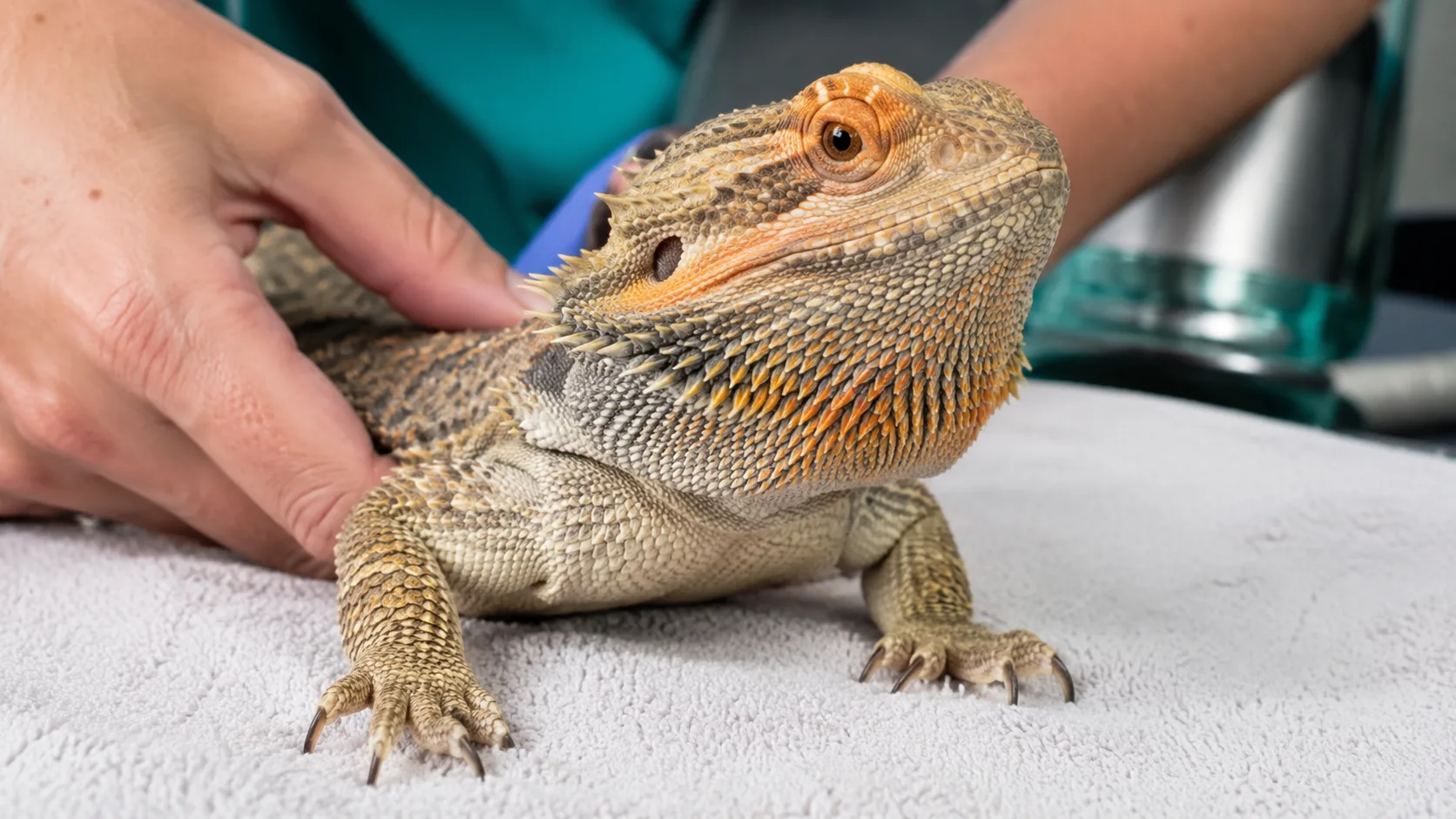
How do I know if my reptile is sick?
Short answer
Reptiles hide illness until it's advanced, so watch for: sustained weight loss, loss of appetite past species norms, sunken eyes, mucus or bubbles around the mouth, open-mouth breathing, lethargy, abnormal droppings, stargazing, jaw tremors, retained shed and visible wounds. Any single high-severity sign — open-mouth breathing, neurological signs, significant weight loss — is an immediate reptile-vet appointment.
- Author
- Reptimo Editorial
- Updated
- Updated
- Reading time
- 8 min read
Why reptiles hide illness
The Merck Veterinary Manual opens its reptile chapter with a warning that frames everything in this article: reptiles often don't show signs of illness until disease has progressed, making it critical that owners know what to look for before the animal is too far gone for treatment. Two factors combine to make this true for almost every species in the hobby:
- Slow metabolism. Disease processes that would visibly affect a mammal in days take weeks or months in a reptile.
- Prey-animal instinct. Showing weakness in the wild attracts predators; captive reptiles still instinctively mask discomfort.
The keeper-side counter-measure is a consistent log: weight, feeding, basking activity, droppings, shed dates. Patterns appear in the log weeks before behaviour changes. The PetMD lizard illness guide makes the same point — by the time keepers notice "something looks off," the underlying problem usually has weeks of history.
How to triage each sign
For every sign in this article, run the same triage:
- Is the husbandry correct? Temperature, humidity, UVB, photoperiod, diet — verified with instruments, not assumptions.
- Is the sign isolated or combined? A single mild sign with stable weight and correct husbandry usually waits. The same sign combined with another sign or sustained weight loss changes the calculation.
- Is the sign on the high-severity list? Some signs — open-mouth breathing, neurological signs, prolapse, deep wounds — go straight to a vet regardless of the rest.
- Have you logged it? A symptom logged once with a date is far more useful than the same symptom remembered vaguely later.
Sign 1 — Sustained weight loss
The most diagnostically useful long-term signal in reptile keeping.
- Concerning when: weight drops more than 10 % of starting body weight, drops steadily over multiple weighings, or any loss in a hatchling or juvenile.
- Reassuring when: weight is stable during a known fast (brumation, winter slowdown, shed cycle).
- Triage: weigh weekly on a flat digital kitchen scale. Track over months, not weighings. Sustained loss is a vet visit; stable is not.
Sign 2 — Appetite loss past species norms
Almost every reptile species fasts at some point. The question is whether the fast is within or outside species norms.
- Within norms: brumation in bearded dragons, winter slowdown in ball pythons or leopard geckos, pre-shed refusal, post-meal rest, recent rehoming.
- Outside norms: a hatchling refusing for over a week, an adult refusing in spring (post-brumation period), refusal combined with weight loss, refusal combined with any other sign.
- Triage: check husbandry first. The species-specific cause cascade is in ball python feeding refusal and leopard gecko appetite loss.
Sign 3 — Respiratory distress
Open-mouth breathing, audible wheezing, clicking, mucus or bubbles around the nostrils — all classic respiratory infection signs, and per the PetMD respiratory infections guide, a documented medical emergency in reptiles.
- Concerning when: ever. There is no benign version of this sign.
- Triage: book a reptile vet within 24–48 hours. Don't raise humidity to "mask" it; high humidity plus cool temperatures is one of the most common predisposing causes. Verify temperatures hit species norms while the vet appointment is pending.
Sign 4 — Sunken eyes
A dehydration signal in lizards, chelonians and snakes — though context-dependent.
- Concerning when: combined with sticky-looking mouth lining, orange/yellow urates, lethargy, or weight loss.
- Reassuring when: isolated brief eye retraction during sleep or stress in chameleons (covered in our chameleon hydration guide) — it can be stress-driven and reversible.
- Triage: improve hydration immediately (more frequent watering, spot misting, warm soaks for snakes and lizards). If eyes don't improve within 24–48 hours of correct hydration, see a vet — sub-cutaneous fluids may be needed.
Sign 5 — Stargazing and neurological signs
Stargazing — the reptile twists its head and neck upward, can't right itself, sometimes lies on its back — is one of the most distinctive neurological signs in reptiles. The PetMD stargazing guide covers it as a symptom of multiple serious conditions, most notably inclusion body disease in boas and pythons, but also severe thiamine deficiency, head trauma, septicemia and infectious encephalitis.
- Concerning when: any reptile shows persistent abnormal head posture, loss of righting reflex, tremors, paralysis, or unusual swimming patterns (turtles especially).
- Triage: immediate vet visit. Quarantine the animal from any collection-mates pending diagnosis.
Sign 6 — Mouth issues (mucus, cheesy discharge, redness)
Sticky mucus inside the mouth, cheesy yellow-white discharge along the gum line, or red and swollen gums all point to infectious stomatitis ("mouth rot"), per the Merck bacterial diseases reference.
- Concerning when: any visible mucus or discharge, or red/swollen gum tissue.
- Triage: vet visit within a few days. Mouth rot becomes systemic if left untreated and can affect bone in advanced cases.
Sign 7 — Abnormal droppings
A healthy dropping has three parts: a firm darker faecal portion, a chalky white urate portion, and a small clear or pale liquid.
- Concerning when: runny or watery faeces sustained over multiple droppings, blood, undigested prey, all-yellow or all-orange urates (dehydration in some species, normal in others — check species), parasitic worms visible, no droppings at all for over 10 days in a reptile that's been eating.
- Triage: bring a fresh stool sample (under 24 hours old) for a faecal parasite exam. Most parasite cases are treatable; catching them early matters.
Sign 8 — Jaw tremors and weak hind legs
Classic signs of metabolic bone disease, the single most common preventable chronic illness in captive lizards.
- Concerning when: ever. By the time tremors are visible, MBD is well-established.
- Triage: check UVB age and UVI at basking (see our UVB guide for the right numbers in bearded dragons), supplement calcium with D3 immediately, and book a reptile vet for confirmation and treatment.
Sign 9 — Retained shed not resolving
A complete shed comes off in a few days. Retained patches that don't clear with one or two correct humid-hide cycles indicate chronic husbandry issues or systemic problems.
- Concerning when: repeated retained shed despite correct humid hide and humidity; retained shed on toes that doesn't resolve in 48–72 hours; retained shed around the eye.
- Triage: see our species-specific guide (leopard gecko stuck shed) for the home-treatment protocol. Persistent failure is a vet visit.
Sign 10 — Visible wounds, swellings or abscesses
Cuts, bites, swellings, lumps, abscesses.
- Concerning when: any wound that's bleeding, swelling that's larger than a pea or growing, any signs of infection (redness, warmth, discharge), or any visible bone.
- Triage: clean small surface scrapes with dilute povidone-iodine twice a day; anything larger, deeper, or infected goes to the vet. Abscesses in reptiles often need surgical drainage — they don't reliably respond to antibiotics alone.
Sign 11 — Shell or scale changes (turtles and snakes)
Soft patches, pitting, discolouration, blisters, flaking that exposes fresh tissue.
- Concerning when: pitting, foul smell, bleeding, or rapid spread.
- Triage: turtles see our red-eared slider shell rot guide; snakes with belly blisters or scale rot need humidity reduction and topical treatment with vet escalation if it doesn't clear in 2 weeks.
Sign 12 — Prolapse and gravid emergencies
Anything protruding from the cloaca — intestine, hemipenis, oviduct, egg stuck mid-passage — is a vet emergency. So is a female with visible eggs (palpable or via X-ray) that hasn't laid them within the expected window for her species (dystocia, "egg-binding").
- Triage: vet within hours, not days. Keep any prolapsed tissue moist with clean, warm saline-soaked gauze en route; don't attempt to push it back yourself.
When 'wait and watch' is wrong
Some signs change the rules. The list below is a short-form quick-reference — any of these are immediate or 24-hour vet visits regardless of how the reptile is otherwise behaving:
- Open-mouth breathing, wheezing, mucus from nostrils.
- Neurological signs — stargazing, tremors, paralysis, loss of righting.
- Prolapse from the cloaca.
- Visible trauma, deep wounds, exposed bone, eye damage.
- Sudden inability to use a limb.
- Severe burns from heat sources.
- Gravid female past the expected laying window with no eggs delivered.
For everything else — single mild signs, weight stable, husbandry verified — the right answer is usually re-check the numbers, log the observation, and re-assess in a few days.
Finding a reptile vet
Search the Association of Reptilian and Amphibian Veterinarians (ARAV) directory for vets near you with documented reptile experience. Most general small-animal vets see only a handful of reptile cases per year; a reptile-experienced exotics vet is a meaningfully different clinical resource for anything beyond a basic check. Save their details before you need them — many of the emergencies above happen outside regular business hours.
Frequently asked questions
What's the earliest sign a reptile is sick?
Is open-mouth breathing in a reptile always an emergency?
Why do reptiles hide illness so well?
What does stargazing mean in a reptile?
What are abnormal droppings in a reptile?
Is lethargy alone a reason to see a vet?
What does a reptile vet emergency look like?
Can I treat reptile illness at home?
How do I find a reptile vet?
Sources
- How to Tell If Your Lizard Is Sick · PetMD
- Disorders and Diseases of Reptiles · Merck Veterinary Manual
- Respiratory Infections in Reptiles · PetMD
- Stargazing Syndrome in Reptiles · PetMD
- Bacterial Diseases of Reptiles · Merck Veterinary Manual
Quick check
Test what you just learned
A short quiz, just for you. Pick an answer to get instant feedback — there's no pass mark, this is for your benefit.
Quiz questions and answers
Which symptom is an immediate reptile-vet emergency?
Correct answer: Open-mouth breathing or audible wheezing
Open-mouth breathing, audible wheezing, and bubbles or mucus around the nostrils all point to a respiratory infection — documented in every reputable reptile health resource as a YMYL emergency. Book within 24–48 hours; don't wait to see if it improves.
Why do reptiles hide illness so well?
Correct answer: Slow metabolism plus prey-animal instinct to mask weakness — by the time obvious signs appear, the condition is often advanced
Reptiles instinctively mask discomfort as a prey-animal survival strategy, and their slow metabolism means disease progression takes weeks rather than days. The keeper-side counter is a consistent log: weight, feeding, droppings, basking activity — patterns appear in the log long before behaviour changes.
Your reptile has stopped eating for 10 days but weight is stable, husbandry is correct, and it's mid-winter. What's the right next step?
Correct answer: Re-check husbandry, weigh weekly, log the refusal, and re-offer at the usual cadence
Stable weight, correct husbandry, and a normal seasonal slowdown together = no emergency. Re-check the numbers, log the refusal, weigh weekly, and most reptiles resume on their own. The combination 'refusal + sustained weight loss' is what changes the calculation.