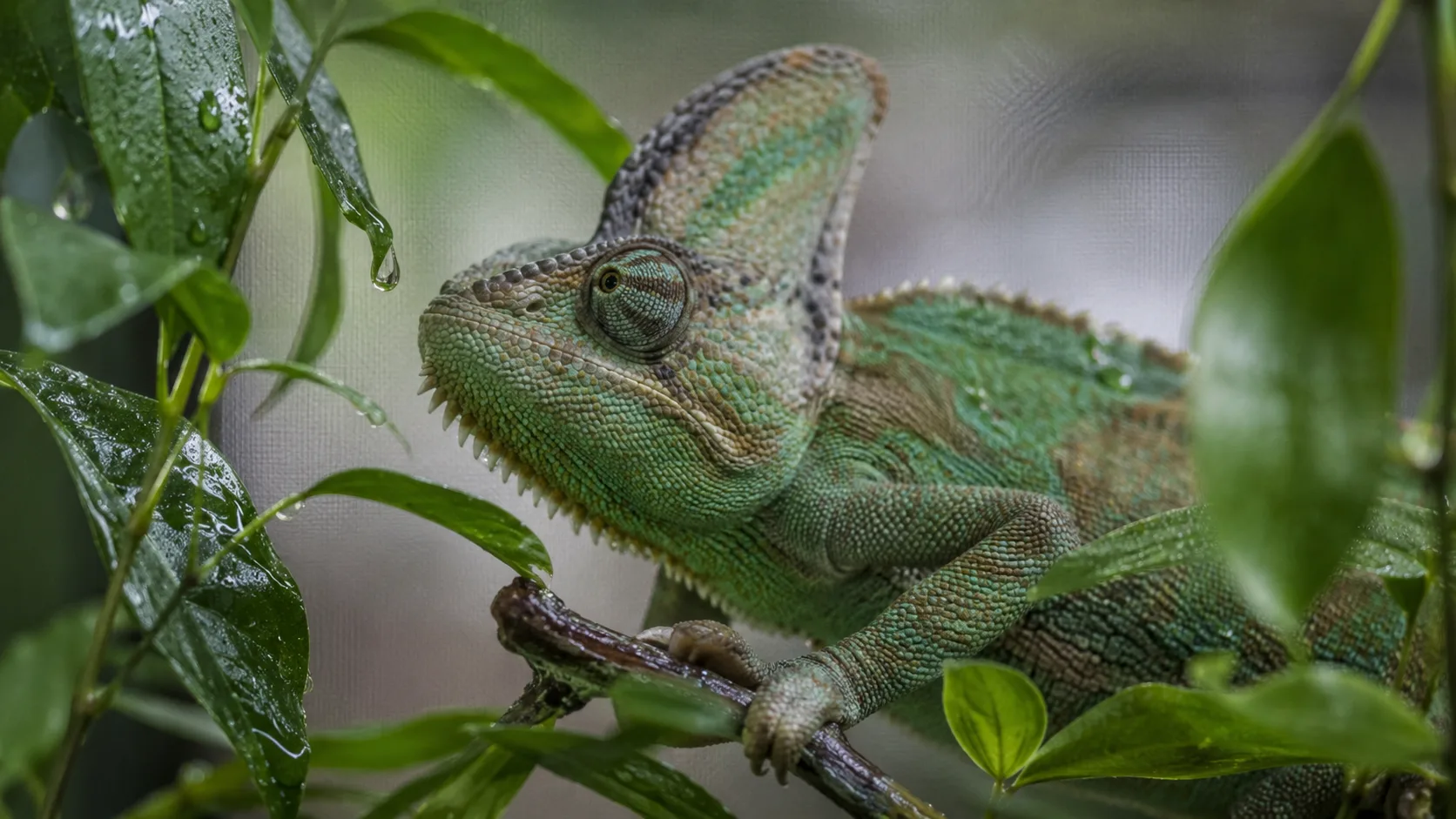
How do I keep my veiled chameleon hydrated?
Short answer
Veiled chameleons drink only moving water — they don't recognise a still bowl. Mist the enclosure heavily for 2 minutes morning and evening, run a slow-drip system 2–4 hours mid-day, and check the urate (the white part of the dropping): mostly white means well hydrated, orange or yellow means dehydrated. Dehydration is the #1 cause of preventable death in captive veiled chameleons.
- Author
- Reptimo Editorial
- Updated
- Updated
- Reading time
- 6 min read
Why hydration is the #1 husbandry priority
Dehydration is the most-cited preventable cause of death in captive veiled chameleons. The species evolved in semi-arid Yemen and southern Saudi Arabia where they drink almost exclusively from dew, condensation and brief rainfall — never from standing pools — and the captive husbandry must replicate that or they decline silently. The chameleon-keeper community treats hydration as the central daily task, not an optional extra; the Chameleon Academy hydration primer opens with exactly that framing.
The good news: a well-hydrated chameleon is unambiguously visible from its urate colour. The bad news: by the time sunken eyes are obvious, the chameleon has already lost significant body water and is at risk of permanent organ damage.
Care parameters
Veiled chameleon hydration — at a glance
| Parameter | Recommended value | Notes |
|---|---|---|
| Morning misting | 2 min heavy, before lights-on | Lap-drinking happens in low light |
| Mid-day dripper | 1 drop / 2–4 sec, 2–4 hours | Onto broad leaves in upper third |
| Evening misting | 2 min heavy, after lights-out | |
| Daytime humidity | 30–50 % | Spikes 80–100 % during misting then dries |
| Night humidity | 70–100 % | Naturally elevated; promotes drinking |
| Healthy urate colour | Mostly to entirely white |
How chameleons actually drink
A veiled chameleon's drinking response is triggered by movement and light reflection on a droplet, not by the presence of water itself. They sit high in the canopy, fix one independently-aiming eye on a droplet on a leaf, and lap it with a quick darting tongue. A still bowl looks like nothing edible.
This is why three rookie mistakes never work:
- A water bowl on the floor — ignored, grows bacteria, raises humidity.
- A "wet floor" from heavy misting — chameleons live in the upper canopy and don't descend to drink.
- Watering from a syringe into the mouth — risks aspiration pneumonia, unsafe outside a vet's care.
Replicate rainfall. That's the entire principle.
Misting schedule
The ReptiFiles veiled chameleon care sheet and the PetMD care sheet agree on the cadence: two heavy mistings per day, plus a daytime hydration source.
- Morning — heavy 2-minute misting, ideally in the 15 minutes before enclosure lights come on. The lights-off period is when most lapping happens; many keepers never see it.
- Evening — heavy 2-minute misting, ideally 15–30 minutes after lights go off. Replicates the cooling-evening dew the chameleon would find in the wild.
- Mid-day — either a slow dripper (preferred) or a brief light misting. Don't mist heavily mid-day on a hot enclosure: the standing humidity stays too high too long and drives respiratory infections.
Use a pump-style pressure sprayer, a battery mister, or an automated system (MistKing, Climist). Spray the foliage and the upper enclosure walls, not the chameleon directly — chameleons hate being misted on the body and stress-retract their eyes, masking the very symptom you're trying to avoid.
Dripper setup
A slow-drip system is the safest mid-day hydration source. The set-up:
- A drip vessel — a commercial dripper, a clean takeaway cup with a pinhole, or a small reservoir with an aquarium air-line and clamp.
- Mounted above the upper third of the enclosure, positioned so drops fall onto a broad-leaved plant (Pothos, Ficus, or a generous silk alternative).
- Drip rate of one drop every 2–4 seconds — slow enough that droplets form on leaves long enough for the chameleon to drink, fast enough that the leaf surface stays interesting.
- Runs for 2–4 hours per day, ideally mid-morning.
- A basin at the bottom to catch runoff, emptied every day.
Reading urate colour
The white part of a chameleon's dropping — the urate — is the most reliable hydration indicator available without a vet. Per the Chameleon Academy primer, urates start out white in the kidneys; as they move through the intestine, the body reclaims water from them, turning them progressively yellow then orange. A well-hydrated chameleon doesn't need to reclaim that water, so its urates stay mostly white.
- Pure white — well hydrated.
- White with up to ~15 % yellow/orange tip — normal range.
- About 50 % orange — the chameleon needs more water; escalate misting frequency and add a dripper.
- Mostly to fully orange — significant dehydration; vet visit if combined with sunken eyes, lethargy or refusal to climb.
Log urate colour weekly alongside weight and feeding. It's the single metric that catches hydration drift before it becomes a crisis.
Signs of dehydration
Beyond urate colour, watch for:
- Sunken eye turrets (always check at multiple times of day; brief retraction during sleep or stress isn't always dehydration).
- Loss of skin elasticity — gentle pinch on the side stays tented longer than it should.
- Lethargy, weak grip, unwillingness to climb.
- Refusal to eat for more than 2–3 days alongside any of the above.
- Dry, sticky-looking mouth lining.
A chameleon with sunken eyes plus orange urates plus reduced climbing is dehydrated; that combination warrants an immediate vet visit because sub-cutaneous fluids may be needed. The Chameleon Academy sunken-eyes guide covers the differential between dehydration, stress and other causes in detail.
What humidity to aim for
Veiled chameleons need a wet/dry cycle, not constant humidity. Daytime ambient humidity should drop to 30–50 % between mistings; night-time humidity naturally rises into the 70–100 % range as temperatures cool. Sustained daytime humidity above 70 % drives respiratory infections, which kill veiled chameleons faster than mild dehydration would. A screen enclosure is standard precisely because it dries between mistings — glass enclosures don't.
When to see a vet
Most hydration problems are solved by improving the misting and dripper routine. Move to a vet visit when you see:
- Urates mostly to fully orange.
- Sunken eyes that don't improve after 24 hours of corrected hydration.
- Refusal to climb or move, weak grip.
- Open-mouth breathing, mucus around the mouth or nose (respiratory infection — separate emergency).
- Sudden colour change to consistently dark with no environmental trigger.
Bring a recent photo of the urates, a misting/dripper schedule, and the enclosure humidity readings. For the broader symptom vocabulary that applies across reptile species, see our warning-signs checklist.
Frequently asked questions
How often should I mist a veiled chameleon?
What's the urate test for chameleon hydration?
Do veiled chameleons drink from a water bowl?
What dripper rate does a veiled chameleon need?
Are sunken eyes always a sign of dehydration?
How can I tell if my chameleon is drinking?
What's the safest way to rehydrate a dehydrated chameleon at home?
What humidity does a veiled chameleon need?
Can I syringe water into my chameleon's mouth?
Sources
- Basics: Chameleon Hydration and Drinking · Chameleon Academy
- Dehydrated Chameleon? Read This · ReptiFiles
- Veiled Chameleon Care Sheet · ReptiFiles
- Veiled Chameleon Care Sheet · PetMD
- Chameleon Medical: Sunken Eyes · Chameleon Academy
Quick check
Test what you just learned
A short quiz, just for you. Pick an answer to get instant feedback — there's no pass mark, this is for your benefit.
Quiz questions and answers
How do veiled chameleons naturally drink?
Correct answer: By lapping moving droplets from leaves after rain or misting
Chameleons evolved in rainforests and humid mountains where rain hits leaves above them. They lap moving droplets — almost never recognise still water in a bowl, and rarely soak. Misting + a dripper is the correct delivery system.
Your veiled chameleon's urates are 60 % orange. What does that mean?
Correct answer: Mild dehydration — increase misting and add a dripper
Urates that are mostly orange indicate the chameleon is reclaiming significant water from urine, which means it's not getting enough. That's the cue to increase misting frequency and add a dripper. If sunken eyes, lethargy or refusal to climb appear alongside it, escalate to a vet.
What's the safest mid-day hydration aid for a veiled chameleon?
Correct answer: A slow dripper at one drop every 2–4 seconds onto broad leaves in the upper enclosure
A slow dripper gives consistent droplets the chameleon can lap, in the upper canopy where it lives. Bowls aren't recognised as water and grow bacteria; constant misting causes humidity-driven respiratory infection. Slow drip 2–4 hours/day is the standard.