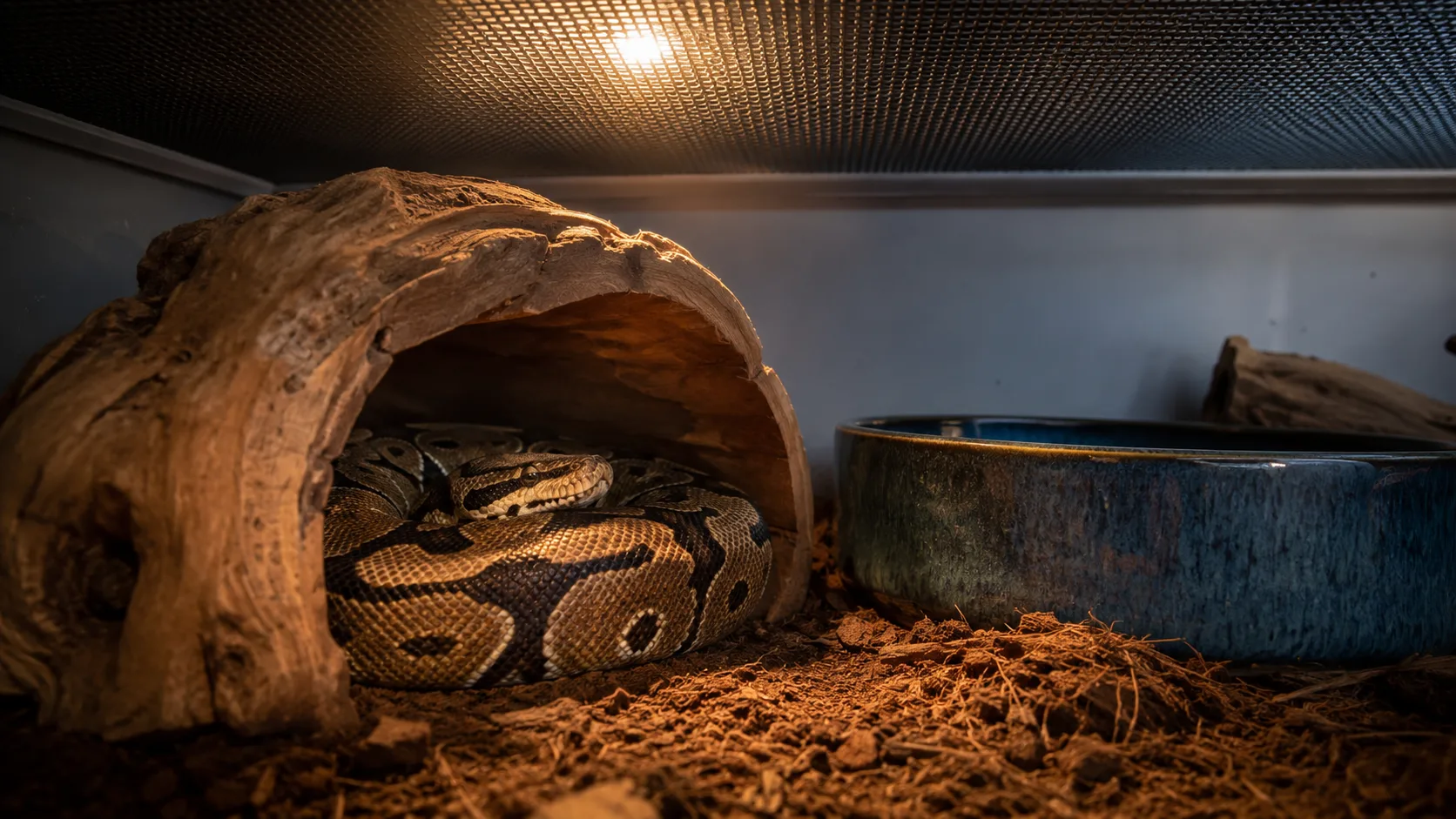
How do you care for a ball python?
Short answer
An adult ball python needs a 120 × 60 × 60 cm (4 × 2 × 2 ft) enclosure, a warm-side surface of 30–32 °C (86–90 °F), a cool side of 24–26 °C (75–78 °F), 55–60 % humidity rising to 70 % during a shed, two snug hides (one each side), a thermostatted heat source and an appropriately sized frozen-thawed rodent every 7–14 days. Expect 20–30 years.
- Author
- Reptimo Editorial
- Updated
- Updated
- Reading time
- 6 min read
What you're signing up for
Ball pythons (Python regius) are nocturnal ambush predators from West and Central African savannah and forest. They are one of the most commonly kept pet snakes worldwide — calm, slow, defensively curling into the name-giving ball rather than biting, and reaching a moderate adult size of 90–150 cm. They are also the snake that gets surrendered most often, because the captive baseline they need (correct heat, humidity, ventilation, low handling) is exacting in a way that doesn't match the "easy beginner snake" pet-store pitch.
This pillar guide is the entry point. Quick parameter summary first, then sections on each system with links out to deep-dive spokes.
Care parameters
Ball python — care parameters at a glance
| Parameter | Recommended value | Notes |
|---|---|---|
| Adult enclosure | 120 × 60 × 60 cm / 4 × 2 × 2 ft | Minimum; bigger is better |
| Adult size | ♀ 120–150 cm, ♂ 90–120 cm | Females larger |
| Warm-side surface | 30–32 °C / 86–90 °F | |
| Ambient air | 26–28 °C / 78–82 °F | |
| Cool side | 24–26 °C / 75–78 °F | |
| Humidity | 55–60 % | 65–70 % during shed cycles |
| Diet (adult) | F/T rodent every 10–14 days | |
| Handling | 2–3 ×/week, 10–20 min | Not within 48 h of meal or during shed |
| Lifespan | 20–30 years (40+ documented) |
Enclosure
A 4 × 2 × 2 ft (120 × 60 × 60 cm) enclosure is the modern minimum for an adult ball python. The older "40-gallon breeder" recommendation (90 × 45 × 30 cm) is outdated, and rack-system housing — common in breeding operations — is increasingly criticised on welfare grounds for pet keeping, as documented by ReptiFiles' care guide. Recent welfare research has shown ball pythons actively use the horizontal and vertical space in larger enclosures, contradicting the "they're lazy snakes that don't need room" myth.
PVC enclosures hold heat and humidity better than glass and let you mount heat sources internally. Glass tanks work but lose heat fast and typically need higher-wattage heating to hit the warm-side target. Most experienced keepers buy the adult enclosure upfront — a juvenile adjusts within days if you provide two snug, low-ceilinged hides (one warm, one cool) so it never feels exposed.
Detailed sizing options live in the tank size guide.
Heating
Two zones, controlled by a thermostat:
- Warm-side surface at 30–32 °C (86–90 °F) — provided by a radiant heat panel (RHP) on a pulse-proportional or dimming thermostat. RHP is the modern standard because it heats from above without bright light, mimicking sun-warmed surfaces ball pythons rest under.
- Cool side ambient at 24–26 °C (75–78 °F) — typically room temperature with no extra heat in a heated home.
- Night drop to 22–24 °C (72–75 °F) on the warm side. Ball pythons are active at night and need mild background heat — but no bright light overnight.
Heat mats work as supplemental belly heat under one hide but should not be the primary heat source for an adult in a 4-foot enclosure. Heat rocks are a chronic burn hazard and unanimously rejected by modern care guides. Full detail in the temperature spoke.
Humidity and shedding
55–60 % ambient humidity is the daily target, with brief 65–70 % spikes during shed cycles (signalled by cloudy eyes and dull skin). Achieve it with:
- A moisture-holding substrate — cypress mulch, coconut husk chunks, or a soil/sphagnum mix. Aspen and reptile carpet dry out too fast.
- A large heavy water bowl positioned partly over the warm side.
- A partially-covered lid if you're using a screen top (which leaks humidity).
- A humid hide (small box with damp sphagnum moss) on the cool side the snake uses voluntarily during sheds.
Don't fog the enclosure to 90 % — sustained excess humidity without ventilation creates ideal conditions for respiratory infection. Detail in the humidity spoke.
Feeding
Frozen-thawed (F/T) rodents are the modern standard, recommended across every reputable care sheet including PetMD. Live prey carries real injury risk — a defensive rat or even a mouse can damage a snake that doesn't strike immediately. Sizing rule: prey diameter should match the snake's thickest body section.
Schedule by life stage:
Care parameters
Ball python feeding schedule
| Parameter | Recommended value | Notes |
|---|---|---|
| Hatchling / juvenile (< 200 g) | Hopper mouse every 5–7 days | |
| Juvenile / sub-adult (200–500 g) | Adult mouse every 7–10 days | |
| Sub-adult (500 g – 1 kg) | Weaned rat every 10–14 days | |
| Adult (> 1 kg) | Small to medium rat every 10–14 days |
Full feeding logic, scenting, and how to handle a refusal sit in the feeding schedule spoke.
Handling
After a settle-in period (1–2 weeks, no handling, no food for the first 5–7 days, then offer once), 2–3 handling sessions per week of 10–20 minutes is plenty. Support the snake's body along its length — never grab mid-body or restrain. Don't handle within 48 hours of a meal (regurgitation risk) or during a shed cycle (skin is fragile, the snake is stressed).
Ball pythons defensively curl into a ball; bites are rare and minor. A hatchling occasionally bluff-strikes from stress; this fades with consistent gentle handling.
Common problems
The Reptimo cross-species warning signs checklist covers the universal red flags. Ball-python- specific patterns:
- Refusing food for weeks or months in winter — usually normal seasonal slowdown if weight is stable, husbandry is correct, and the snake is otherwise active. Walkthrough in the not-eating guide.
- Open-mouth breathing, mucus, wheezing — respiratory infection, vet appointment within days. Details in the RI guide.
- Stuck shed, eye caps retained — humidity was too low during the shed cycle. Offer a humid hide and a 15-minute shallow soak; never pull skin off.
- Tiny black or red specks on scales, persistent water-bowl soaking — mites. Treat with a Provent-a-Mite-style spray (follow label) and consult a vet for severe infestations.
This guide compiles husbandry from authoritative sources and is not veterinary advice. Any health concern is a reptile-vet appointment, ideally with a written husbandry log (temperatures, humidity, feeding log, weight) to speed diagnosis.
Frequently asked questions
How long do ball pythons live?
Are ball pythons good for beginners?
What size enclosure does an adult ball python need?
What temperature does a ball python need?
What humidity does a ball python need?
What do ball pythons eat?
How often do you feed a ball python?
Are ball pythons calm and OK to handle?
Why does my ball python hide all the time?
Sources
- Ball Python Care Sheet · PetMD
- Ball Python Husbandry · Reptiles Magazine
- Ball Python Care Guide · ReptiFiles
- Disorders and Diseases of Reptiles · Merck Veterinary Manual
Quick check
Test what you just learned
A short quiz, just for you. Pick an answer to get instant feedback — there's no pass mark, this is for your benefit.
Quiz questions and answers
What's the minimum adult enclosure for a ball python by modern welfare standards?
Correct answer: 120 × 60 × 60 cm (4 × 2 × 2 ft)
120 × 60 × 60 cm (4 × 2 × 2 ft) is the modern minimum for an adult ball python. The 40-gallon recommendation is outdated and the rack-system standard is increasingly criticised on welfare grounds for pet keepers. Bigger is better — ball pythons explore far more than the 'lazy snake' myth suggests.
What humidity should a ball python have on a normal (non-shed) day?
Correct answer: 55–60 %
55–60 % is the daily target. Spike to 65–70 % during shed cycles. Sustained humidity above 70 % without ventilation drives respiratory infection — the opposite problem from stuck shed.
What's the safest prey to feed a ball python?
Correct answer: Appropriately sized frozen-thawed rodents
Frozen-thawed (F/T) rodents are the modern standard — no risk of the prey biting the snake (a defensive rat can do serious damage), easier to source, welfare-friendly. Prey diameter matches the snake's thickest body section.
Your healthy adult ball python skips meals for three months in winter. What's the right response?
Correct answer: Re-check husbandry, weigh weekly, keep offering at normal cadence
Multi-month winter fasts in healthy adult ball pythons are normal. Re-check temperatures and humidity, weigh weekly, and keep offering food on the usual schedule. Vet only if there's actual weight loss, sunken sides, or signs of illness.