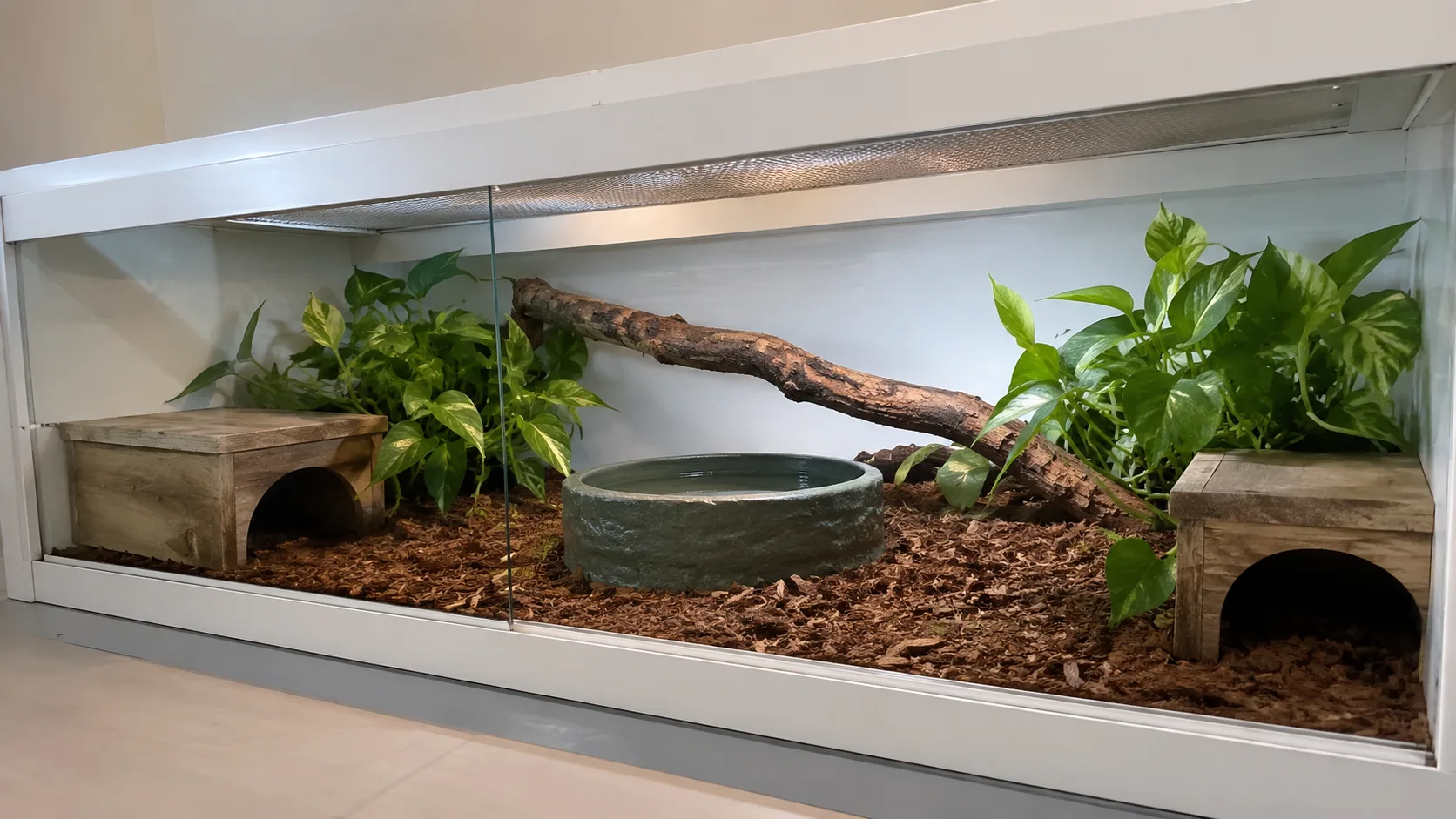
How big a tank does a ball python need?
Short answer
Adult ball pythons need at least a 120 × 60 × 60 cm (4 × 2 × 2 ft) enclosure, with 150 × 60 × 60 cm (5 × 2 × 2 ft) the welfare-focused standard. Hatchlings can start in a 60 × 40 × 30 cm faunarium for the first 6–12 months. The old "40-gallon breeder" recommendation and rack-system housing are increasingly criticised on welfare grounds for pet keepers.
- Author
- Reptimo Editorial
- Updated
- Updated
- Reading time
- 5 min read
How big an enclosure by life stage
The biggest mistake in ball python keeping is treating the adult enclosure size as optional. Per consistent guidance across ReptiFiles, PetMD's modern care sheet and Reptiles Magazine's husbandry guide, adult ball pythons benefit substantially from properly-sized horizontal enclosures.
Care parameters
Ball python enclosure size by life stage
| Parameter | Recommended value | Notes |
|---|---|---|
| Hatchling (under 200 g) | 60 × 40 × 30 cm tub OR adult enclosure with dense clutter | Both work; clutter is critical in the larger size |
| Juvenile (200–500 g) | 90 × 45 × 45 cm minimum, adult enclosure preferred | |
| Sub-adult / adult (500 g – 1 kg+) | 120 × 60 × 60 cm minimum / 150 × 60 × 60 cm preferred | |
| Large adult female (1.5 kg+) | 150 × 60 × 60 cm minimum |
Hatchlings and juveniles
Two equally valid approaches:
Approach 1 — Small tub / faunarium for the first year. A 60 × 40 × 30 cm (~30 L) plastic tub with two snug hides and basic substrate is secure and easy to heat. Most experienced keepers use this for hatchlings that arrive shy or refuse food in larger spaces. Upgrade to the adult enclosure by 12 months or sooner.
Approach 2 — Adult enclosure from day one, densely furnished. A 4 × 2 × 2 ft enclosure works for a hatchling IF you provide:
- Two snug, low-ceilinged hides — one warm side, one cool side.
- Dense clutter: silk or live pothos plants, cork bark slabs, branches, a sphagnum-moss humid hide.
- A floor pattern that prevents the snake from ever crossing more than ~30 cm without cover.
The "baby in a big tank fails to thrive" pattern comes from bare big tanks. A well-furnished big tank is fine.
Why floor space matters more than height
Ball pythons are predominantly terrestrial ambush predators. They climb low branches and ledges when given the option, but the bulk of their behaviour happens on or near the floor. Practical implications:
- Floor footprint (length × width) is the most important dimension. 4 × 2 ft floor is the meaningful minimum.
- Height of 45–60 cm is plenty. Taller enclosures don't add usable space for this species and make thermal layering harder.
- Vertical décor still matters — a low climbing branch and a ledge encourage exploration even though the snake spends most time at floor level.
Why rack systems are controversial for pets
Rack systems — stacked low-clearance tubs sharing a heat source — work for large-scale breeders managing dozens of snakes efficiently. For a single pet, contemporary welfare-focused care guidance is moving away from them:
- Restricted horizontal exploration and no real thermal gradient.
- No enrichment (climbing surfaces, varied substrate, varied décor).
- Low-clearance tubs limit posture and natural behaviour.
- Difficult to observe the snake's behaviour and condition.
This isn't a moral judgement against breeders — rack systems serve a specific operational need. But for a keeper with one or two pet ball pythons, the modern welfare-focused recommendation is a furnished PVC enclosure of at least 4 × 2 × 2 ft. The pillar care guide has the full husbandry picture.
Glass vs PVC vs other enclosures
Care parameters
Ball python enclosure material comparison
| Parameter | Recommended value | Notes |
|---|---|---|
| PVC (e.g. Animal Plastics, Custom Cages, Reptizoo PVC) | Recommended | Holds heat/humidity, opaque sides feel secure, easy to mount internal heat |
| Sealed wood (some Vivexotic, Vision-style) | Recommended | Similar to PVC; check for sealed seams |
| Glass aquarium with mesh top | OK if modified | Loses humidity fast; wrap 3 sides for security, add a partial cover |
| Bioactive front-opening glass enclosure | Good if sized right | Easier humidity management than top-mesh glass |
| Rack systems | Not recommended for pet keeping | See section above |
PVC enclosures are the modern default — opaque on three sides (security), hold heat and humidity well, allow internal heat-source mounting (radiant heat panel), and come in the right sizes off the shelf. Glass tanks work but typically need a partially-covered lid to hold humidity and three-side wrapping to feel secure.
What goes inside
Once the enclosure is the right size, fill it correctly:
- Two snug hides — one warm, one cool. Both should be tight enough that the snake's coiled body just fills the space (low-ceilinged caves, not large open boxes).
- Large heavy water bowl big enough for the snake to soak in if it chooses, positioned partly over the warm side. Refresh every 1–2 days.
- Moisture-holding substrate — cypress mulch, coconut husk chunks, or a soil/sphagnum mix. Detail in the humidity guide.
- Décor for visual barriers — silk plants, cork bark, branches — so the snake can move without feeling exposed.
- A radiant heat panel mounted on the ceiling, controlled by a pulse-proportional thermostat. Numbers in the temperature guide.
A snake that hides 90 % of the time isn't always sad — ball pythons are ambush predators who sit and wait. But chronic hiding combined with refusing food and weight loss is a husbandry audit, not a tank- size issue alone. See the not-eating guide for the broader diagnostic flow.
Frequently asked questions
What size tank does an ADULT ball python need?
Is a 40-gallon breeder tank big enough for an adult ball python?
Can I keep a baby ball python in an adult-sized tank?
What size tank for a baby (hatchling) ball python?
Are tall enclosures good for ball pythons?
Why are rack systems controversial for pet ball pythons?
Does the ball python tank need to be opaque on the sides?
Do ball pythons actually use the extra space if you give them a bigger tank?
Can I house two ball pythons together?
Sources
- Ball Python Care Sheet · PetMD
- Ball Python Care Guide · ReptiFiles
- Ball Python Husbandry · Reptiles Magazine
Quick check
Test what you just learned
A short quiz, just for you. Pick an answer to get instant feedback — there's no pass mark, this is for your benefit.
Quiz questions and answers
What's the modern welfare MINIMUM enclosure for an adult ball python?
Correct answer: 120 × 60 × 60 cm (4 × 2 × 2 ft)
120 × 60 × 60 cm (4 × 2 × 2 ft) is the modern welfare minimum, with 5 × 2 × 2 ft preferred. The older 40-gallon breeder is undersized for adults, especially females.
Can a hatchling ball python live in a 4-foot enclosure?
Correct answer: Yes if well-furnished with snug hides and clutter
Yes. The 'baby in a big tank stresses' problem is really 'baby in a bare big tank stresses.' Add multiple snug hides, dense décor (silk plants, cork bark, branches) and the hatchling has the same secure microhabitats it would in a tub.
Why do modern care guides increasingly criticise rack systems for pet ball pythons?
Correct answer: They restrict horizontal exploration, thermal gradient and behavioural enrichment — fine for breeders, not ideal for pet welfare
Racks work for high-volume breeding management but restrict the behaviour we now know ball pythons exhibit when given proper space. For a single pet, a furnished enclosure with a real gradient and clutter is the modern welfare standard.