What temperature does a ball python need?
Short answer
Ball pythons need a warm-side surface of 30–32 °C (86–90 °F), an ambient air temperature of 26–28 °C (78–82 °F), a cool retreat of 24–26 °C (75–78 °F) and a gentle night drop to 22–24 °C (72–75 °F). Use a radiant heat panel or overhead bulb on a thermostat with a probe at the warm-side surface. Heat mats only as backup.
- Author
- Reptimo Editorial
- Updated
- Updated
- Reading time
- 4 min read
What temperatures does a ball python need?
Ball pythons (Python regius) are nocturnal ambush predators from West and Central African savannah and forest. They thermoregulate by moving along a warm-to-cool gradient through hides and burrows — never in direct sun. Three zones matter: a warm-side surface that drives digestion, an ambient air range that keeps the cool side liveable, and a gentle night drop that mirrors their natural daily cycle. The numbers below come from PetMD's ball python care sheet and Reptiles Magazine's husbandry guide.
Care parameters
Ball python temperature targets
| Parameter | Recommended value | Notes |
|---|---|---|
| Warm-side surface (day) | 30–32 °C / 86–90 °F | Substrate under the basking spot or RHP |
| Ambient air | 26–28 °C / 78–82 °F | |
| Cool side air | 24–26 °C / 75–78 °F | |
| Night-time (warm side) | 22–24 °C / 72–75 °F | Mild background heat; no bright light |
| Absolute floor | ≥ 22 °C / 72 °F | Sustained drops below this suppress immunity |
| Hard ceiling | ≤ 35 °C / 95 °F | Above: risk of burns on contact surfaces |
How to measure temperature correctly
The same mistake recurs in nearly every "my ball python won't eat" forum post: a stick-on dial thermometer on the side of the tank reading 28 °C while the actual substrate temperature is 22 °C. Air temperature at glass height tells you almost nothing about the surface the snake's belly is on.
Use both:
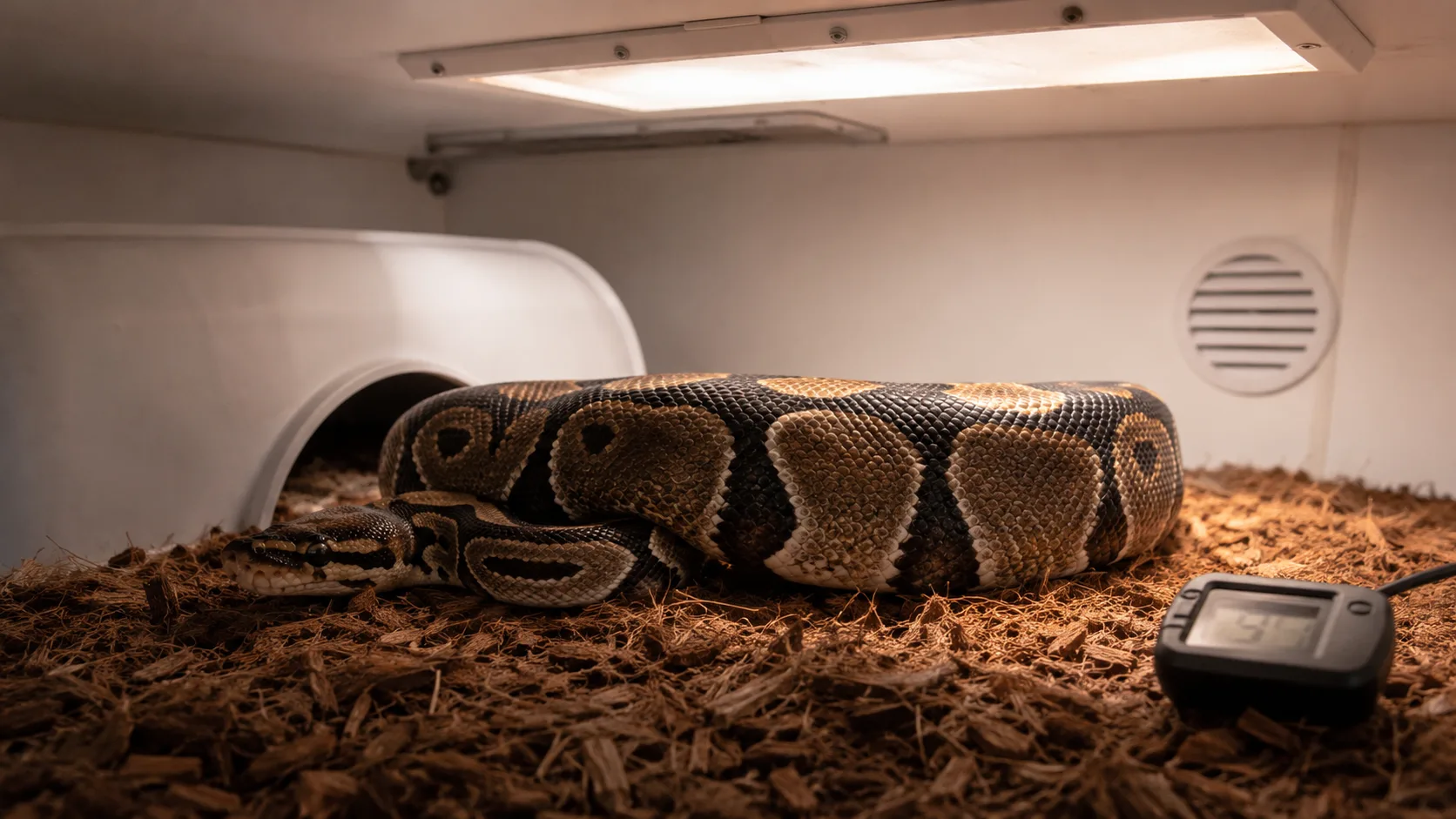
- Digital probe thermometer with the sensor taped flat to the warm-side substrate. This is also where the thermostat probe goes — one probe controls heat, a second independent probe verifies.
- Infrared (IR) temperature gun for spot-checks of the basking surface, the inside floor of the warm hide, and the cool side. Point at the substrate, not the snake itself.
- A third reading on the cool side confirms a real gradient — the cool side should always sit at least 4–6 °C below the warm side.
What heat source to use
A radiant heat panel (RHP) on a pulse-proportional or dimming thermostat is the modern standard for ball pythons in PVC enclosures: it heats from above without bright light, mounts flush to the ceiling out of reach, and produces a gentle warm-floor pattern that mirrors sun-warmed surfaces in the wild.
Alternatives, in rough preference order:
- Ceramic heat emitter (CHE) on a thermostat — works similarly to an RHP, slightly less efficient, available in lower price brackets.
- Halogen flood bulb — fine in glass tanks but cycles harder under a thermostat and dries the air; can complicate the humidity setup.
- Heat mat under the warm side — acceptable as supplemental belly heat under a hide, never as the primary heat source for an adult ball python in a 4 × 2 × 2 ft enclosure. Always on a thermostat — unregulated mats reach 50 °C+ and cause burns.
What to skip outright:
- Heat rocks — chronic burn risk, every reputable care guide warns against them.
- Coloured night bulbs (red, blue, "moonlight") — disrupt the nocturnal cycle and don't add useful heat.
- Unregulated heat of any kind — a thermostat is non-optional.
Night temperatures
Ball pythons are active at night, when wild individuals leave their hides to hunt. In captivity that means a mild background heat overnight, not a hard drop. Aim for the warm side to fall to 22–24 °C (72–75 °F) — enough to digest a recent meal and stay active, not so cold that immunity drops.
Achieve this by setting the thermostat to a lower setpoint at night (any modern reptile thermostat has a day/night cycle), or by sizing the heat source so passive room cooling lands in range when room temperature drops 2–3 °C after lights-out. Never run bright lights overnight: the species evolved to hunt in darkness.
Common heating mistakes
Most "ball python not eating" diagnostics resolve to one of these:
- Warm side actually too cool. Stick-on dial says 28 °C; IR gun on the substrate says 22 °C. Re-measure with the right tool. See the not-eating guide.
- Heat mat without a thermostat. Surface temperature creeps above 45 °C, the snake abandons the warm side and may show belly burns. Add a thermostat or replace the mat with an RHP.
- No proper gradient. Whole tank reads 30 °C; the snake has nowhere to cool down. Re-balance bulb/RHP placement so the cool side stays below 26 °C.
- Night too cold in winter (room drops to 18 °C). Combine with open-mouth breathing, mucus or wheezing → respiratory infection risk, see the RI guide.
For the broader temperature-driven appetite logic (which generalises across reptile species), see the leopard gecko temperature guide — different numbers, same principle.
Frequently asked questions
What's the right warm-side temperature for a ball python?
What ambient temperature does a ball python need?
Do ball pythons need heat at night?
What heat source is best for a ball python?
How do I measure a ball python's temperature accurately?
Can a ball python be too cold?
Can a ball python be too hot?
Why do ball pythons stop eating in winter even with correct temperatures?
Should I use a heat lamp or a radiant heat panel?
Sources
- Ball Python Care Sheet · PetMD
- Ball Python Husbandry · Reptiles Magazine
- Disorders and Diseases of Reptiles · Merck Veterinary Manual
Quick check
Test what you just learned
A short quiz, just for you. Pick an answer to get instant feedback — there's no pass mark, this is for your benefit.
Quiz questions and answers
What warm-side surface temperature does a ball python need to feed reliably?
Correct answer: 30–32 °C (86–90 °F)
Ball pythons need a warm-side surface of 30–32 °C (86–90 °F). Below ~27 °C feeding response drops sharply — wrong heat is the first thing to rule out on any food refusal. Above 35 °C the snake retreats permanently and risks burns.
What's the right night-time strategy for a ball python?
Correct answer: Mild background heat keeping the warm side around 22–24 °C (72–75 °F); no bright light
Ball pythons are nocturnal — they're active when lights are out. Keep background heat overnight (RHP or CHE on a thermostat) at 22–24 °C, but skip white or coloured bulbs. The mild gradient is enough to digest a recent meal.
Where should you measure the warm-side temperature?
Correct answer: On the warm-side substrate with a digital probe or infrared gun
Surface temperature on the substrate where the snake lies is the meaningful reading. Use an infrared (IR) temperature gun for spot-checks and a digital probe thermometer on the substrate as the thermostat sensor. Air-temperature dials are unreliable.