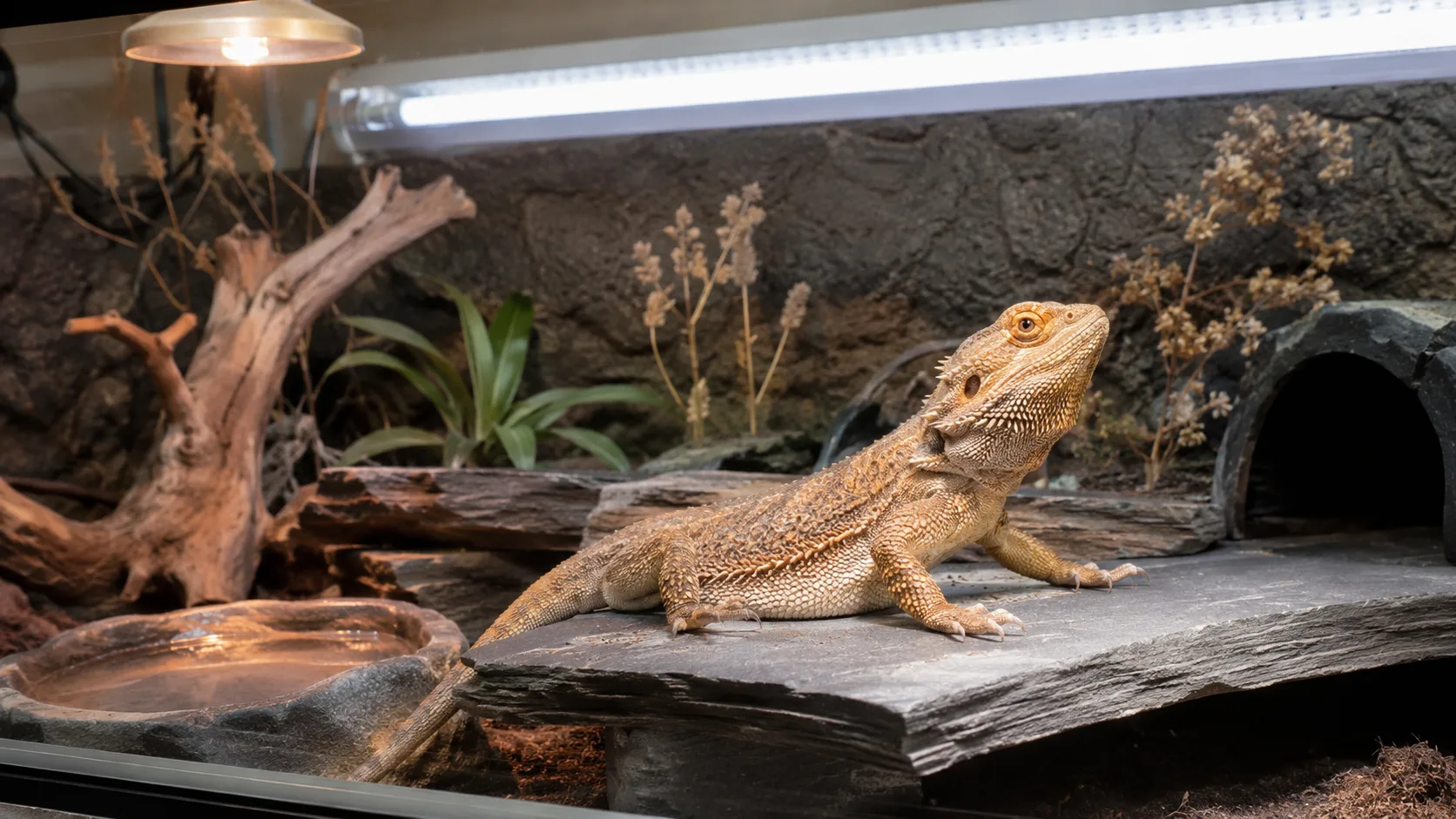
How do you care for a bearded dragon?
Short answer
A bearded dragon needs a 120 × 60 × 60 cm (4 × 2 × 2 ft) enclosure with a basking surface of 40–43 °C (104–110 °F), an ambient cool side of 24–27 °C (75–80 °F), a T5 high-output UVB tube giving UVI 4–6 at basking, daily greens with calcium-with-D3-dusted insects 3–5 times per week, fresh water, and a real 12-hour night with all lights off.
- Author
- Reptimo Editorial
- Updated
- Updated
- Reading time
- 6 min read
What you're signing up for
Bearded dragons (Pogona vitticeps) are diurnal, omnivorous lizards from the arid inland of Australia. In captivity they're one of the most recommended beginner reptiles because they tolerate handling and have calm, observable personalities — but they're emphatically NOT low-effort. A correctly-kept dragon needs strong UVB, a hot basking surface, an adult-sized enclosure, fresh greens daily and live insects multiple times a week. Get those right and they reach 8–12 years; get them wrong and the most common outcome is preventable metabolic bone disease within the first year.
This pillar guide is the index to the rest of the Reptimo bearded dragon library. Each section here links out to a deeper guide on the specific parameter. Start with the tank setup checklist if you're buying gear, or jump to metabolic bone disease signs if you're worried about an existing dragon.
Care parameters
Bearded dragon — care parameters at a glance
| Parameter | Recommended value | Notes |
|---|---|---|
| Adult enclosure | 120 × 60 × 60 cm / 4 × 2 × 2 ft | Minimum; 5 × 2 × 2 ft preferred |
| Basking surface | 40–43 °C / 104–110 °F | Hatchlings: 43–46 °C / 110–115 °F |
| Cool side air | 24–27 °C / 75–80 °F | |
| Night-time | 18–22 °C / 65–72 °F | All heat and lights off |
| Humidity | 30–40 % | Below 50 % long-term |
| UVB | UVI 4–6 at basking | T5 HO tube, two-thirds of tank length |
| Diet (adult) | 70 % greens / 30 % insects | |
| Insects (adult) | 3–5×/week, Ca+D3 dusted | |
| Lifespan | 8–12 years (up to 15) |
Enclosure
Adult bearded dragons grow to roughly 50 cm head-to-tail in their first year and patrol horizontally. A 4 × 2 × 2 ft enclosure is the minimum that allows proper thermoregulation between a hot basking zone and a true cool retreat; 5 × 2 × 2 ft is the modern standard preferred across welfare- focused care guides like ReptiFiles.
PVC or PVC-and-wood enclosures hold heat better than glass and let you mount UVB internally without a glass barrier. Glass tanks work but lose heat fast and force higher-wattage bulbs. Most keepers buy the adult enclosure from day one — a hatchling adjusts to a large space within days if you provide enough décor (cork bark, silk plants, a low ledge) to break the floor plan into "rooms".
The deep dive — substrate choices, hides, water dish placement — lives in the dedicated tank setup checklist.
Heating and lighting
Two parallel systems on independent thermostats and a single mechanical timer:
- Heat: a halogen flood (50–100 W) on a dimming or pulse-proportional thermostat, set so the basking surface reads 40–43 °C (104–110 °F) with an infrared temperature gun on the spot the dragon actually lies on.
- UVB: a T5 HO linear tube (Arcadia Dragon 12 % or Zoo Med ReptiSun 10.0) covering two-thirds of the enclosure length, mounted inside, giving UVI 4–6 at basking measured with a Solarmeter 6.5.
Run a 12-hour-on / 12-hour-off photoperiod year-round. At night, all heat and light off — bearded dragons need a real night-time temperature drop to sleep and cycle hormones, and red "night-glo" bulbs disrupt that. The full mounting and replacement-schedule detail is in the dedicated UVB guide, plus the temperature deep dive.
Feeding
Bearded dragons are omnivores whose diet shifts with age. Hatchlings need protein for fast growth; adults need fibre and calcium-rich greens to avoid obesity. The split most contemporary care guides converge on, per PetMD:
- Hatchlings (0–4 months): insects multiple times daily, dusted with calcium-with-D3 most feedings. Greens always available even though they're mostly ignored at this age.
- Juveniles (4–12 months): insects once daily, greens always available, calcium-with-D3 most feedings, multivitamin weekly.
- Adults (12 months+): greens daily, insects 3–5 times per week, calcium-with-D3 most insect feedings, multivitamin every 1–2 weeks.
Insect choice: dubia roaches and black soldier fly larvae (calciworms)
are the gold standard for nutrition; crickets work but escape and stink;
mealworms only as treats (high fat, hard chitin). Greens: collard greens,
mustard greens, dandelion greens, escarole. Skip iceberg lettuce
(nutritionally empty), spinach and kale long-term (oxalates), and avoid
fruit beyond an occasional bite. Detail by life stage:
bearded-dragon-feeding-by-age (coming in a future batch).
Hydration and bathing
A shallow ceramic water dish on the cool side, refreshed every 1–2 days, covers most bearded dragons. Many never visibly drink from it — they extract most water from fresh greens, the occasional misted leaf, and weekly 10-minute baths in shallow lukewarm water.
Don't raise tank humidity to "help" hydration: chronic humidity above 50 % significantly raises respiratory infection risk in this dry-dwelling species. If the dragon's eyes are sunken or its skin looks dehydrated, a bath plus a vet appointment is the answer, not a mister.
Common problems and when to see a vet
The Reptimo cross-species warning-signs checklist covers the universal red flags. Bearded-dragon-specific patterns:
- Refusing food but otherwise active in autumn/winter — likely brumation, normal in adults; check weight weekly. Detailed in the not-eating guide.
- Weakness in back legs, tremors, "rubber jaw" — metabolic bone disease. Same-week vet appointment, then audit UVB. See MBD signs.
- Black beard sustained for days + lethargy — stress, illness or brumation. Black beard during basking only is normal.
- Sunken eyes, weight loss — dehydration; bath, vet, audit greens intake.
- Open-mouth breathing with mucus, audible wheezing — respiratory infection (humidity too high or temperature too low). Reptile vet within days.
YMYL note: this guide compiles husbandry from authoritative sources and is not a substitute for veterinary advice. For any of the patterns above, book a reptile-experienced vet — bringing a written husbandry log (temperatures, UVB age, feeding, weights) gets a faster diagnosis.
What to skip
Most starter kits include something on this list. Spend the money on UVB and the right enclosure instead:
- Coloured "night-glo" bulbs (red, blue, "moonlight").
- Compact twist-in UVB bulbs.
- Loose calci-sand for hatchlings.
- Heat rocks (chronic burn risk).
- Glass lid between the dragon and the UVB tube.
- Mealworms or pinky mice as a staple food.
Frequently asked questions
How long do bearded dragons live?
Are bearded dragons good pets for beginners?
What size tank does an adult bearded dragon need?
What temperature does a bearded dragon need?
What do bearded dragons eat?
How often do bearded dragons need to eat?
Do bearded dragons need water?
What humidity should a bearded dragon tank have?
What are signs of a sick bearded dragon?
Sources
- Bearded Dragon Care Sheet · PetMD
- Bearded Dragon Care Guide · ReptiFiles
- Bearded Dragon Complete Lighting & Heating Guide · Zen Habitats
- Disorders and Diseases of Reptiles · Merck Veterinary Manual
Quick check
Test what you just learned
A short quiz, just for you. Pick an answer to get instant feedback — there's no pass mark, this is for your benefit.
Quiz questions and answers
Which set of basking temperatures is correct for an adult bearded dragon?
Correct answer: 40–43 °C (104–110 °F)
Bearded dragons are open-sun-baskers from inland Australia and need a hot surface — 40–43 °C (104–110 °F) for adults, slightly higher for hatchlings. The cooler ranges leave them too cold to digest food, and 50 °C+ causes burns.
What's the right adult diet ratio for a bearded dragon?
Correct answer: 70 % fresh greens, 30 % insects (3–5×/week)
Adult bearded dragons shift to a plant-leaning omnivore diet — roughly 70 % fresh greens, 30 % insects. Hatchlings are the opposite (mostly insects). All-insect adult diets cause obesity and fatty liver; fruit-heavy diets cause diarrhoea and crash blood sugar.
How big should the adult enclosure be?
Correct answer: 120 × 60 × 60 cm (4 × 2 × 2 ft) minimum
120 × 60 × 60 cm (4 × 2 × 2 ft) is the agreed minimum for an adult, with 5 × 2 × 2 ft strongly preferred. Anything smaller drives glass-surfing, obesity and chronic stress.
How often should a healthy adult bearded dragon eat insects?
Correct answer: 3–5 times a week
Adults: insects 3–5 times per week, greens daily. Daily insects in an adult cause obesity and fatty liver disease. Hatchlings and juveniles eat insects more often because they're growing fast.