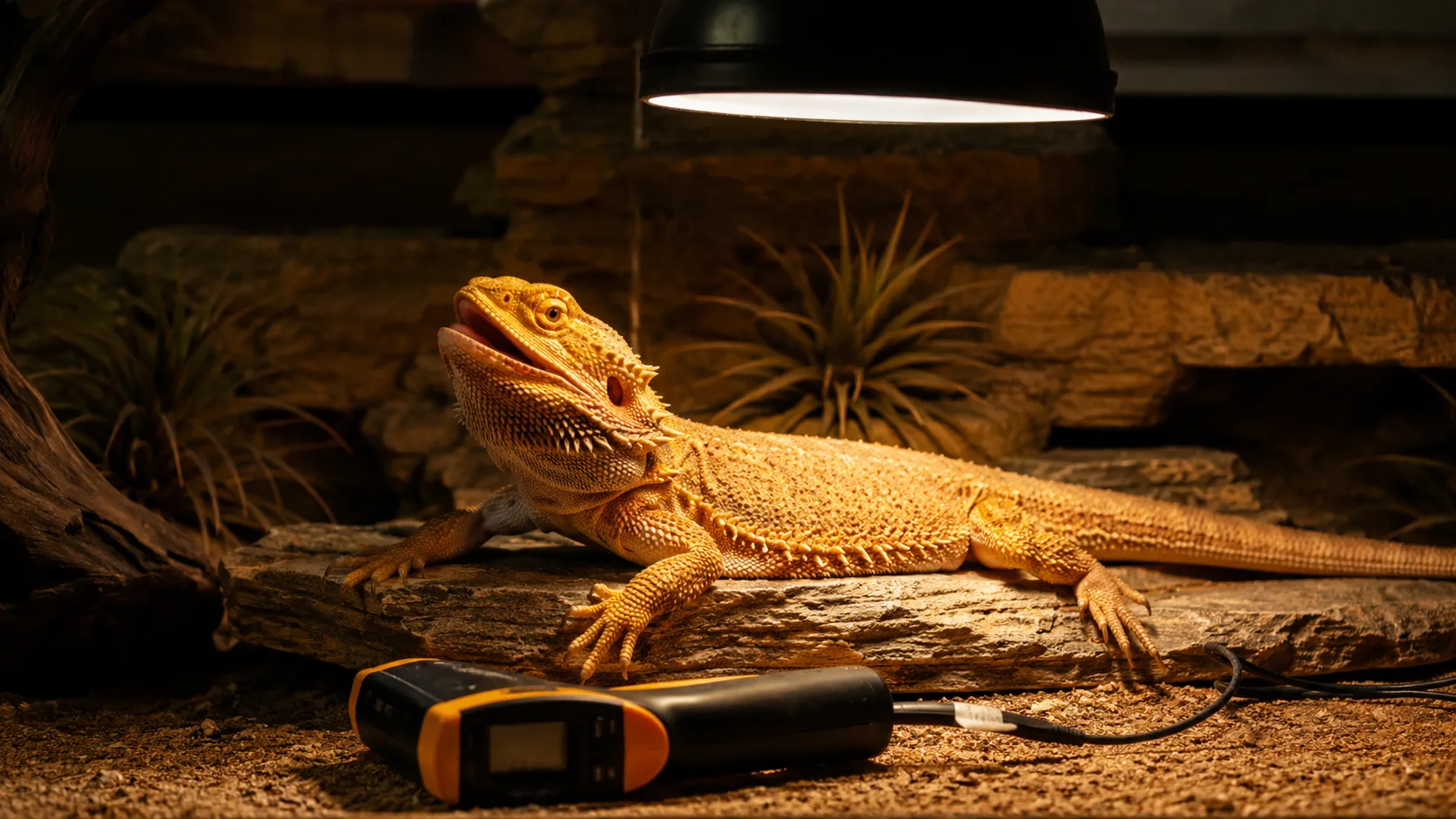
What temperature does a bearded dragon need?
Short answer
Adults need a basking surface of 40–43 °C (104–110 °F), an ambient cool side of 24–27 °C (75–80 °F) and a night-time drop to 18–22 °C (65–72 °F) with all heat off. Hatchlings bask hotter, 43–46 °C (110–115 °F). Measure the basking surface with an infrared temperature gun, never a stick-on dial.
- Author
- Reptimo Editorial
- Updated
- Updated
- Reading time
- 4 min read
What temperatures does a bearded dragon need?
Bearded dragons are open-sun-baskers from the arid Australian interior, and their bodies are tuned to a sharp thermal gradient. They need a very hot basking surface for digestion and a much cooler retreat for sleep and thermoregulation. The numbers below come from ReptiFiles' temperature explainer and consistent guidance across PetMD's care sheet. Hit all three zones — basking surface, ambient cool side and night drop — and you've removed the single biggest cause of slow growth, refused meals, and chronic stress in captive bearded dragons.
Care parameters
Bearded dragon temperature targets
| Parameter | Recommended value | Notes |
|---|---|---|
| Basking surface (adult) | 40–43 °C / 104–110 °F | Measured with IR gun on the basking spot |
| Basking surface (hatchling) | 43–46 °C / 110–115 °F | Hotter to fuel fast growth |
| Cool side air | 24–27 °C / 75–80 °F | |
| Night-time (whole tank) | 18–22 °C / 65–72 °F | All heat and lights off |
| Hard floor max | ≤ 46 °C / 115 °F | Above this, dragon stops basking; risk of burns |
How to measure temperature correctly
The single most common reason keepers think their setup is fine when it isn't: relying on a stick-on dial thermometer on the side of the tank. Air temperature at glass height is essentially uncorrelated with the basking surface a few centimetres under a halogen flood.
Use these instead:
- Infrared (IR) temperature gun — point at the basking surface the dragon actually lies on. This is the meaningful reading. A cheap IR gun in the 0–60 °C range works; no need for a Solarmeter for temperature (Solarmeter 6.5 is for UV Index — see the UVB guide).
- Digital probe thermometer with the sensor taped to the basking surface gives you a continuous readout for the thermostat.
- Cool-side probe confirms the gradient — air at the cool end should hover at 24–27 °C while the dragon basks.
What heat source to use
A halogen flood bulb on a dimming or pulse-proportional thermostat is the modern standard, per Zen Habitats' lighting guide. Wattage depends on enclosure size and how far the dragon basks from the bulb — most 4 × 2 × 2 ft enclosures land somewhere between 50 W and 100 W. Dial the thermostat setpoint until the surface reads in the 40–43 °C band with an IR gun.
What to skip for adult bearded dragons:
- Heat mats — bearded dragons thermoregulate top-down via basking, not belly heat. A mat under the cool side does nothing useful and a mat under the basking spot is redundant with the bulb above.
- Coloured "night-glo" bulbs — red, blue and "moonlight" bulbs disrupt sleep and don't provide useful heat.
- Heat rocks — chronic burn risk; never appropriate.
Night temperatures
Bearded dragons need a real night. In their native range, inland Australia drops 15 °C or more overnight, and that drop is part of how they regulate sleep, hormones and seasonal behaviour. In a heated room, turning everything off after the 12-hour photoperiod gets you to 18–22 °C (65–72 °F) on its own — exactly right.
The exception is a room that genuinely drops below 15 °C (60 °F) — a poorly-heated outbuilding or winter in an unheated room. In that case add a low-wattage ceramic heat emitter on its own thermostat, set to kick in only at the floor temperature, so the cycle is preserved without disturbing the dragon with light. Detail on the broader hatchling-vs-adult difference is in the pillar care guide.
What goes wrong — and how to fix it
Most temperature-driven problems trace to one of three patterns. Compare against the symptoms in the cross-species warning-signs checklist; for food refusal specifically, see the bearded-dragon not-eating guide.
- Basking surface too cool (< 38 °C / 100 °F): sluggish digestion, food sits in the gut, dragon stops eating, weight slowly drops. Often caused by a too-weak bulb, a tube further than ~30 cm from the basking spot, or a thermostat probe in the wrong place. Re-measure with an IR gun and raise the setpoint.
- Basking surface too hot (> 46 °C / 115 °F): dragon abandons the basking spot, hides on the cool side, may pant with open mouth. Surfaces above 50 °C cause burns from direct contact. Lower the thermostat or move the bulb further away.
- Ambient too warm with no cool retreat: dragon has nowhere to thermoregulate, stress builds, glass surfing, refused meals. Drop the basking bulb wattage or stop a secondary heat source. The cool side should always read at least 5–10 °C below the basking surface.
Frequently asked questions
What basking temperature does a bearded dragon need?
What ambient temperature should a bearded dragon tank be?
Do bearded dragons need heat at night?
What's the best thermostat for a bearded dragon?
How do I measure the basking temperature correctly?
What happens if a bearded dragon is too cold?
What happens if a bearded dragon is too hot?
Do I need different temperatures for a baby vs adult bearded dragon?
How long does it take for a bearded dragon to warm up before eating?
Sources
- Bearded Dragon Temperatures & UVB · ReptiFiles
- Bearded Dragon Complete Lighting & Heating Guide · Zen Habitats
- Bearded Dragon Care Sheet · PetMD
Quick check
Test what you just learned
A short quiz, just for you. Pick an answer to get instant feedback — there's no pass mark, this is for your benefit.
Quiz questions and answers
What basking surface temperature does an ADULT bearded dragon need?
Correct answer: 40–43 °C (104–110 °F)
Adults bask at 40–43 °C (104–110 °F) — measured on the actual surface, not the air. Hatchlings need slightly hotter (43–46 °C). Below 38 °C, digestion is sluggish; above 46 °C the dragon retreats permanently.
What's the correct night-time strategy?
Correct answer: All heat and light off; only add a ceramic emitter if the room drops below 15 °C (60 °F)
Bearded dragons need a real night with a temperature drop. Red bulbs disturb sleep and add no useful heat. A normal heated home stays warm enough overnight; only escalate to a ceramic emitter if the room itself is very cold.
Where should you measure the basking temperature?
Correct answer: On the actual basking surface, with an infrared temperature gun
Surface temperature on the spot the dragon lies on is what matters — and it's typically 5–10 °C hotter than the air above it. An infrared (IR) temperature gun is the standard tool; stick-on dial thermometers read room air and lie about basking.