How big should a bearded dragon tank be?
Short answer
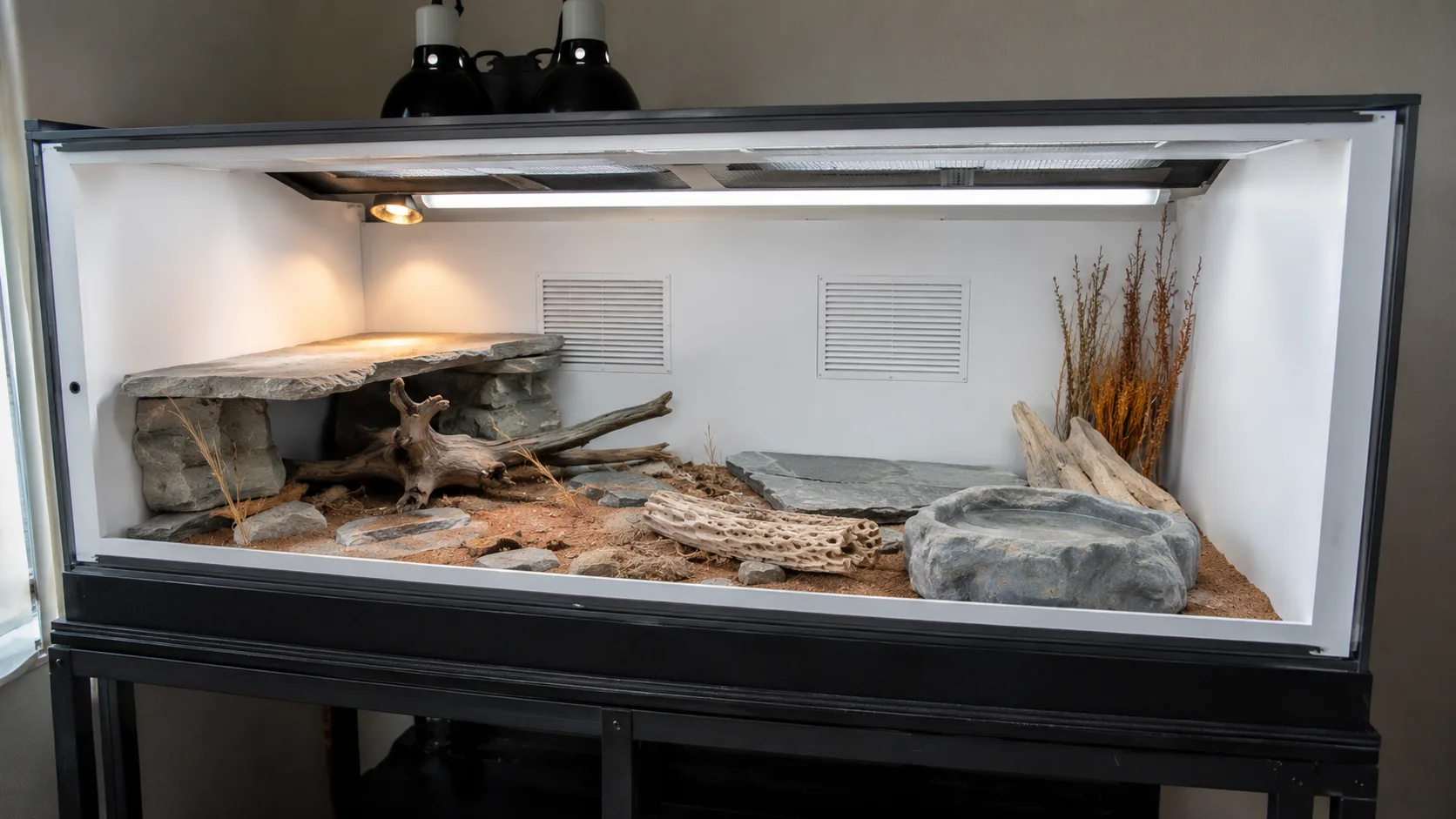
Adult bearded dragons need at least 120 × 60 × 60 cm (4 × 2 × 2 ft) of floor space, with 150 × 60 × 60 cm (5 × 2 × 2 ft) the modern welfare standard. Hatchlings can start in 90 × 45 × 45 cm for the first 4–6 months. The 20-gallon and 40-gallon recommendations on pet-store kits are outdated and undersized.
- Author
- Reptimo Editorial
- Updated
- Updated
- Reading time
- 6 min read
Adult minimum and modern standard
Bearded dragons (Pogona vitticeps) reach 45–55 cm head-to-tail in their first year and are active, patrolling, basking lizards. Per modern welfare-focused care literature including ReptiFiles and Zen Habitats' lighting guide, the adult enclosure standards are:
Care parameters
Bearded dragon enclosure size by life stage
| Parameter | Recommended value | Notes |
|---|---|---|
| Hatchling (0–4 months) | 90 × 45 × 45 cm intermediate OR adult enclosure with dense clutter | Both work |
| Juvenile (4–9 months) | Adult enclosure with continued clutter as confidence grows | |
| Adult (12+ months) | 120 × 60 × 60 cm (4 × 2 × 2 ft) MINIMUM | 150 × 60 × 60 cm strongly preferred |
| Adult, gold standard | 180 × 60 × 60 cm or outdoor enclosure | Multiple climbing platforms |
Why bigger matters
Three concrete benefits of a properly sized enclosure:
1. Real thermal gradient. The whole point of separating basking from cool side is the dragon's ability to thermoregulate by moving between them. In a 4 × 2 × 2 ft enclosure with a 100 W basking lamp on one end, the cool end naturally sits 15+ °C lower than the basking surface. In a 40-gallon breeder, that same gradient is impossible — the cool end gets too hot.
2. Real exploration space. Bearded dragons in larger enclosures display more natural behaviour: patrolling, climbing, basking-then- retreating cycles. The "lazy dragon" myth comes from observing dragons in tanks too small to display these behaviours.
3. Multiple territories within one enclosure. A 5-foot enclosure fits a hot basking ledge, a cool hide, a humid hide for sheds, a water dish on the cool side, climbing branches, and ground cover — all without crowding. The dragon chooses its location moment-to- moment.
Hatchlings: options
Two equally valid approaches:
Approach 1 — Intermediate enclosure for the first few months. A 90 × 45 × 45 cm (3 × 1.5 × 1.5 ft) enclosure for the first 4–6 months. The smaller space helps a shy hatchling feel secure and locate food easily. Upgrade to 4 × 2 × 2 ft by 6–9 months. The intermediate enclosure becomes a quarantine / hospital tank later.
Approach 2 — Adult enclosure from day one, densely furnished. A 4 × 2 × 2 ft enclosure works for a hatchling if you provide:
- 2–3 hides distributed around the enclosure.
- Cork bark slabs leaning against walls (gives vertical perch options + visual barriers).
- Silk or live plants for cover.
- A floor pattern that prevents the hatchling crossing more than ~30 cm of open space at a time.
- A feeding dish in a consistent location so the hatchling learns where food appears.
Approach 2 saves the cost of two enclosures over the dragon's lifetime; Approach 1 is gentler for very shy individuals.
PVC vs glass
Care parameters
Bearded dragon enclosure material comparison
| Parameter | Recommended value | Notes |
|---|---|---|
| PVC (Zen Habitats, Custom Cages, Animal Plastics) | RECOMMENDED | Holds heat, opaque sides feel secure, internal UVB mounting easy, correct sizes off-the-shelf |
| Sealed wood (Vivexotic Repti-Home, similar) | RECOMMENDED | Similar to PVC; check seam sealing |
| Glass terrarium (Exo Terra, Zoo Med) | OK if modified | Loses heat fast; needs higher-wattage bulbs; wrap 3 sides with vinyl for security |
| Glass aquarium with mesh top | Limited use | Originally designed for fish; heat escape and security issues; only use small sizes for juveniles |
| DIY plywood / melamine enclosure | Excellent if well-built | Same benefits as PVC; tougher build |
The standard recommendation for modern bearded dragon keeping is a PVC enclosure in the 4 × 2 × 2 ft size. Sealed wood enclosures (Vivexotic Repti-Home style) work similarly. Glass terrariums work but typically require:
- Vinyl wrap or backing on three sides to give visual security.
- Higher-wattage basking bulb to compensate for heat loss.
- Careful UVB mounting (glass tops block UVB, so the tube must be inside the enclosure under the mesh, not above the glass).
Height and verticality
60 cm (24 in) of height is the standard for a 4-foot enclosure. Bearded dragons benefit from:
- A raised basking platform (slate ledge, cork shelf, branches).
- A secondary climbing branch they can ascend if they want.
- A clear sight line across the enclosure.
Don't go higher than 75 cm — thermal layering becomes problematic (the warm air rises and the floor stays cool), and the dragon spends most time on the ground anyway. Bearded dragons are predominantly terrestrial despite the climbing they enjoy.
Never co-house
Bearded dragons are solitary in the wild and should be housed individually in captivity. Per PetMD and consistent guidance across modern care literature:
- Even apparently calm pairs typically have a dominance dynamic with one dragon quietly losing weight while the dominant one thrives.
- Same-sex males ALWAYS fight, often to severe injury or death.
- Mixed-sex pairs result in unwanted breeding (females produce infertile eggs alone too — reproductive risk).
- Two enclosures cost slightly more upfront and dramatically less in veterinary bills.
If you want multiple bearded dragons, get multiple enclosures.
Outdoor enclosures
In climates with stable warm-season temperatures (25–35 °C during the day), an outdoor enclosure is the gold standard:
- Direct unfiltered sun is the best UVB source available — no bulb matches it.
- Natural temperature gradient with shaded retreats.
- Real day/night cycle without artificial photoperiod.
- Behavioural enrichment beyond what any indoor enclosure provides.
Requirements:
- Predator-proof: top mesh, secure latches, no gaps a cat / hawk / raccoon can exploit.
- Escape-proof: bearded dragons climb wire mesh.
- Reliable shaded retreat from peak sun (avoid heat stroke).
- Stable temperatures — bring the dragon indoors when night drops below 15 °C (60 °F) for sustained periods.
For the full enclosure setup (substrate, hides, water, décor) see the tank setup checklist. For the heating and UVB system that the enclosure houses, see temperature and UVB. The broader husbandry baseline is in the pillar care guide.
Frequently asked questions
What size tank does an ADULT bearded dragon need?
Is a 40-gallon breeder tank big enough?
Can a baby bearded dragon live in an adult-sized tank?
What size tank for a hatchling bearded dragon?
How tall does a bearded dragon enclosure need to be?
What's the difference between PVC and glass tanks?
Why are bigger enclosures better?
Can I keep two bearded dragons together?
Outdoor enclosures for bearded dragons?
Sources
- Bearded Dragon Care Sheet · PetMD
- Bearded Dragon Care Guide · ReptiFiles
- Bearded Dragon Enclosure Setup · Zen Habitats
Quick check
Test what you just learned
A short quiz, just for you. Pick an answer to get instant feedback — there's no pass mark, this is for your benefit.
Quiz questions and answers
What's the modern minimum enclosure for an adult bearded dragon?
Correct answer: 120 × 60 × 60 cm (4 × 2 × 2 ft)
120 × 60 × 60 cm (4 × 2 × 2 ft) is the modern welfare minimum, with 150 × 60 × 60 cm (5 × 2 × 2 ft) preferred. The 40-gallon breeder is outdated and undersized for adults.
Can a hatchling bearded dragon live in a 4-foot enclosure?
Correct answer: Yes if densely furnished with hides, plants and visual cover
A well-furnished adult enclosure works fine for a hatchling. The 'baby stresses in large tank' problem is really 'baby stresses in BARE large tank'. Add multiple hides, cork bark, silk plants and visual barriers and the hatchling thrives.
Why are PVC enclosures generally preferred over glass for bearded dragons?
Correct answer: Better heat retention, easier to mount UVB inside, opaque sides feel secure, available in correct adult sizes
PVC enclosures hold heat better (lower bulb wattage needed), mount UVB internally without glass barriers, are opaque on three sides (security), and ship in the correct adult sizes. Glass tanks work but require modifications.
Can you keep two bearded dragons in the same enclosure?
Correct answer: No — bearded dragons are solitary and co-housing causes bullying, suppressed feeding, fighting
Bearded dragons are solitary. Co-housing causes dominance bullying (one dragon quietly losing weight), food competition, occasional fighting, and chronic stress. House individually, always.