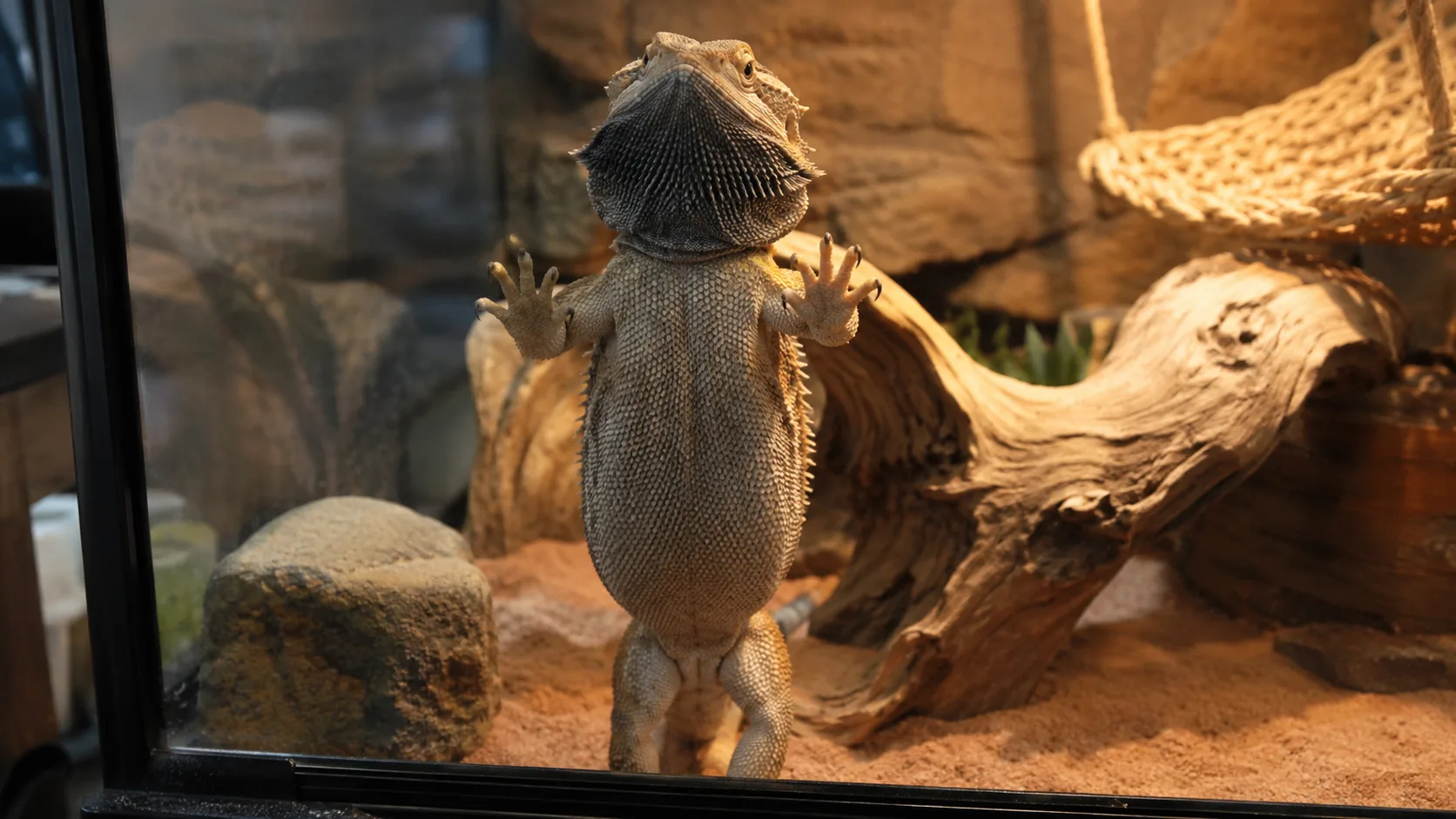
Why is my bearded dragon's beard black or why is it glass surfing?
Short answer
A black beard signals stress, discomfort, illness, brumation, or occasional sun-warming after rapid temperature change. Glass surfing (frantic scratching at the glass) usually means the enclosure is too small, the dragon sees its reflection, or temperature/lighting is wrong. Both behaviours are messages to investigate husbandry — not things to ignore or "punish."
- Author
- Reptimo Editorial
- Updated
- Updated
- Reading time
- 6 min read
What a black beard actually means
A bearded dragon's gular pouch ("beard") can darken from light tan to deep black within seconds. It's a communication signal — context-dependent and not inherently bad. The ReptiFiles bearded dragon behaviour guide catalogues seven common triggers:
Care parameters
Black beard — common triggers
| Parameter | Recommended value | Notes |
|---|---|---|
| Stress or discomfort | New environment, new pets, sudden noise, handling | |
| Defensive display | Beard + open mouth + body flattening — warning posture | |
| Mating display (males) | Combined with head bobbing during breeding season | |
| Warming after rapid cooling | Black absorbs heat faster — physical, benign | |
| Brumation prep / coming out | Often combined with reduced appetite, less activity | |
| Illness or discomfort | Persistent unexplained blackening — investigate | |
| Hormonal pressure | Especially adult males during spring |
Brief blackening during basking, while waking up, after a cool night, or during a clear stress event is normal communication. The concerning pattern is persistent blackening at random times, especially combined with other warning signs.
When black beard is benign
Common situations where you don't need to act:
- Dragon basks with darkened beard, then beard lightens after warming — normal physical thermoregulation.
- Male bobs head and shows dark beard during spring — breeding behaviour.
- Dragon briefly shows dark beard at a sudden noise, then settles — normal stress response.
- Beard darkens after handling, lightens within minutes back in enclosure — handling stress recovery.
When black beard is worth investigating
Patterns that warrant checking husbandry:
- Persistent dark beard at random times with no obvious trigger.
- Black beard plus reduced appetite over multiple days.
- Black beard plus lethargy or reduced basking.
- Black beard plus weight loss on the chart.
- Black beard plus other warning signs (sunken eyes, abnormal droppings, tremors).
Investigate temperature, UVB, humidity, recent environmental changes, and any visible health signs. See bearded dragon not eating for the broader symptom-cluster framework.
Why bearded dragons glass surf
Glass surfing — frantic scratching at the glass on hind legs — is a stress behaviour. Almost always means something in the environment isn't working. The most common causes, in order:
Care parameters
Glass surfing — common causes
| Parameter | Recommended value | Notes |
|---|---|---|
| Under-sized enclosure | Adults need ≥ 120 gallons / 4×2×2 ft | |
| Seeing own reflection | Especially front glass, dim background | |
| Wrong temperature or UVI | Too hot, too cold, or UVI outside species range | |
| No visual cover inside | Open enclosure = constant feeling of exposure | |
| Neighbouring pet visible | Other dragons, cats, dogs creating sightlines | |
| Brand-new environment | Recent rehoming, recent change | |
| Hormonal pressure (mature) | Sexually mature males in spring | |
| Basking-time impatience | Wants lights on / food now |
A healthy adult bearded dragon in a correctly-sized, well-furnished enclosure with appropriate temperature and visual cover rarely glass surfs. Sustained surfing is information.
The undersized enclosure case
PetMD's bearded dragon care sheet and modern care across sites converge: adult bearded dragons need at least 120 gallons or 4×2×2 ft of horizontal space. Many keepers leave dragons in 40-gallon juvenile tanks well past adulthood. The behavioural signs include:
- Chronic glass surfing, especially in afternoons.
- Restlessness, pacing along front glass.
- Frequent climbing on furniture.
- Reduced settling in any single hide.
- "Bored" appearance — the dragon is alert but with nothing useful to do.
The fix is the enclosure upgrade, not behavioural modification. See bearded dragon tank size for the full discussion.
The reflection problem
Front-glass enclosures with dark backgrounds turn into mirrors from inside. The dragon sees another dragon (itself) and either tries to get to it or away from it. Both manifest as glass surfing.
Quick test: hold a piece of paper outside the front glass behind the dragon. If surfing stops, you've confirmed reflection. The fix:
- Apply opaque background to the back of the enclosure (poster paper, contact paper, printed background).
- Add visual cover inside (plants, branches, cork bark) to break sightlines.
- Bright internal lighting helps — a well-lit enclosure interior reduces reflectivity of the glass from inside.
What to do about glass surfing
A structured response:
- Verify enclosure size. Adult dragons need ≥ 120 gallons / 4×2×2 ft. If under-sized, upgrade is the answer.
- Verify temperatures. IR gun on basking surface — 95–110 °F. Cool side 75–85 °F. UVI 4–6 at basking.
- Check for reflection. Cover back and sides of glass; add internal visual cover.
- Reduce stressors. Move enclosure away from other pets' sightlines, reduce noise, reduce handling for 1–2 weeks.
- Check for hormonal triggers. Mature males in spring may surf seasonally; lower seasonal handling stress.
- Log the behaviour. Time of day, duration, what stops it. Patterns surface in the log.
Most cases resolve once one or more underlying causes is fixed. Persistent surfing in a correctly-set-up enclosure is worth discussing with a reptile-experienced vet.
When these behaviours become a vet visit
Either black beard or glass surfing on its own rarely warrants a vet — the underlying causes are environmental. Vet visit if the behaviours combine with:
- Refused food past species norms.
- Weight loss on the chart.
- Lethargy outside seasonal patterns.
- Visible illness signs (sunken eyes, mucus, abnormal droppings).
- Tremors, twitching, or any neurological signs.
- Black beard persisting for days with no obvious trigger.
- Glass surfing in a verified-correct, large, well-furnished enclosure with no reflection issue.
For the broader warning-signs framework, see "is my reptile sick?".
Seasonal context
Both behaviours can have seasonal components:
- Brumation onset (Oct–March) — black beard plus reduced activity can be brumation preparation. See bearded dragon brumation.
- Spring breeding (March–May) — mature males show black beards, head-bob and glass-surf more during breeding season; usually resolves by late spring.
- Mid-summer — heat-stress can drive both behaviours if temperatures are excessive.
Log behaviour with date in your husbandry log; seasonal patterns emerge over a year.
The summary framing
Bearded dragons communicate constantly through colour, posture and behaviour. Black beard and glass surfing are two of the loudest signals — and almost always information about the environment, not the dragon itself. Read them, check husbandry, and the underlying cause is usually fixable.
For the broader care plan, see bearded dragon care guide. For the temperature side, see bearded dragon temperature.
Frequently asked questions
Why is my bearded dragon's beard black?
What is glass surfing in bearded dragons?
Is a black beard always bad?
Why does my bearded dragon glass surf in the morning?
Does glass surfing mean my bearded dragon's enclosure is too small?
Can stress cause a bearded dragon's beard to turn black?
Should I cover my bearded dragon's enclosure to stop glass surfing?
When does black beard or glass surfing become a vet visit?
Is glass surfing different from impaction or other illness signs?
Sources
- Bearded Dragon Body Language · ReptiFiles
- Bearded Dragon Care Sheet · PetMD
- How to Tell If Your Lizard Is Sick · PetMD
Quick check
Test what you just learned
A short quiz, just for you. Pick an answer to get instant feedback — there's no pass mark, this is for your benefit.
Quiz questions and answers
What does a bearded dragon's black beard usually mean?
Correct answer: A communication signal — most commonly stress, discomfort, brumation, mating display, or warming after rapid cooling
Black beard is communication, context-dependent. Brief blackening during basking or warming is benign. Persistent blackening at random times signals something to investigate — stress, discomfort, illness, brumation, mating. Read the context.
What's the most common single cause of chronic glass surfing in adult bearded dragons?
Correct answer: Under-sized enclosure — adults need at least 120 gallons / 4×2×2 ft, and many are kept in 40-gallon juvenile tanks too long
Under-sized enclosures are the dominant cause of chronic glass surfing in adults. Bearded dragons need at least 120 gallons / 4×2×2 ft for adults; many keepers leave them in juvenile tanks long after they need an upgrade. Other causes are reflection, wrong temperature/UVI, no visual cover.
Your bearded dragon is glass surfing but eating normally, weight is stable, husbandry is correct, and the enclosure is genuinely large. What's the right next step?
Correct answer: Add visual cover inside (plants, branches, hides), cover the back and sides of the glass to eliminate reflection, reduce handling for 1–2 weeks
Healthy dragon + correct husbandry + glass surfing = usually a reflection or visual-cover issue. Cover the back/sides of the glass, add plants and branches inside to break sightlines, reduce handling briefly. Most cases resolve. Vet visit is only needed if surfing combines with other warning signs.