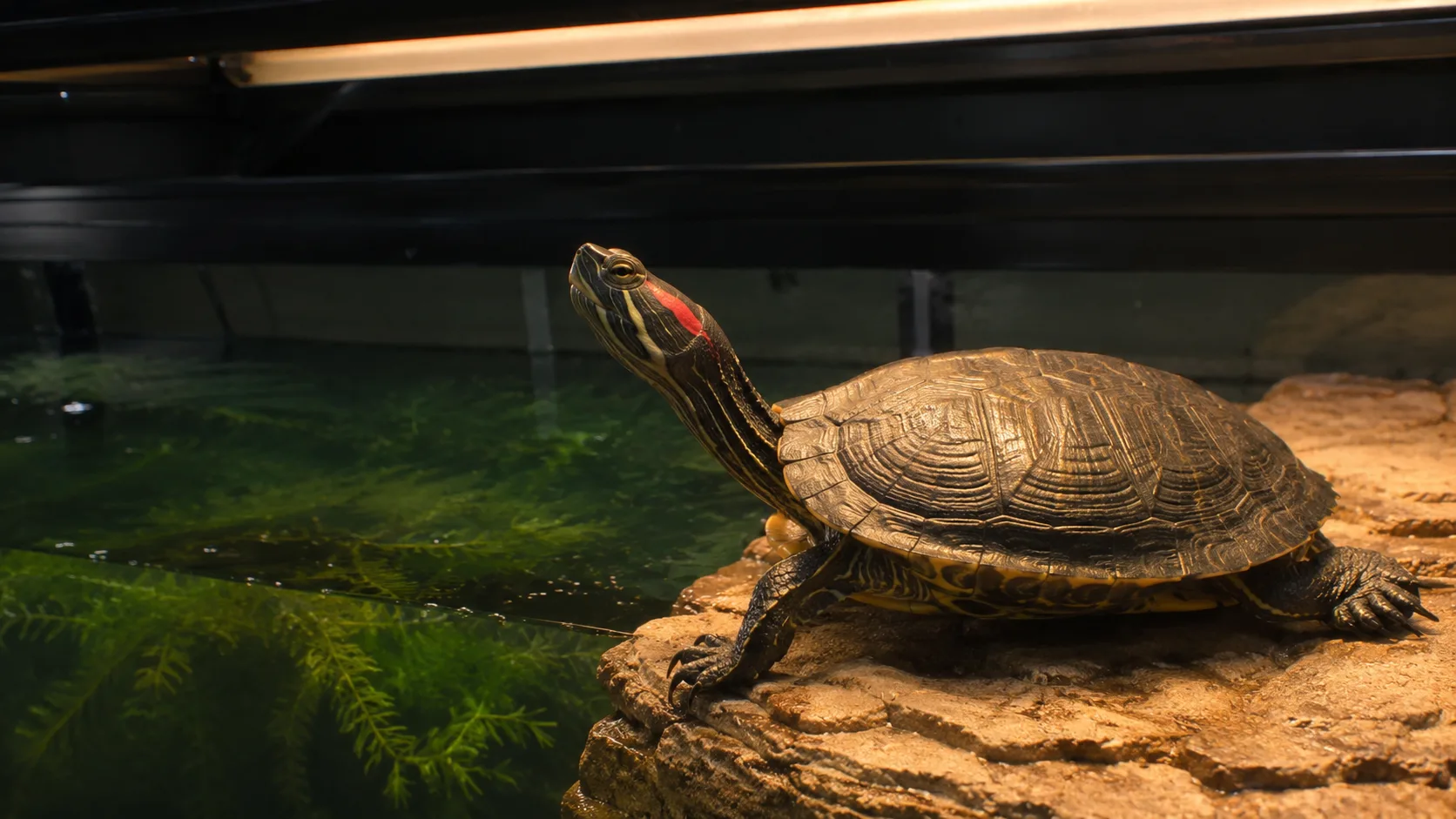
How do you care for a red-eared slider turtle?
Short answer
An adult red-eared slider needs at least 280 L (75 US gallons) of swimming water at 24–27 °C (75–80 °F), a dry basking platform with a surface of 32–35 °C (90–95 °F), strong UVB (UVI 3–4 at basking), powerful external filtration, a varied omnivorous diet that shifts toward greens with age, and an annual vet check for shell and weight.
- Author
- Reptimo Editorial
- Updated
- Updated
- Reading time
- 5 min read
What you're signing up for
Red-eared sliders (Trachemys scripta elegans) are semi-aquatic freshwater turtles native to the south-central US. They are the most commonly kept pet turtle worldwide — and the most commonly given up, released, or surrendered, because the cute hatchling sold in a 10-gallon kit grows into a 25-cm adult that needs 75+ US gallons of filtered swimming water for 20–40 years. This pillar guide assembles the modern welfare-focused baseline, drawing on PetMD's care sheet and The Bio Dude's care sheet.
Care parameters
Red-eared slider — care parameters at a glance
| Parameter | Recommended value | Notes |
|---|---|---|
| Adult tank (indoor) | ≥ 280 L / 75 US gal swimming water | 380 L / 100 US gal preferred |
| Adult size | ♀ 25–30 cm, ♂ 15–20 cm | Females larger |
| Water temperature | 24–27 °C / 75–80 °F | Hatchlings 26–28 °C |
| Basking surface | 32–35 °C / 90–95 °F | Fully dry platform |
| UVB | UVI 3–4 at basking | T5 HO tube, replace every 12 months |
| Filtration | 2–3× tank volume per hour | External canister; non-negotiable |
| Diet (adult) | ~70 % plants / 30 % protein | |
| Lifespan | 20–40 years (50+ documented) |
Enclosure and water volume
The standard guidance crossing care sheets:
- Hatchling (under 10 cm shell): 80 L (20 US gallons) minimum, with the understanding you're upgrading within months.
- Juvenile (10–15 cm): 150 L (40 US gallons).
- Adult female (25–30 cm): 280 L (75 US gallons) minimum, 380 L (100 US gallons) preferred.
- Adult male (15–20 cm): 200 L (55 US gallons) minimum.
Water depth should be at least 1.5× the shell length so the turtle can fully swim, with secure access to a dry basking platform. Outdoor ponds suit them best in mild climates — a 1,000 L garden pond with basking access and predator-proof cover beats any indoor tank.
Water temperature and filtration
Water at 24–27 °C (75–80 °F) year-round for adults; hatchlings slightly warmer at 26–28 °C. Use a fully-submersible aquarium heater inside a protective sleeve or guard — turtles will crack an unprotected glass heater eventually, and the resulting electrical fault is a real hazard. Two smaller heaters split across the tank are safer than one large one in case of failure.
Filtration is the single biggest welfare investment. Sliders are prolific waste producers; without strong external filtration the ammonia spike from a single skipped water change can crash a tank overnight.
- External canister filter rated for 2–3× the tank volume per hour. A 280 L tank wants a filter rated at 600–900 L/h actual flow.
- Combine mechanical media (sponge), biological media (ceramic rings, K1 media) and chemical media (activated carbon, refreshed monthly).
- 25–30 % water change weekly, full media rinse (in tank water, not tap water) monthly.
Basking and UVB
A dry basking platform under a halogen flood bulb and a linear T5 HO UVB tube is the standard setup:
- Basking surface 32–35 °C (90–95 °F) — measured with an infrared temperature gun on the platform, not the air above it.
- UVB: T5 HO tube giving UVI 3–4 at the basking surface, mounted inside the enclosure with no glass between bulb and turtle. Replace every 12 months — UV output drops invisibly long before visible light dims. See the cross-species UVB guide for the Ferguson zone framework and meter checks.
- Photoperiod: 12 hours on / 12 hours off, year-round, on a mechanical timer.
The basking spot has to be fully dry. Wet shells under heat lamps are a leading cause of shell rot — the turtle climbs out specifically to dry off, and a constantly damp platform defeats the purpose.
Diet by life stage
Sliders are omnivores whose diet inverts as they age. Per The Bio Dude's care sheet:
- Hatchling / juvenile (< 10 cm): ~70 % protein and 30 % plants. Quality commercial pellets (Mazuri, Zoo Med, Reptomin), F/T bloodworms, small earthworms, small feeder fish (no goldfish — thiamine destruction), with leafy greens always available even if initially ignored.
- Sub-adult (10–18 cm): transition toward 50/50 over several months.
- Adult (18 cm+): ~70 % plants (romaine, kale rotation, dandelion greens, duckweed, water lettuce, anacharis) and 30 % protein (commercial pellets 2–3× per week, occasional earthworms).
Feed in a separate container if possible — keeps the main tank cleaner. Don't feed iceberg lettuce (nutritionally empty), spinach (oxalates), or fatty cat/dog food. Whole-prey items (chicks, mice) are unnecessary and over-fatty for sliders.
Common problems
- Shell rot (white/grey fuzzy patches, soft spots, foul smell) — see the dedicated shell rot guide. YMYL — vet-reviewed treatment matters.
- Soft, pliable shell in a juvenile — metabolic bone disease, almost always wrong or expired UVB. Same-week vet appointment.
- Refusing to bask — basking lamps wrong temperature, UVB expired, or platform too wet. Re-check temperatures with an IR gun and the UVB tube install date.
- Lethargy + sunken eyes + bubbles at nostrils — respiratory infection, often a chronic water-temperature problem. Reptile vet.
The cross-species early-warning patterns are summarised in "is my reptile sick?".
Rehoming and the invasive species issue
Red-eared sliders are listed among the IUCN's 100 worst invasive species worldwide. Released pets outcompete native turtles, transmit ranavirus and other diseases, and rapidly establish self-sustaining wild populations across Europe, Asia and Australia. In many countries release is illegal.
If you can't keep a slider any longer:
- Contact a regional reptile rescue or turtle-specific rehoming network.
- Local herpetological societies often have foster lists.
- Some aquariums and licensed exotic facilities accept surrenders.
- Never release into the wild, regardless of how "wild" it looks.
If you're still deciding whether a slider is right for you, the best beginner pet reptile guide compares it honestly against lower-commitment options.
Frequently asked questions
How long do red-eared sliders live?
What size tank does a red-eared slider need?
What water temperature does a red-eared slider need?
What basking temperature should the dry area be?
Do red-eared sliders need UVB?
What do red-eared sliders eat?
Why is my red-eared slider's shell soft or peeling?
How often should I clean a red-eared slider tank?
Is it OK to release a red-eared slider into a local pond?
Sources
- Red-Eared Slider Care Sheet · PetMD
- Red Ear Slider Care and Maintenance · The Bio Dude
- Red-Eared Slider Shell Rot — Causes, Symptoms & Treatment · TurtleHolic
- Disorders and Diseases of Reptiles · Merck Veterinary Manual
Quick check
Test what you just learned
A short quiz, just for you. Pick an answer to get instant feedback — there's no pass mark, this is for your benefit.
Quiz questions and answers
What's the minimum swimming-water volume for an ADULT red-eared slider?
Correct answer: 280 L (75 US gallons), 380 L preferred
Adult sliders need at least 280 L (75 US gallons) of swimming water, with 380 L (100 US gallons) preferred — and outdoor ponds are even better in mild climates. The pet-store '10-gallon starter kit' is grossly undersized and the leading cause of stunting and shell deformities.
What basking surface temperature does a slider need?
Correct answer: 32–35 °C (90–95 °F)
Basking surface 32–35 °C (90–95 °F), measured with an infrared temperature gun on the platform. The basking spot must be fully dry. Cooler bask = wet incomplete basking; hotter = burns and avoidance.
What's the right adult diet ratio for a red-eared slider?
Correct answer: ~70 % plants (greens, duckweed), 30 % protein (pellets, occasional fish)
Diet inverts with age. Hatchlings are protein-heavy because they're growing; adults shift to plant-heavy. All-pellet or all-protein adult diets cause obesity, fatty liver and shell pyramiding.
Why must you never release a captive red-eared slider into a wild pond?
Correct answer: They're a documented invasive species (IUCN top-100 worst), often illegal, and devastating to native turtles
The IUCN lists red-eared sliders among the world's 100 worst invasive species. Released pets outcompete native turtles, spread disease, and crash ecosystems. Rehome through a reptile rescue, never release.