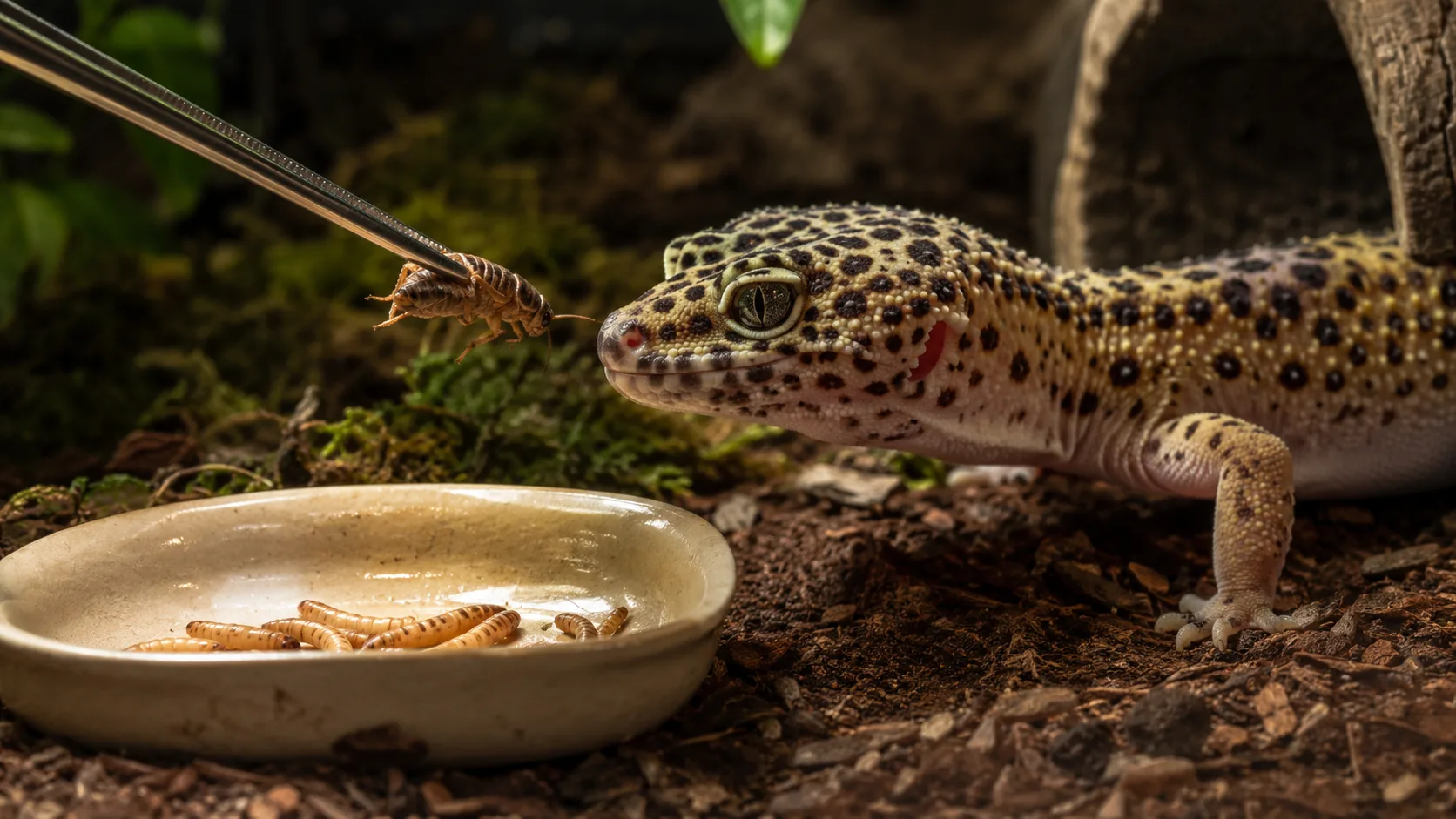
How often should I feed my leopard gecko?
Short answer
Hatchlings and juveniles under 6 months: 3–5 small insects daily. Sub-adults (6–12 months): 5–7 insects every other day. Adults: 6–10 appropriately sized insects 2–3 times per week. Always dust insects with calcium with vitamin D3 most feedings, and feed gut-loaded prey within 24 hours of buying.
- Author
- Reptimo Editorial
- Updated
- Updated
- Reading time
- 4 min read
How often by life stage
Leopard geckos (Eublepharis macularius) are obligate insectivores — they eat live invertebrates and nothing else. Feeding frequency drops sharply with age because hatchlings are building bone and fat reserves while adults conserve. Per PetMD's leopard gecko care sheet and consistent guidance from ReptiFiles' diet guide, the standard schedule looks like this:
Care parameters
Leopard gecko feeding schedule by life stage
| Parameter | Recommended value | Notes |
|---|---|---|
| Hatchling (0–4 months) | 3–5 small insects DAILY | Multiple short feedings if practical |
| Juvenile (4–6 months) | 4–6 small insects DAILY | |
| Sub-adult (6–12 months) | 5–7 insects EVERY OTHER DAY | Tail visibly fills out |
| Adult (12 months+) | 6–10 insects 2–3×/WEEK | |
| Calcium + D3 dust | 4–5 of 7 meals (juv) / 3 of 7 (adult) | |
| Multivitamin (Repashy Supervite or equivalent) | Every 2 weeks |
Which insects to feed
The modern staples in well-kept leopard gecko collections:
- Dubia roaches (Blaptica dubia) — high protein, easy calcium absorption, low fat, gut-load well, don't smell, can't climb glass, don't fly. The default if your local laws allow.
- Black soldier fly larvae (BSFL / "calciworms") — naturally high in calcium, soft body, accepted by most geckos, ship live easily.
Rotate in for variety, not as staples:
- Crickets — fine nutritionally but loud, smelly, escape and bite resting geckos at night. Remove uneaten ones within 15 minutes.
- Hornworms — water-rich and gut-loaded with carotenoids; good treats for an underweight or dehydrated gecko.
- Silkworms — soft, calcium-rich, expensive and short-lived once shipped.
Treats only, not staples:
- Mealworms / superworms — too fatty as staples and the hard chitin shell is harder to digest. A small dish for grazing is fine; don't build a diet around them.
- Wax worms — dessert. Geckos love them and refuse better food afterwards. Maximum once a week, 1–2 worms.
Sizing the prey
Rule of thumb across every reputable care sheet: a feeder insect should be no wider than the space between the gecko's eyes. Wider prey can choke or, more often, cause impaction (an undigested mass that blocks the gut). Smaller is always safer — a row of small insects is better than one large one. For a typical adult leopard gecko this works out to medium dubias (~1.5 cm), small to medium crickets, or ½-inch (12 mm) hornworms.
Gut-loading: the invisible feeding
The gecko gets whatever sits in the insect's digestive tract. Feed insects nutrient-dense food for 24–72 hours before offering them:
- Fresh greens (collard greens, dandelion greens, mustard greens).
- Diced squash, carrot, or sweet potato.
- A commercial dry gut-load such as Repashy Bug Burger, Zoo Med Cricket Crack, or Mazuri Better Bug Diet.
- Fresh water from a small sponge or gel cubes (never an open dish — insects drown).
Insects starved in a tub for three days are nutritionally hollow no matter what supplement you dust them with. The ReptiFiles diet guide explicitly flags gut-loading as the most under-rated feeding step.
Calcium, D3 and multivitamin schedule
Leopard geckos in the wild get most of their vitamin D3 from a small amount of low-level UVB exposure. In captivity, most setups skip UVB (though it's increasingly recommended at low UVI), which makes supplementation non-negotiable. Per the Merck Veterinary Manual, metabolic bone disease in captive leopard geckos is almost always a calcium / D3 deficiency.
- Calcium with vitamin D3 — dust insects with the powder immediately before feeding. Frequency: 4–5 of every 7 meals for hatchlings and juveniles; 3 of every 7 for adults.
- Plain calcium (no D3) — for occasional extra dustings beyond the D3 schedule; an open dish of plain calcium in the tank is harmless but mostly unnecessary if dusting is on schedule.
- Multivitamin (Repashy Supervite, Arcadia EarthPro-A, or equivalent) — once every 2 weeks for everyone. Covers vitamin A, E and trace minerals that calcium powder misses.
Skip generic "reptile vitamin" liquids; they don't survive insect gut-loading and overdose risk is higher.
When the gecko refuses food
A leopard gecko that suddenly stops eating is almost always an environmental signal, not a feeding problem. Check temperature first — the warm side must sit at 28–30 °C (82–86 °F) for digestion to work, see the temperature guide. Then check whether the gecko is mid-shed (cloudy eyes, dull skin), in seasonal slowdown (autumn through early spring), or recently rehomed (give two weeks of no handling).
The full diagnostic walkthrough is in the not-eating guide. For shedding-related appetite drops, see stuck-shed care. If temperatures and routine are right and the gecko is losing weight, that's a vet appointment, not a feeding tweak.
Frequently asked questions
How often do leopard geckos eat?
What's the best feeder insect for a leopard gecko?
How big should the feeder insects be?
Do leopard geckos need calcium and vitamin D3?
Why won't my leopard gecko eat?
Should I leave a dish of mealworms in the tank?
What should I gut-load feeder insects with?
Can leopard geckos eat fruit or vegetables?
How do I know if my leopard gecko is eating too much or too little?
Sources
- Leopard Gecko Care Sheet · PetMD
- Leopard Gecko Feeding & Diet · ReptiFiles
- Disorders and Diseases of Reptiles · Merck Veterinary Manual
Quick check
Test what you just learned
A short quiz, just for you. Pick an answer to get instant feedback — there's no pass mark, this is for your benefit.
Quiz questions and answers
How often should a HEALTHY ADULT leopard gecko eat?
Correct answer: 6–10 insects 2–3 times per week
Adults: 6–10 appropriately sized insects 2–3 times per week. Daily feeding causes obesity and fatty liver. Hatchlings and juveniles eat much more often because they're growing fast.
Which is the safest staple feeder insect?
Correct answer: Dubia roaches or black soldier fly larvae
Dubia roaches and black soldier fly larvae are the modern staples — high protein, easy to gut-load, low fat, easy calcium absorption. Mealworms are OK as occasional treats but too fatty/hard as staples. Wax worms are dessert, not food.
How do you make sure your gecko gets enough calcium?
Correct answer: Dust the insects with calcium-with-D3 powder at most feedings
Dust the insect itself with a calcium-with-D3 powder right before feeding — 3–5 of every 7 meals depending on life stage. Insects ingest it, the gecko ingests the insect. Loose powder in the tank or water doesn't work.