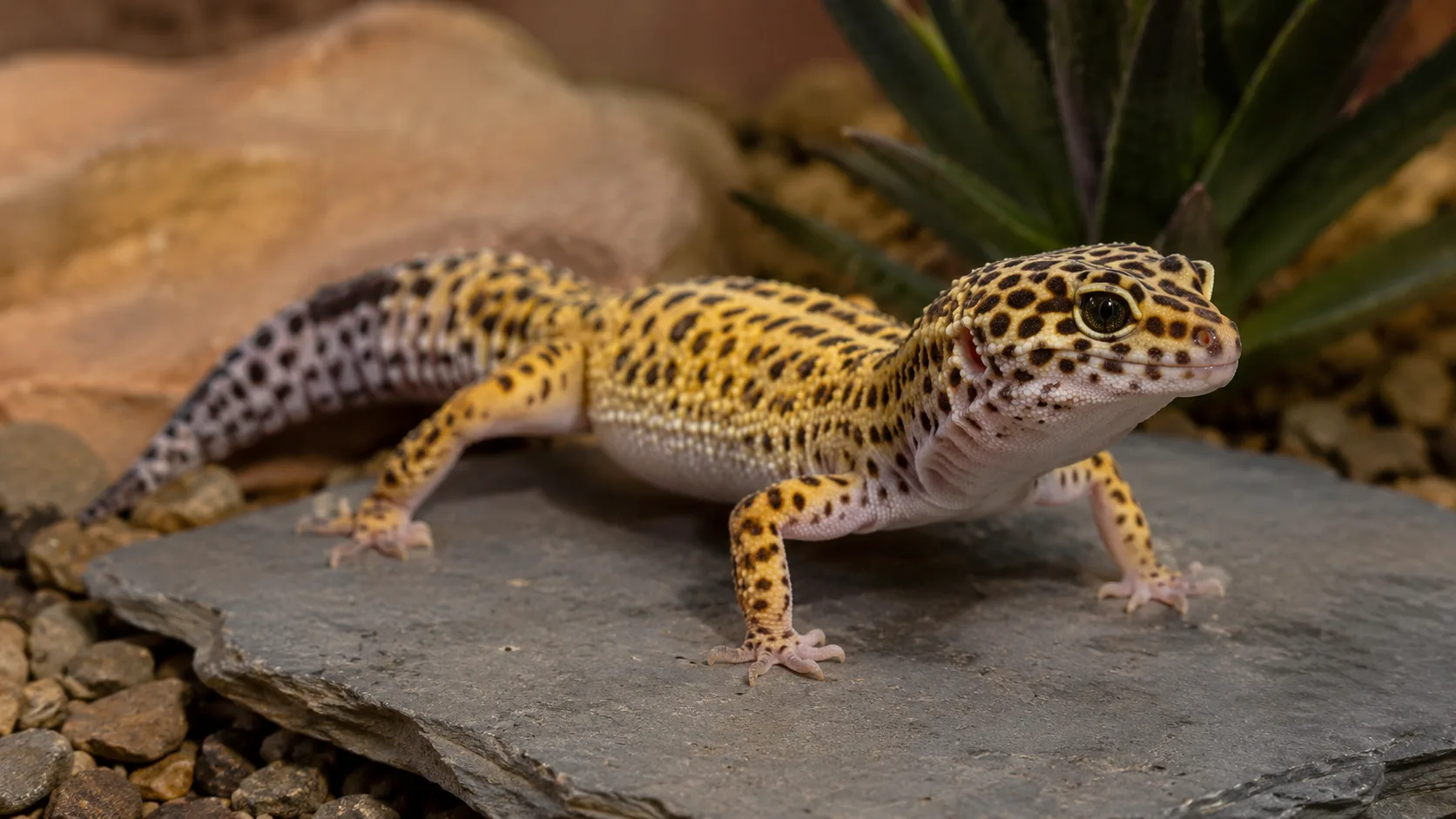
How do I take care of a leopard gecko?
Short answer
Leopard geckos need a 90 × 45 × 45 cm (3 × 1.5 × 1.5 ft) front-opening enclosure, a warm side of 28–30 °C (82–86 °F) with a heat mat on a thermostat, a cool side of 22–24 °C (72–75 °F), three hides (warm, cool, humid), a low-output UVB tube on a 12-hour cycle, and a varied insect diet dusted with calcium and vitamin D3. They live 15–20 years.
- Author
- Reptimo Editorial
- Updated
- Updated
- Reading time
- 7 min read
What you're signing up for
Leopard geckos (Eublepharis macularius) are crepuscular, ground-dwelling desert lizards from Afghanistan, Pakistan and north-west India. In captivity they're one of the most popular beginner reptiles for good reasons — they stay manageable in size (adults 18–25 cm / 7–10 in), tolerate handling, eat commonly-available feeder insects, and the husbandry parameters are simple enough to hit reliably once you understand the underlying logic.
The catch is the lifespan. A well-kept leopard gecko routinely lives 15–20 years, with documented cases past 25. This guide walks the full husbandry stack a new keeper needs; each major topic has its own dedicated spoke article you can drill into.
Care parameters
Leopard gecko — quick reference parameters
| Parameter | Recommended value | Notes |
|---|---|---|
| Adult size | 18–25 cm / 7–10 in | Snout to tail tip |
| Lifespan | 15–20 years | Up to 25+ in optimal care |
| Enclosure (adult) | 90 × 45 × 45 cm / 3 × 1.5 × 1.5 ft | Minimum; bigger is better |
| Warm side | 28–30 °C / 82–86 °F | |
| Cool side | 22–24 °C / 72–75 °F | |
| Humidity (ambient) | 30–40 % | Humid hide at 70–80 % |
| Diet | Insectivore | Crickets, roaches, mealworms; dusted with Ca+D3 |
| Feeding (adult) | Every 2–3 days | 5–7 insects per meal |
| Photoperiod | 12 h on / 12 h off |
Enclosure
An adult leopard gecko needs at least a 90 × 45 × 45 cm (3 × 1.5 × 1.5 ft) front-opening enclosure. The older "10-gallon glass tank" recommendation is outdated — modern care guides including ReptiFiles' complete guide and Zen Habitats' care Q&A both recommend more space because leopard geckos actively patrol horizontal floor space when given the room.
Glass aquariums work but lose heat fast; PVC and wood enclosures hold heat and humidity gradients better. Front-opening enclosures reduce stress during routine maintenance — being grabbed from above triggers a predator response.
Heating
Two heat zones, plus optional basking surface:
- Warm side — 28–30 °C (82–86 °F) at the floor of the warm hide. Source is an under-tank heat mat on a thermostat with the probe taped to the warm-side surface.
- Cool side — 22–24 °C (72–75 °F). Usually achieved by ambient room temperature.
- Optional basking spot — a low-wattage halogen for a surface peak of 30–32 °C (86–90 °F) under a basking ledge. Adds a daytime cue and supports any UVB tube above.
The complete temperature setup, including night handling and what goes wrong, has its own article — see our leopard gecko temperature guide.
Lighting
Two lights matter:
- UVB tube (recommended) — a low-output linear tube such as Arcadia ShadeDweller (2.4 %) or Zoo Med ReptiSun 5.0 T5 HO, on a 12-hour on/off cycle. Mounted inside the enclosure without glass between bulb and gecko. Replace annually. Per modern care guidance, low-level UVB supports D3 synthesis and bone health even in crepuscular species, though calcium-with-D3 dusting is still required.
- Daytime visible light — a low-wattage LED bar or a basking lamp on the same 12-hour timer. Even without UVB, a visible light/dark cycle is what regulates the gecko's circadian rhythm.
Skip coloured "night-glo" bulbs (red, blue, purple). Modern care advice treats them as disruptive to nocturnal behaviour; an under-tank heater on a thermostat handles overnight heat without light.
Hides and furniture
Three hides, minimum:
- Warm hide — directly over the heat mat. The gecko spends most of the day here. Snug fit, dark inside.
- Cool hide — on the opposite end. Same snug fit.
- Humid hide — placed on the cool-to-warm boundary, filled with damp sphagnum moss. The dedicated shedding zone. Without it, stuck shed becomes near-certain — see our stuck shed treatment guide.
Add a shallow water dish on the cool side (refresh daily), some climbing décor (cork bark, low branches), and visual breaks (silk or live plants). A gecko with no cover paces the glass — that's stress, not exercise.
Substrate
Three workable options, none controversial when used correctly:
- Tile or slate — totally impaction-safe, easy to clean, holds heat well. Default recommendation for hatchlings and first-time keepers.
- Excavator clay — packed firm, can be sculpted into burrows. Adult geckos do well on it; risky for hatchlings.
- Bioactive desert mix — 60 % play sand + 40 % organic topsoil, lightly damp at the base, with springtails and isopods. Excellent for adults; not recommended for hatchlings under 12 months because they may ingest substrate with prey.
Avoid pure dry calci-sand, which is widely associated with impaction in juveniles, and reptile carpet that snags toes.
Feeding
Leopard geckos are strict insectivores. The staple feeders are crickets, dubia roaches and discoid roaches; mealworms and superworms work as secondary options; waxworms only as occasional treats (high fat → obesity and addiction). No fruit, no vegetables, no commercial pellets.
Care parameters
Leopard gecko — feeding cadence
| Parameter | Recommended value | Notes |
|---|---|---|
| Hatchlings (0–6 months) | Daily | 5–7 appropriate insects |
| Juveniles (6–12 months) | Every other day | 5–7 insects |
| Adults (12+ months) | Every 2–3 days | 5–7 insects |
| Insect size rule | No wider than the gap between the gecko's eyes | |
| Calcium + D3 dust | 2–3 feedings per week | |
| Multivitamin | Once per week | Light dust only |
Always gut-load insects for 24–48 hours before feeding (commercial gut-load, leafy greens, carrots). Crickets and roaches should be active and well-fed; mealworms straight from the deli cup are nutritionally near-empty.
Water
A shallow, heavy ceramic dish on the cool side, large enough for the gecko to sit in, refreshed daily. Most water uptake happens from prey and from the humid hide; the bowl is partly an ambient-humidity buffer. Don't let it dry out for more than a day.
Handling
Leopard geckos tolerate handling but don't seek it. Some rules:
- No handling for the first 1–2 weeks in a new home — let the gecko acclimate.
- No handling during a shed cycle — stress triggers tail drops.
- Never grab by the tail — it autotomises (drops) under threat and regrows in a smaller, irregular shape.
- Support the body from below — fingers under the belly, not over the back.
- Short sessions — 5–10 minutes, a few times a week is plenty.
If the gecko consistently tries to escape, give it more time and shorter sessions; don't push through.
Shedding
Healthy sheds happen every 4–8 weeks for adults, more often for growing juveniles. The signs: skin colour dulls, then turns pale and papery 12–24 hours before the shed peels off in large pieces — which the gecko usually eats. Provide a working humid hide; intervene only if pieces are stuck after 24 hours past completion. Full protocol in our stuck shed guide.
Signs of illness
Leopard geckos hide illness well. Watch for:
- Tail going thin (fat-store organ — early starvation indicator).
- Sustained appetite loss with husbandry verified correct.
- Stuck shed not resolving with a humid hide and warm soak.
- Lethargy, wobbling, weak grip.
- Sticky mucus around the mouth, audible breathing.
- "Stargazing" — twisting the head and neck upward.
- Sustained underweight, runny droppings, or blood in droppings.
For the full husbandry-first triage when a gecko stops eating, see our leopard gecko appetite-loss guide. For the broader vocabulary of warning signs across reptile species, see the Merck Veterinary Manual's reptile chapter.
What this guide doesn't cover
Breeding, morph genetics, group housing trade-offs and treating specific illnesses are beyond a beginner care guide. If you've got the basics from this article working comfortably for six months, those are the next topics to drill into.
For the next set of spokes covering temperature, feeding refusals and shedding problems specifically:
Frequently asked questions
Are leopard geckos good pets for beginners?
What size enclosure does a leopard gecko need?
Do leopard geckos need UVB?
How often should I feed my leopard gecko?
What do leopard geckos eat?
How long do leopard geckos live?
Can leopard geckos live together?
Do leopard geckos need handling?
What's the most common cause of leopard gecko illness?
Sources
- Leopard Gecko Care Sheet · PetMD
- The Ultimate Guide to Leopard Gecko Care · ReptiFiles
- Answering the Most Asked Leopard Gecko Questions · Zen Habitats
- Leopard Gecko Care Sheet · Reptiles Magazine
- Disorders and Diseases of Reptiles · Merck Veterinary Manual
Quick check
Test what you just learned
A short quiz, just for you. Pick an answer to get instant feedback — there's no pass mark, this is for your benefit.
Quiz questions and answers
What's the minimum enclosure size for an adult leopard gecko?
Correct answer: 90 × 45 × 45 cm (3 × 1.5 × 1.5 ft)
An adult leopard gecko needs at least 90 × 45 × 45 cm (3 × 1.5 × 1.5 ft). The older 10-gallon advice is now considered too small — proper thermal gradient, three hides and active floor exploration all need real floor space.
Which three hides should a leopard gecko always have?
Correct answer: Warm hide, cool hide, humid hide
Three hides solve three different problems: a warm hide for digestion, a cool hide for sleeping/temperature regulation, and a humid hide with damp sphagnum moss for shedding. Skip any of the three and you'll see appetite or shedding problems within months.
How often should an adult leopard gecko be fed?
Correct answer: Every 2–3 days, 5–7 appropriately-sized insects per meal
Adults thrive on every-2-to-3-days feeding with 5–7 appropriate insects. Daily feeding for an adult drives obesity, especially on mealworms; weekly feeding is too sparse and causes appetite issues. Calcium-with-D3 dust 2–3 feedings per week.