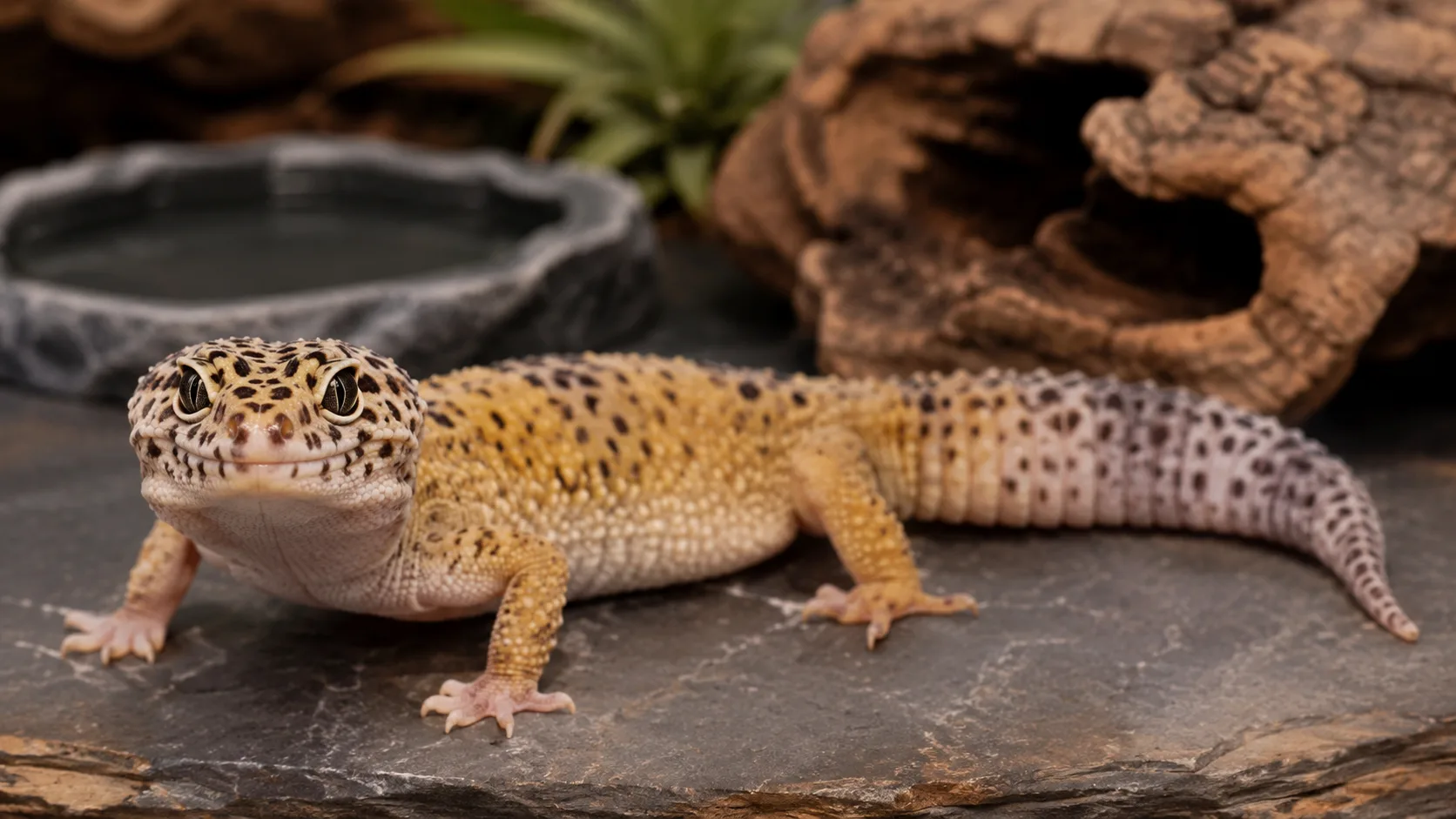
How long do leopard geckos live?
Short answer
In captivity with correct husbandry, leopard geckos live 15–20 years on average, with documented individuals reaching 27+ years. Wild leopard geckos live much shorter — 6–8 years — due to predation and resource pressure. Husbandry that supports a long captive life is correct temperatures (88–92 °F warm side), low-level UVB, vet-recommended supplementation, varied feeders and stable humidity.
- Author
- Reptimo Editorial
- Updated
- Updated
- Reading time
- 6 min read
Captive vs wild lifespan
Leopard geckos (Eublepharis macularius) are among the longest-lived common pet reptiles when kept correctly. The PetMD leopard gecko care sheet and the ReptiFiles leopard gecko care guide both put well-kept captive lifespan at 15–20 years, with documented individuals reaching 27+ years.
Wild leopard geckos live 6–8 years on average — limited by predation, parasite re-exposure, drought, resource competition and seasonal cold snaps. The captive doubling comes from removing those pressures: stable temperature, reliable food, no predators, no re-exposure to parasites, and access to vet care.
Care parameters
Leopard gecko lifespan benchmarks
| Parameter | Recommended value | Notes |
|---|---|---|
| Wild average | 6–8 years | |
| Captive average (good husbandry) | 15–20 years | |
| Captive top end (well-documented) | 25–28 years | |
| Cited record | 27 years 9 months (Ron Tremper male) | |
| Sexual maturity | 8–12 months | |
| Full adult size | 18–24 months |
The 15–20 year planning horizon is longer than many new keepers realise. A leopard gecko adopted in early adulthood by a 22-year-old is plausibly a pet through that keeper's mid-40s.
What shortens leopard gecko lives
The preventable causes of premature decline, in approximate order:
- Metabolic bone disease from chronic inadequate UVB and supplementation. Documented across the Merck Veterinary Manual as the most common preventable chronic illness in captive reptiles. See reptile MBD signs.
- Impaction from cool temperatures plus loose substrate. The husbandry combination, not substrate alone, is what causes most cases. See leopard gecko substrate.
- Parasite burden from wild-caught feeder insects or un-quarantined new geckos. Many older animals carry low-grade chronic parasite loads that compound over years.
- Chronic dehydration from missing humid hide, dry ambient humidity year-round, or no available drinking water.
- All-mealworm diets — high phosphorus, low calcium, hard chitin. Slow contributor to nutritional imbalance and MBD.
- Reproductive stress in females. Egg production depletes calcium; egg-binding (dystocia) is a real risk. Don't breed unless you specifically want to.
Acute deaths are different — usually trauma (escape, drop, cohab fight) or untreated illness that progressed past intervention.
What extends leopard gecko lives
The five practices that have the biggest impact on the long end of the range:
- Correct warm-side temperature (88–92 °F / 31–33 °C surface, verified with an IR gun). Cool warm sides cause cumulative digestive issues over years. See leopard gecko temperature.
- Low-level UVB plus calcium-with-D3 supplementation. Modern consensus has moved to recommending both, even for crepuscular geckos. See leopard gecko UVB.
- Varied feeders — dubia, crickets, BSF larvae, occasional waxworms. Not all-mealworm. Gut-load all feeders 24–48 hours before offering.
- Don't breed female geckos unless you specifically want to. Females kept solo live close to male averages.
- Weekly weighing. Catches trends early. A 5 % drop on the chart is a fixable husbandry problem; the same drop noticed visually a month later is often a vet visit.
Vet checks every 1–2 years catch slow problems before they're visible.
Life stages
Roughly how a captive leopard gecko's life maps out:
Care parameters
Leopard gecko life stages
| Parameter | Recommended value | Notes |
|---|---|---|
| Hatchling (0–4 months) | Daily feeding · paper towel substrate · fast growth · vulnerable | |
| Juvenile (4–12 months) | Daily-to-every-other-day feeding · 5×/week Ca+D3 dusting · still growing | |
| Subadult (1–2 years) | Every-other-day feeding · 3×/week Ca+D3 · approaching full size | |
| Adult (2–15 years) | Feeding every 2–3 days · 2–3×/week Ca+D3 · stable weight, stable routine | |
| Geriatric (15+ years) | Slower feeding, smaller meals · softer food if dental issues · more frequent vet checks |
The very long stable adulthood (years 2–15) is where most of the chronic-husbandry payoff happens — and where the cumulative effect of small care choices over years adds up to the gap between average and top-end lifespans.
Sex and lifespan
Males live slightly longer than females on average, almost entirely due to reproductive stress in females:
- Egg production depletes calcium and stresses the body.
- Egg-binding (dystocia) is a real and sometimes fatal risk in poorly-supplemented females.
- Females breed even without a male present (infertile eggs) when in good condition — the energetic cost still applies.
Females that don't breed live close to male averages. If you don't plan to breed, keep your female solo (which is best for leopard geckos generally — they're not social), maintain correct supplementation, and provide a moist laying area if she goes gravid with infertile eggs.
Morphs and lifespan
Most morphs have no lifespan implications. Two exceptions:
- Enigma morph — well-documented Enigma Syndrome, a neurological disorder presenting as circling, head tilt, balance issues and stargazing. Severely affected geckos have reduced quality of life; mild cases can live full lifespans.
- Lemon Frost morph — elevated rate of iridophoroma (skin tumours), often appearing in middle age. Some affected geckos live full lifespans with veterinary management; others develop metastatic disease.
Standard, blizzard, mack snow, tangerine, hypo, and most other common morphs have no known lifespan-affecting genetic issues.
Geriatric care (15+ years)
Older leopard geckos may need adjustments:
- Softer food — crushed or chopped insects if dental wear is apparent.
- Easier hides — shallower ramps, lower thresholds.
- More frequent shorter feedings instead of large meals.
- Supplemental hydration — offer warm baths weekly, mist humid hide more often.
- More frequent vet checks — annually or twice yearly.
- Reduced handling — sessions shorter and less frequent.
- Wider monitoring — log weight monthly minimum.
Geriatric decline is usually gradual — weight loss, slower feeding, reduced activity. The vet's role shifts to comfort and pain management.
Planning for a 15–20+ year commitment
The honest framing: a leopard gecko is a longer commitment than many beginners realise. A 22-year-old keeper plausibly cares for the same gecko into their mid-40s. Plan for:
- Long-term husbandry costs — fresh UVB tubes every 12 months, thermostat replacements every 5–7 years, supplement re-stocks every 6 months.
- Vet relationship — find a reptile-experienced vet early, before you need one. ARAV directory is the starting point.
- Travel arrangements — pet-sitter who knows reptiles, or a reliable boarding option.
- Life changes — moving, relationship changes, kids, career changes. Plan for how the gecko fits.
For the full care plan, see the leopard gecko care guide. For early warning signs of decline, see the skinny tail troubleshooting guide.
Frequently asked questions
What's the longest recorded leopard gecko lifespan?
Why do leopard geckos live longer in captivity than the wild?
Do male or female leopard geckos live longer?
How can I help my leopard gecko live longer?
What's the most common cause of premature death in captive leopard geckos?
Does morph affect lifespan?
How old does a leopard gecko need to be considered an adult?
What do leopard geckos die of in old age?
Is 10 years considered old for a leopard gecko?
Sources
- Leopard Gecko Care Sheet · PetMD
- Leopard Gecko Care Guide · ReptiFiles
- Disorders and Diseases of Reptiles · Merck Veterinary Manual
Quick check
Test what you just learned
A short quiz, just for you. Pick an answer to get instant feedback — there's no pass mark, this is for your benefit.
Quiz questions and answers
What's a realistic captive lifespan for a well-kept leopard gecko?
Correct answer: 15–20 years average, with documented individuals reaching 27+ years
Captive leopard geckos with correct husbandry live 15–20 years on average. The most-cited record is 27 years 9 months. Wild leopard geckos live only 6–8 years due to predation and resource pressure. Plan for a 15–20+ year commitment when adopting.
What's the single biggest preventable cause of premature death in captive leopard geckos?
Correct answer: Metabolic bone disease (MBD) from inadequate UVB and supplementation
MBD is the dominant preventable cause of early decline in captive leopard geckos — chronic inadequate UVB or supplementation, often combined with high-phosphorus diet. The preventive habits (low-level UVB, calcium-with-D3 dusting, varied feeders) are cheap and the difference in outcome is years.
Why do female leopard geckos typically live slightly shorter than males?
Correct answer: Reproductive stress (egg production, risk of egg-binding) shortens lifespan; non-breeding females live closer to male averages
Egg production depletes calcium and stresses the body; egg-binding (dystocia) is a real risk. Females kept solo and not bred live close to male lifespans. The welfare implication: don't breed your female unless you specifically want to.