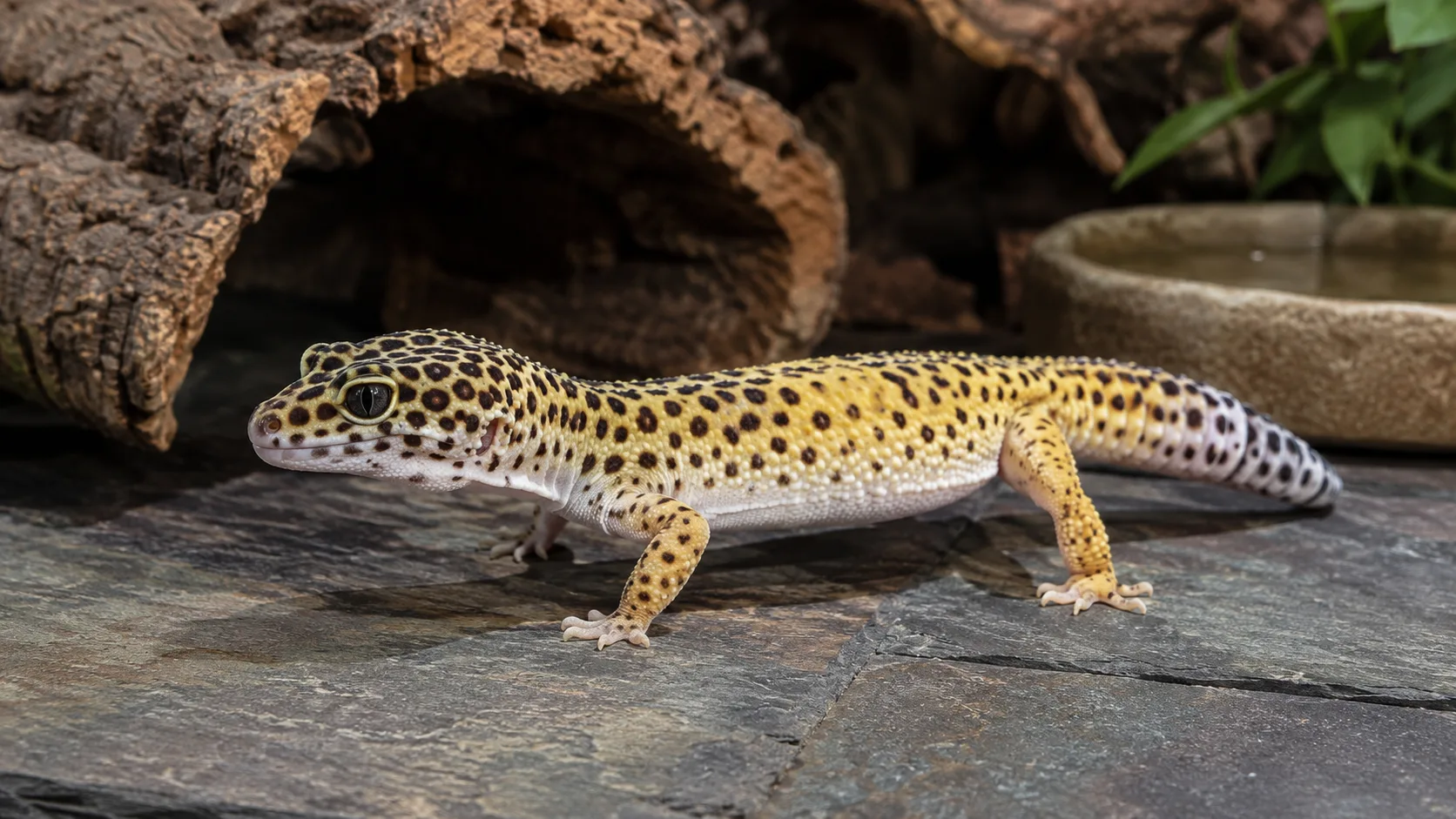
What is the best substrate for a leopard gecko?
Short answer
The safest substrates for a leopard gecko are paper towel (starter option), reptile carpet (replace when soiled), tile (long-lived, flat), or a 50/50 topsoil and play-sand mix 5–10 cm deep with enrichment items (bioactive-style). Avoid loose calci-sand, walnut shell, pine and cedar shavings. Loose substrate raises impaction risk only if husbandry is poor — temperatures and supplementation matter more than substrate alone.
- Author
- Reptimo Editorial
- Updated
- Updated
- Reading time
- 6 min read
The substrate debate, framed correctly
Substrate is the single most-argued topic in leopard gecko keeping — and most of the argument misses the underlying biology. The PetMD leopard gecko care sheet and the ReptiFiles substrate guide both make the same point: impaction is mostly a husbandry problem, not a substrate problem in isolation.
A healthy adult leopard gecko on correct temperatures (88–92 °F warm side), good calcium supplementation, and a varied feeder diet rarely impacts on naturalistic substrates. A cool, under-supplemented gecko can impact on almost anything — including substrates marketed as safe. So pick substrate on welfare and convenience grounds; fix the underlying husbandry separately.
What actually causes impaction
Five upstream factors, in approximate order of impact:
Care parameters
Real causes of impaction in leopard geckos
| Parameter | Recommended value | Notes |
|---|---|---|
| Cool warm-side temperatures | Stalls digestion of food and incidentally swallowed substrate | |
| Dehydration | Gut contents thicken; substrate doesn't pass | |
| Calcium deficiency | Drives substrate-seeking behaviour (geophagia) | |
| Oversized prey | Sluggish digestion; obstructs gut passage | |
| Underlying illness | Parasites, infection, metabolic issues all slow gut motility |
Fix any of those and substrate-related impaction risk drops dramatically. Conversely, perfect substrate with cool warm side and no calcium dusting is still a problem waiting to happen.
What to pick for each life stage
Match substrate to where the gecko is in life:
- Hatchling / juvenile (under 30 g) — paper towel. Zero impaction risk. Easy to spot-clean. Lets you monitor poop quality during the highest-risk life phase.
- Sub-adult / establishing (30–45 g) — paper towel, reptile carpet, or tile. Move to naturalistic once the gecko is feeding reliably and weight is stable.
- Adult / established (45 g+) — tile or a 50/50 topsoil and play-sand bioactive mix. The naturalistic option offers enrichment via burrowing and choice.
- Quarantine / illness — paper towel, regardless of age. Easy visibility, easy cleaning.
Safe substrate options compared
Care parameters
Safe leopard gecko substrate options
| Parameter | Recommended value | Notes |
|---|---|---|
| Paper towel | Zero impaction risk · No enrichment · Easy cleaning · Replace every few days | |
| Reptile carpet | Low impaction risk · Snags toenails occasionally · Bacterial buildup if not washed · Replace every 1–2 months | |
| Slate / non-glazed ceramic tile | Zero impaction risk · Holds heat well · Lasts the life of the gecko · No burrowing enrichment | |
| 50/50 topsoil + play-sand (bioactive) | Naturalistic, allows burrowing · Holds humidity in humid hide · Cycle 30–60 days before introducing gecko | |
| Plain washed play sand | Adequate for adult geckos with correct husbandry · Avoid for juveniles · Stir occasionally |
Substrates to avoid
Care parameters
Substrates to avoid
| Parameter | Recommended value | Notes |
|---|---|---|
| Loose calci-sand | High impaction risk; calcium claim is misleading | |
| Walnut shell, crushed corn cob | Sharp edges, indigestible, impaction risk | |
| Cedar shavings | Toxic oils — never use for any reptile | |
| Pine shavings | Toxic oils — never use for any reptile | |
| Gravel, small reptile-bark chips | Sharp, indigestible, high impaction risk |
The Merck Veterinary Manual explicitly warns against cedar and pine shavings across reptile species due to phenol toxicity. Calci-sand is the single most common "sold as safe, actually risky" product in the leopard gecko market.
Bioactive setups in detail
Bioactive substrate replicates the desert-edge microclimates leopard geckos evolved in. Standard recipe:
- 60% organic topsoil (no fertilisers, no perlite)
- 30% washed play sand
- 10% sphagnum moss (broken into pieces)
- 5–10 cm deep
- Leaf litter cover on top
- Springtail and powder-blue isopod cleaner crew
- Desert-adapted hardy plants (snake plant, jade, haworthia)
Cycle for 30–60 days before introducing the gecko: keep moist on one end (humid hide area), dry on the other end, add the cleaner crew, let it establish. Once cycled, spot-cleaning needs are minimal — the cleaner crew handles waste.
Tile setups in detail
A tile setup is the simplest naturalistic option:
- Measure the enclosure floor, cut slate or non-glazed ceramic tile to fit — most home-improvement stores cut for free.
- Place tile directly on the enclosure floor.
- Fill the gap behind tiles with kitchen-roll or excluder.
- Add a separate "digging box" (small bin of safe substrate) for enrichment.
- Place hides on tile; UTH/heat mat below operates normally.
Slate holds heat well, looks naturalistic, and lasts the life of the gecko. Spot-clean with a damp cloth.
The humid hide
Whatever main substrate you use, every leopard gecko needs a humid hide on the warm-to-cool boundary — a small lidded container with damp sphagnum moss. This is non-negotiable for shedding and hydration; see the leopard gecko stuck shed guide for setup and the terrarium setup guide for the full enclosure picture.
Signs of impaction and what to do
Symptoms:
- No defecation for 7+ days in a normally-pooping gecko.
- Visible bloated belly.
- Refusal to eat.
- Lethargy, less basking.
- Straining without producing waste.
First-line response:
- Verify warm-side temperature is 88–92 °F / 31–33 °C.
- Warm bath: 28–30 °C / 82–86 °F water 5–10 mm deep for 15–20 minutes.
- Hydration check: leave fresh water available, mist a single hide wall lightly.
- Wait 24–48 hours, re-check.
If no improvement: vet visit. The "why is my leopard gecko not pooping?" guide covers the full diagnostic walk-through.
Putting substrate into context
The big-picture order of operations for a healthy leopard gecko gut:
- Correct warm-side temperature (88–92 °F surface, IR-verified).
- Calcium-with-D3 dusting 3× weekly (juveniles 5×).
- Varied gut-loaded feeders (no all-mealworm diet).
- Appropriate prey size (no wider than the gap between the eyes).
- Then choose substrate from the safe list based on enrichment, cleaning convenience and aesthetic preference.
Get the first four right and substrate becomes a low-stakes choice between several safe options. Get them wrong and no substrate choice protects the gecko.
For the full cross-species substrate framework (which mostly generalises from leopard gecko logic), see the reptile enclosure setup guide. For the broader care plan, see the leopard gecko care guide.
Frequently asked questions
Is sand safe for leopard geckos?
What causes impaction in a leopard gecko?
What's the best substrate for a juvenile leopard gecko?
What substrates should I avoid for a leopard gecko?
What is bioactive substrate for a leopard gecko?
Can I use reptile carpet long-term?
Is paper towel a good long-term substrate?
What about ceramic tile?
How do I know if my gecko is impacted?
Sources
- Leopard Gecko Care Sheet · PetMD
- Leopard Gecko Substrate · ReptiFiles
- Disorders and Diseases of Reptiles · Merck Veterinary Manual
Quick check
Test what you just learned
A short quiz, just for you. Pick an answer to get instant feedback — there's no pass mark, this is for your benefit.
Quiz questions and answers
What's the biggest single cause of impaction in a leopard gecko?
Correct answer: Chronically cool warm-side temperatures plus poor supplementation — substrate is secondary
Impaction is mostly a husbandry problem, not a substrate one. Cool warm-side temperatures stall digestion; calcium deficiency drives substrate-seeking behaviour. A healthy gecko on correct temperatures and supplementation rarely impacts; a cool, under-supplemented gecko can impact on almost anything.
Which substrate should you always avoid for a leopard gecko?
Correct answer: Loose calci-sand
Loose calci-sand is the one to avoid — high impaction risk, and it's marketed as a calcium source but is biologically inadequate. Geckos that consume it can develop both impaction and false-confidence calcium deficiency. Stick with paper towel, reptile carpet, tile, or a topsoil-sand bioactive mix.
What's the safest substrate for a juvenile leopard gecko under 30 g?
Correct answer: Paper towel, switched to a naturalistic option once the gecko is established
Paper towel is the right starter for any new juvenile leopard gecko — zero impaction risk, easy to spot-clean, lets you monitor poop quality. Switch to tile or a topsoil-sand bioactive mix once the gecko is established and ~30 g.