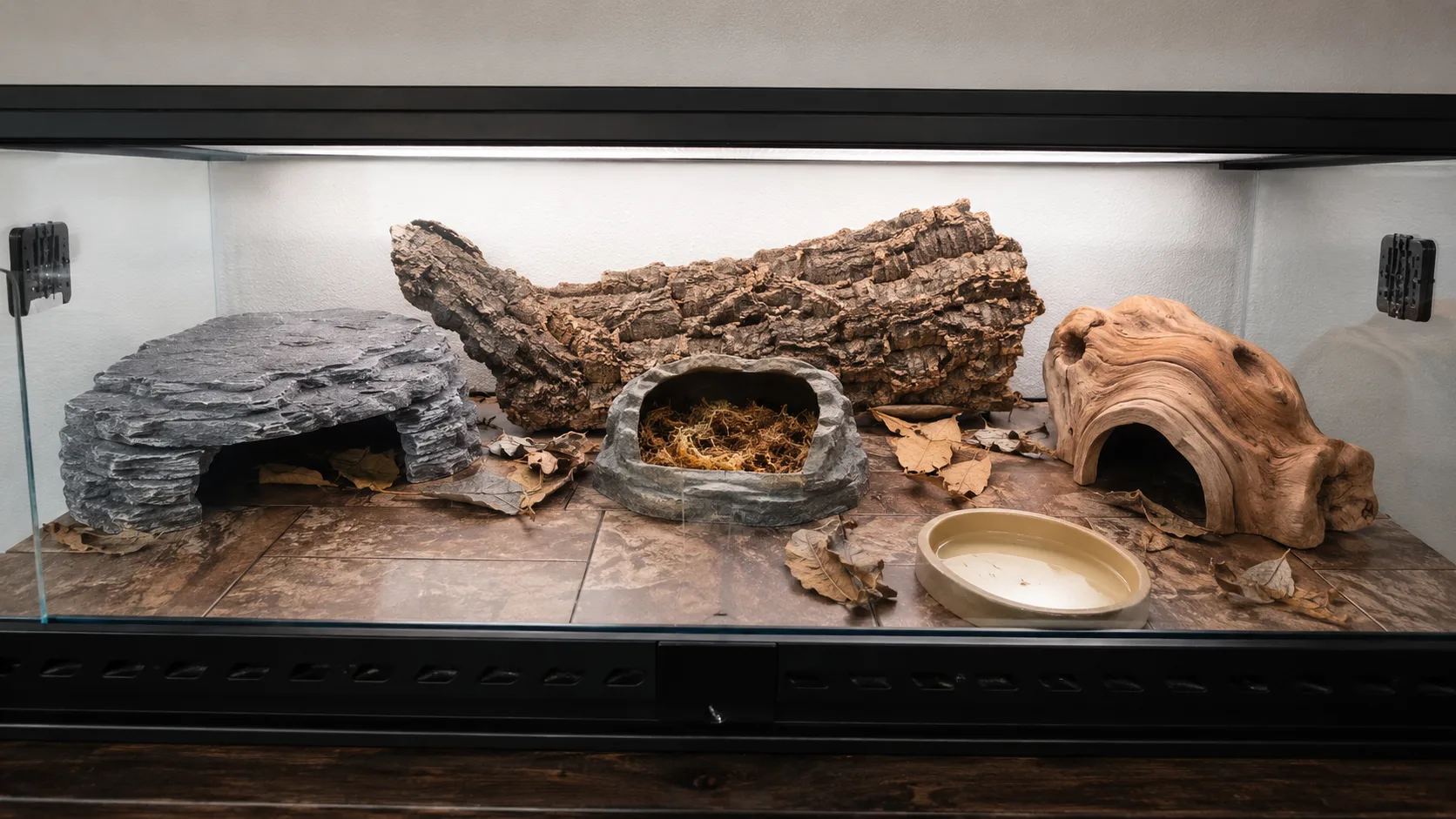
How do I set up a leopard gecko terrarium?
Short answer
A leopard gecko terrarium needs at least 60 × 30 × 30 cm (24 × 12 × 12 in) — ideally 90 × 45 × 45 cm. Provide three hides (warm, cool, humid), a shallow water dish, solid substrate (tile, slate, or carefully managed bioactive), an under-tank heater on a thermostat targeting 28–30 °C (82–86 °F) at the warm side, and optional low-level UVB.
- Author
- Reptimo Editorial
- Updated
- Updated
- Reading time
- 8 min read
What you need before you start
A complete leopard gecko terrarium setup requires the following gear, sourceable from any reputable reptile supplier. Per ReptiFiles' enclosure setup guide and consistent guidance from PetMD's care sheet:
Care parameters
Leopard gecko setup gear list
| Parameter | Recommended value | Notes |
|---|---|---|
| Enclosure | 60×30×30 cm min / 90×45×45 cm preferred | PVC, glass, or sealed wood; floor area matters |
| Under-tank heater (heat mat) | Sized for 1/3 to 1/2 of tank floor | Stick to outside of glass bottom |
| Thermostat | On/off or pulse-proportional | With probe to put inside tank |
| Digital thermometer + IR gun | For verifying temperatures | Stick-on dials are inaccurate |
| Three hides | Warm dry / Cool dry / Humid | All three are non-negotiable |
| Substrate | Tile, slate, reptile carpet, or bioactive | Solid surfaces for hatchlings |
| Water dish | Shallow ceramic, cool side | 1–2 cm water depth |
| Décor (cork bark, branches, dried leaves) | For enrichment | Geckos explore vertical features |
| Optional: low-level UVB tube | T5 HO 5–7 % | Mount inside on a 12-h timer if used |
Step 1 — Choose the enclosure
Two acceptable sizes:
- Minimum: 60 × 30 × 30 cm (24 × 12 × 12 in / 20-gallon long). OK for a single adult, tight but functional. Limited room for three distinct hide microclimates.
- Modern preferred: 90 × 45 × 45 cm (36 × 18 × 18 in / ~40-gallon long). Comfortable adult space with room for proper hide separation, décor, and a true thermal gradient. Modern care literature increasingly recommends this as the baseline.
PVC enclosures (Zen Habitats, Custom Cages) are easiest to keep at correct temperatures. Front-opening glass terrariums (Exo Terra, Zoo Med Naturalistic) work fine. Standard aquarium tanks with a screen lid work but lose heat from above and need careful mat-only heating.
Step 2 — Mount the heating
Leopard geckos thermoregulate via belly heat, not overhead basking like a bearded dragon. The standard setup:
- Under-tank heat mat stuck to the underside of the glass on one end of the tank, sized to cover one-third to one-half of the floor area.
- Thermostat plugged between the wall and the heat mat, with the temperature probe inside the tank on the substrate under the warm hide. Set to 30 °C (86 °F).
- Digital probe thermometer as a secondary check in the same spot, confirming the thermostat reading.
- Optional small basking spot — low-wattage halogen on a dimming thermostat at the warm end creating a surface of 30–32 °C (86–90 °F) under the basking branch. Not required but adds thermoregulation options.
Detailed temperature targets and what goes wrong are in the temperature guide.
Step 3 — The three-hide system
Three hides is the single most impactful setup decision for leopard gecko welfare. Each covers a specific need:
- Warm dry hide on the warm side. The gecko spends most of the day here digesting food. Small, snug, low-ceilinged — gecko's body just fills the space.
- Cool dry hide on the cool side opposite. Sleep spot when the warm side feels too hot. Same snug specification.
- Humid hide in the middle (or between warm and cool). A small enclosed container with damp sphagnum moss, accessible via a doorway. Used voluntarily during shed cycles to support clean sheds.
Commercial leopard gecko hides work well; DIY options (small plant pot cut to a doorway, plastic container with sphagnum) work just as well. The hides should look identical from the gecko's perspective on each side except for the warmth.
Step 4 — Substrate
Solid substrates are the safest default and the only option for hatchlings under 6 months:
- Ceramic tile — totally impaction-safe, easy to clean, holds heat well. Cut to fit the tank floor; spot-clean daily.
- Slate — same benefits as tile, more aesthetic.
- Sealed wood / melamine — fine if sealed properly to prevent moisture damage.
- Reptile carpet — safe but needs frequent washing (traps faeces and bacteria); replace rather than reuse heavily soiled pieces.
Acceptable for experienced keepers with adults:
- Bioactive substrate — 60 % play sand + 40 % organic topsoil, kept lightly damp at the base, with isopods and springtails as clean-up crew. Excellent for adults; requires more setup effort.
Avoid:
- Loose calci-sand — widely associated with impaction in juveniles, even with adults the risk is non-trivial.
- Pure sand of any kind for hatchlings.
- Wood shavings, cedar, pine — toxic oils, irritate the gecko.
- Walnut shell, crushed corn — impaction risk.
Step 5 — Heating (recap and verify)
Once the heat mat is in place and the thermostat is set, verify:
- Surface temperature inside the warm hide = 28–30 °C (82–86 °F), measured with an infrared (IR) temperature gun directly on the substrate under the warm hide. This is the meaningful reading.
- Cool side = 22–24 °C (72–75 °F), typically room temperature.
- Night temperature = 18–21 °C (65–70 °F) tank-wide, with the heat mat continuing on the thermostat (no white-light bulbs at night).
Re-verify temperatures weekly for the first month. Heat mats can drift; stick-on dial thermometers can read 5 °C off; the IR gun is the truth.
Step 6 — Water dish
A shallow heavy ceramic dish on the cool side, with 1–2 cm of fresh water. Refresh every 1–2 days. Some geckos drink visibly; many take most of their water from food and brief soaks. The dish also contributes to ambient humidity.
For shedding support, some keepers also offer a small soaking dish during a known shed cycle — a 5–10 minute soak in lukewarm water helps with stuck sheds. Don't force a gecko into water; offer access.
Step 7 — Décor and enrichment
Beyond the three hides:
- Cork bark slabs leaning against walls — visual barriers, climbing surface.
- Cork bark tunnels as additional hides.
- Branches at low heights — leopard geckos do climb when given the option, though they're mostly terrestrial.
- Dried botanical leaves scattered on the floor — natural foraging texture.
- Small dish for grazing food — mealworms or BSFL in a shallow ceramic dish work for free-graze treats.
The enclosure should look interesting, not bare. A bare tank with just hides causes boredom-driven stereotypies (glass surfing, repetitive pacing).
Step 8 — Optional UVB
The historical recommendation was "leopard geckos don't need UVB" because their natural habitat (under-rock crevices in arid regions) gives them minimal natural sun exposure. The modern consensus is shifting — low-level UVB is beneficial.
If you choose to add UVB:
- T5 high-output linear tube — Arcadia ShadeDweller 7 % or Zoo Med ReptiSun 5.0.
- Mounted inside the enclosure with no glass barrier.
- Cover roughly one-third of the enclosure (over the warm side).
- 12-hour-on/12-hour-off on a mechanical timer.
- Target UVI 0.5–1.0 at the basking spot.
If you skip UVB, do NOT skip the calcium-with-D3 supplementation schedule — see the feeding guide.
Never co-house males
Adult male leopard geckos are territorial and will fight, often to severe injury or death. Same-sex female pairs sometimes coexist but modern guidance increasingly recommends solo housing — even apparently calm female pairs typically have one gecko quietly stressed, losing weight, or with suppressed feeding. Solo housing is the safe default.
Putting it together
Build sequence the day before the gecko arrives:
- Place the heat mat under the tank, set the thermostat to 30 °C.
- Let the tank warm up for 24 hours; verify with IR gun.
- Add substrate, then the three hides (warm, cool, humid).
- Add water dish on the cool side.
- Add décor (cork bark, branches, dried leaves).
- Optional: install UVB tube on a 12-hour timer.
- Verify all temperatures one more time.
- Quarantine the new gecko for 30+ days in this enclosure (no handling for the first 1–2 weeks beyond essential checks).
The broader husbandry context is in the pillar care guide; the feeding mechanics in the feeding guide; the feeder insect ranking in the feeder guide.
Frequently asked questions
What's the minimum terrarium size for a leopard gecko?
Why does a leopard gecko need three hides?
What's the best substrate for a leopard gecko?
What temperature does a leopard gecko need?
Do leopard geckos need UVB?
What should I put in a leopard gecko enclosure for enrichment?
What kind of water dish for a leopard gecko?
Where should the heat mat go on a leopard gecko tank?
Can I keep two leopard geckos in one terrarium?
Sources
- Leopard Gecko Care Sheet · PetMD
- Leopard Gecko Enclosure Setup · ReptiFiles
- Leopard Gecko Care · TerrariumQuest
Quick check
Test what you just learned
A short quiz, just for you. Pick an answer to get instant feedback — there's no pass mark, this is for your benefit.
Quiz questions and answers
How many hides does a leopard gecko need?
Correct answer: Three — warm dry, cool dry, and humid (for shedding)
Three hides cover the three microclimates leopard geckos need: warm dry for digestion, cool dry for sleep, humid (damp sphagnum moss) for shedding. Without all three, stuck sheds and chronic stress are common.
What's the safest substrate for a leopard gecko hatchling?
Correct answer: Tile or slate (solid surface)
Solid substrates (tile, slate, sealed wood, reptile carpet) eliminate impaction risk. Loose calci-sand is widely associated with impaction in juveniles and should be avoided. Bioactive setups work for experienced keepers with adults.
Where does the temperature probe of the thermostat go?
Correct answer: Inside the tank on the substrate under the WARM hide
The thermostat probe sits on the substrate inside the warm hide — that's the surface the gecko's belly contacts for digestion heat. Outside-the-tank placement gives wrong readings; an unregulated heat mat reaches 50 °C+ and causes burns.
Can you safely house two adult male leopard geckos together?
Correct answer: No — males will fight, often to severe injury or death
Male leopard geckos are territorial and will fight, often to death. Even apparently calm pairs typically have a subordinate gecko quietly stressed. Solo housing is the modern safe default for this species.