Why is my leopard gecko not pooping?
Short answer
A leopard gecko that's eating but not defecating for 7+ days is usually experiencing slowed digestion from cool warm-side temperatures, mild dehydration, or early impaction. Warm-side surface should be 88–92 °F (31–33 °C). First aid is a 28–30 °C warm bath for 15–20 minutes and a temperature re-check. No improvement in 48 hours, refusal to eat, or a visibly bloated belly = vet visit.
- Author
- Reptimo Editorial
- Updated
- Updated
- Reading time
- 6 min read
What "normal" defecation looks like
A healthy leopard gecko defecates every 1–4 days depending on feeding cadence, age and individual variation. Juveniles defecate more often — often daily — because they eat more often. Adults typically defecate every 2–4 days on a typical feeding schedule.
A healthy poop has three parts:
Care parameters
Normal leopard gecko poop — three parts
| Parameter | Recommended value | Notes |
|---|---|---|
| Faecal portion | Brown to black, firm coherent pellet | |
| Urate portion | Chalky white, sometimes pale yellow tinge | |
| Liquid portion | Small clear or pale fluid |
Concerning variations: yellow or orange urates (often dehydration); runny or watery faeces over multiple events (parasites, gastroenteritis); visible undigested prey (temperature or digestive issue); blood; foul smell beyond normal.
Stable patterns matter more than exact frequency. The diagnostic red flag is a change — "she used to poop daily and now hasn't gone in a week" — not the absolute number.
Cause 1 — Cool warm-side temperature
The single most common cause of a leopard gecko going days without defecating. Leopard gecko digestion stalls below ~85 °F / 29 °C. Target warm-side surface (not air) is 88–92 °F / 31–33 °C.
Verify with an infrared temperature gun on the actual basking surface, not the air around it. The PetMD leopard gecko care sheet and most modern care guidance converge on this temperature range. Common reasons it drifts:
- Heat mat aging or thermostat probe shifted.
- Basking bulb wattage too low for ambient room.
- Probe placement wrong (in air instead of on surface).
- Room temperature dropped seasonally and warm side dropped with it.
Fix temperature first; many "won't poop" cases resolve within 48 hours of correct warm-side temperature.
Cause 2 — Mild dehydration
Leopard geckos are desert-adapted but still need consistent hydration. Sub-clinical dehydration thickens gut contents and slows defecation. Check:
- Fresh water in the bowl daily.
- Humid hide present, moss visibly damp.
- Ambient humidity not chronically below 30 %.
Offer a warm bath (see protocol below) if dehydration is suspected.
Cause 3 — Early impaction
Impaction in leopard geckos is rarely caused by substrate alone. The dominant upstream factors:
- Chronically cool warm side — stalled digestion lets gut contents accumulate.
- Calcium deficiency — drives substrate-seeking behaviour (geophagia).
- Oversized prey — slow digestion, possible obstruction.
- Loose substrate combined with the above — secondary risk.
A healthy adult on correct temperatures and supplementation rarely impacts. Substrate-related impaction is mostly downstream of husbandry problems. See leopard gecko substrate for the longer discussion.
Cause 4 — Brumation or winter slowdown
Even at constant captive temperatures, many leopard geckos eat less and defecate less during winter months (Dec–Feb). This is normal biology and not impaction. The pattern:
- Reduced feeding (2–3 meals a month instead of weekly).
- Reduced defecation matching feeding.
- Stable weight or very slight loss (under 5 %).
- Resumption of normal pattern by March-April.
Stable weight + seasonal timing + correct husbandry = a normal slowdown. The same refusal in spring with weight loss is different.
Cause 5 — Recent stress
A gecko adjusting to a new enclosure, recent handling, or other disturbance can slow gut motility for a week or two:
- New gecko in a new home — 1–2 weeks of reduced defecation is common.
- New enclosure or rearranged furniture.
- New pet in the household.
Reduce handling for 1–2 weeks, verify husbandry, weigh weekly. Most stress-related slowdowns resolve on their own.
The warm-bath protocol
The ReptiFiles impaction guide documents the standard at-home protocol:
- Verify warm-side temperature first. IR gun on the surface; 88–92 °F target. If it's off, this is upstream of everything.
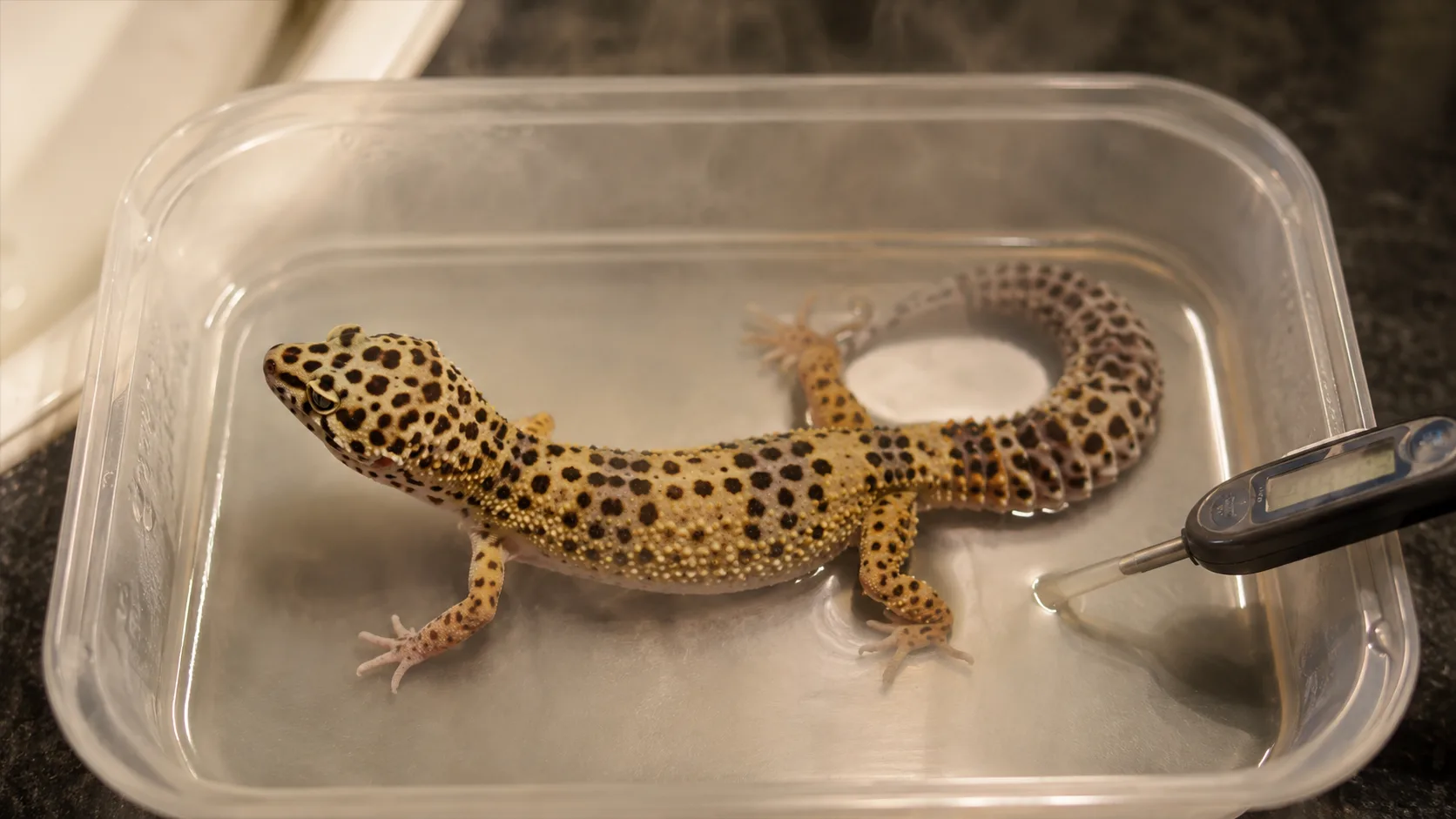
- Set up a shallow bath. Lidded plastic container with a few air holes. Warm water at 28–30 °C / 82–86 °F, depth 5–10 mm (just enough to cover the belly).
- Place the gecko in for 15–20 minutes. Stay in the room. Check water temperature with a probe — water cools fast.
- Gentle abdominal pressure from the water often triggers defecation during or right after the bath.
- Return the gecko to a warm hide. Offer fresh water; mist humid hide.
- Re-assess in 24 hours. If no defecation, repeat the bath.
Most non-impacted cases produce a bowel movement during the first or second bath.
What not to do
A few "home remedies" that are commonly suggested but unsupported by reptile-vet guidance:
- Olive oil or other oils — can interfere with vitamin absorption, unreliable as laxatives, may worsen impaction by binding with gut contents.
- Force-feeding mineral oil — vet-only intervention.
- Manual abdominal massage with pressure — can cause internal injury; warm-water buoyancy is safe; firm pressure isn't.
- Daily baths for a week — repeated stress, dehydrating; if a single bath doesn't work, see a vet rather than escalating frequency.
Signs of true impaction
These move it from "constipation" to "impaction" — and from home-treatment to vet visit:
Care parameters
Signs of true impaction
| Parameter | Recommended value | Notes |
|---|---|---|
| Bloated belly that doesn't soften after a warm bath | Concerning | |
| Palpable lump through the belly wall | Very concerning | |
| Refusal to eat alongside no defecation past 5 days | Concerning | |
| Lethargy, less basking, reduced response | Concerning | |
| Straining in defecation posture without producing waste | Concerning | |
| Weight loss alongside the above | Vet visit | |
| Visible prolapse from the cloaca | Vet emergency |
The Merck Veterinary Manual notes that severe impaction can become fatal if not treated — the trapped gut contents prevent feeding, leading to systemic decline over weeks. Don't delay if the warm-bath protocol doesn't work.
When to see a vet
Specific thresholds:
- Bath + temperature correction don't produce defecation within 48 hours.
- Bloated belly that doesn't soften with bath.
- Palpable lump in the abdomen.
- Refusal to eat for over 5 days alongside no defecation.
- Lethargy, sustained reduced activity.
- Weight loss over multiple weighings.
- Straining without production.
- Any neurological signs (tremors, loss of balance) — same-day vet.
Find a reptile-experienced vet through the ARAV directory. Bring a husbandry log if you have one — the husbandry-log primer covers what to track and why.
Prevention
The cluster of habits that prevents most "won't poop" cases:
- Correct warm-side temperature (88–92 °F / 31–33 °C surface, IR-verified weekly).
- Humid hide present and functional on the warm-to-cool boundary.
- Varied gut-loaded feeders — not all-mealworm.
- Appropriate prey size — no wider than the gap between the eyes.
- Calcium-with-D3 supplementation at species-appropriate cadence.
- Weekly weight log — catches slow declines early.
For the full care plan, see the leopard gecko care guide. For the temperature deep-dive, see leopard gecko temperature.
Frequently asked questions
How often should a leopard gecko poop?
What does normal leopard gecko poop look like?
Is my leopard gecko impacted?
How do I help a leopard gecko with constipation?
Can I give a leopard gecko olive oil for constipation?
Why won't my leopard gecko poop after eating?
What does impaction in a leopard gecko look like physically?
How long can a leopard gecko safely go without pooping?
When does this become a vet visit?
Sources
- Leopard Gecko Care Sheet · PetMD
- Leopard Gecko Impaction · ReptiFiles
- Disorders and Diseases of Reptiles · Merck Veterinary Manual
Quick check
Test what you just learned
A short quiz, just for you. Pick an answer to get instant feedback — there's no pass mark, this is for your benefit.
Quiz questions and answers
What's the most common cause of a leopard gecko going days without pooping?
Correct answer: Cool warm-side temperatures (below 85 °F / 29 °C) stalling digestion
Leopard gecko digestion stalls below ~85 °F. Cool warm-side temperatures are the #1 cause of stalled defecation. Verify warm-side surface with an IR gun (88–92 °F target). That single fix resolves most cases before they progress to impaction.
What's the safe first-line response to a constipated leopard gecko?
Correct answer: Warm bath at 28–30 °C / 82–86 °F for 15–20 minutes, plus temperature correction
Warm bath plus temperature correction is the safe first-line response. Olive oil is old anecdotal advice not supported by modern vet guidance. Force-feeding laxatives is vet-only. Most cases resolve within 24–48 hours of bath plus correct warm-side temperature.
When does a leopard gecko's lack of defecation become a vet visit?
Correct answer: After 48 hours if a bath doesn't help, OR sooner if bloated belly, palpable lump, refusal to eat or lethargy appear
Vet visit if a warm bath plus temperature correction don't produce defecation in 48 hours, or sooner if any concerning signs appear: bloated belly that doesn't soften, palpable lump, refusal to eat for 5+ days, lethargy, straining without production, or weight loss.