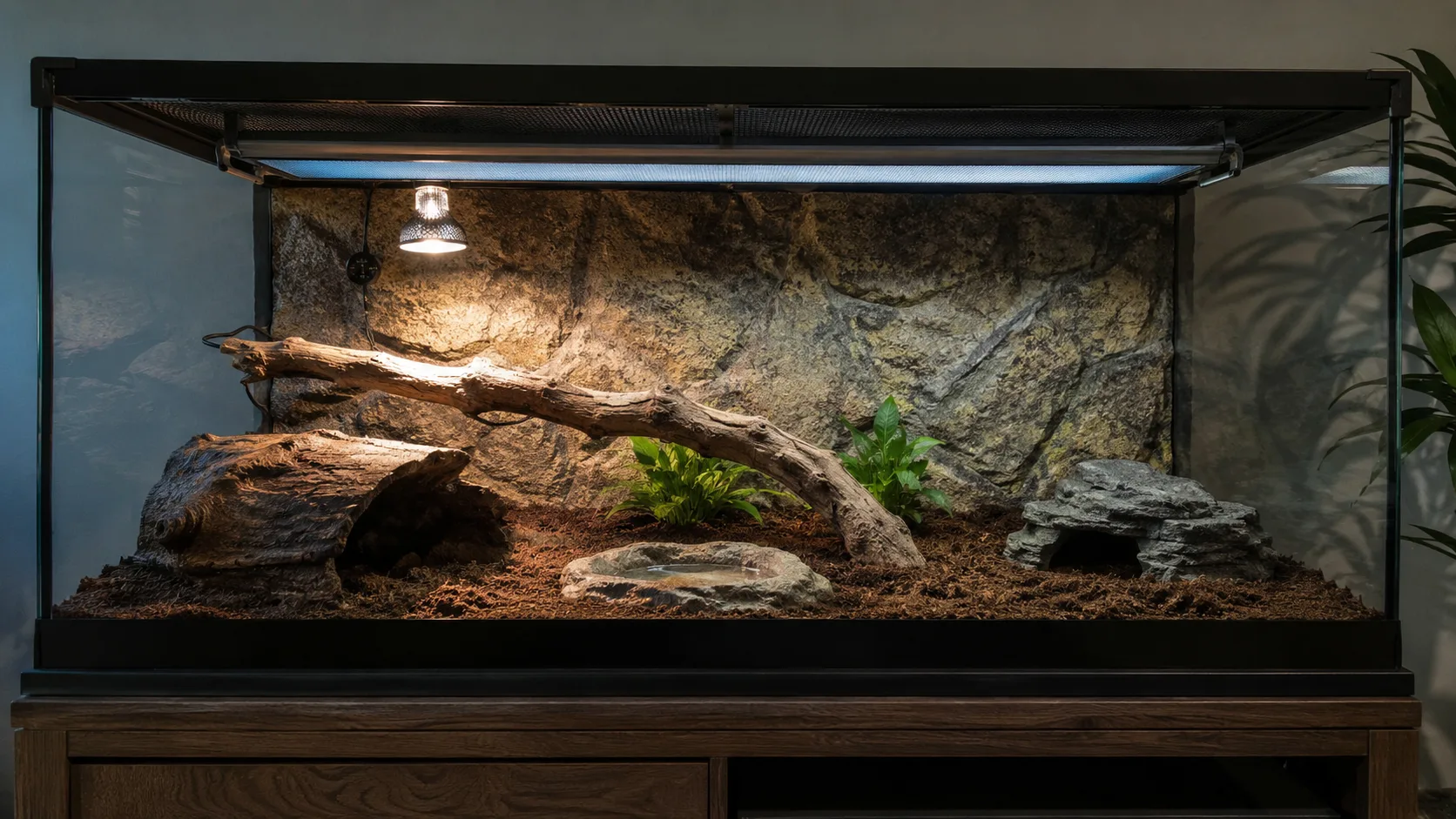
How do I set up a reptile enclosure?
Short answer
Build the enclosure two weeks before the reptile arrives. Start with the correct enclosure type and size for the species, install heating and thermostats, add UVB to match the Ferguson zone, layer appropriate substrate, place at least two hides and water, then run the entire setup for 7–14 days while logging temperatures and humidity. Only introduce the reptile once readings hit species targets.
- Author
- Reptimo Editorial
- Updated
- Updated
- Reading time
- 7 min read
Set up the enclosure first
The single highest-impact piece of advice for any new reptile keeper: build the enclosure two weeks before the reptile arrives, not the same day. The PetMD beginner reptile guide makes this explicit — buying the animal first and setting up around it is the single most common cause of stressful first-month experiences and avoidable feeding refusals.
Cycle-in week serves a real purpose: it lets you verify that temperatures, humidity and lighting hit species targets across a full 24-hour cycle, identify the inevitable surprises (warm side too hot in afternoon sun, basking surface 5 °C below target, room humidity drops at night), and fix them while there's no reptile to stress.
This guide walks the order. For species-specific exact numbers, see the species pillar guides — this is the cross-species framework.
Step 1 — Pick the right enclosure type and size
Match the enclosure to the species' natural posture and behaviour:
Care parameters
Enclosure type by species type
| Parameter | Recommended value | Notes |
|---|---|---|
| Terrestrial desert basker | Horizontal front-opening terrarium | Bearded dragon, uromastyx — width and depth more than height |
| Arboreal climber | Vertical glass or PVC terrarium with mesh top | Crested gecko, chameleon — height more than width |
| Burrowing snake | Horizontal PVC enclosure | Ball python, corn snake — secure-fitting lid, hide on warm and cool side |
| Semi-aquatic turtle | Long aquarium or stock tank | Red-eared slider — large water volume + basking dock above |
| Nocturnal gecko | Horizontal terrarium 36×18×18 in or larger | Leopard gecko — multiple hides on the floor plane |
Size minimums by species sit in the pillar guides (bearded dragon, ball python, red-eared slider). The cross-species rule: undersizing is the most common new-keeper mistake, and "the reptile will grow into it" still requires you to provide the adult-size enclosure before the reptile is adult.
Step 2 — Plan the gradient
Every reptile enclosure needs a temperature gradient — a warm side and a cool side — so the reptile can thermoregulate by moving. Plan this before you install anything:
- Warm side / basking spot at one end. This is where the basking bulb (and often UVB) sits.
- Cool side at the opposite end, with no direct heat.
- Humid hide / humidity gradient for species that need it (leopard geckos, ball pythons, crested geckos, chameleons).
- Hides on both warm and cool side so the reptile can pick temperature without sacrificing security.
A single-temperature enclosure forces the reptile into one compromise after another. Gradient is the single biggest concept in reptile husbandry.
Step 3 — Heating and thermostat
Every heat source attached to an enclosure needs a thermostat. The specific pairing:
Care parameters
Heat source — thermostat pairing
| Parameter | Recommended value | Notes |
|---|---|---|
| Halogen / incandescent basking bulb | Dimming thermostat | Smooth dim down as target hit; preserves visible light |
| Ceramic heat emitter | Pulse or on/off thermostat | No visible light; used for night/ambient |
| Heat mat / heat tape | On/off thermostat | Probe placed on the substrate above the mat |
| Deep heat projector (DHP) | Pulse or dimming thermostat | IR-only; popular for crepuscular species |
Per the Merck Veterinary Manual, thermal burns from unregulated heat sources are a recurring preventable injury in captive reptiles. Thermostat is safety equipment, not an upgrade.
Step 4 — UVB
Almost every reptile benefits from UVB; the question is how much. Match the species to its Ferguson zone, pick a T5 HO tube of the right strength, and mount it inside the enclosure (glass blocks ~95 % of UVB):
- Zone 1–2 (low UVI, 0.5–1.5) — crested gecko, leopard gecko, ball python, corn snake. Arcadia ShadeDweller 7 % or Zoo Med ReptiSun 5.0.
- Zone 3 (high UVI, 4–6 at basking) — bearded dragon, slider, blue-tongue skink. Arcadia Dragon 12 % or Zoo Med ReptiSun 10.0.
- Zone 4 (very high UVI, 4–8+ at basking) — uromastyx, desert iguana. Arcadia Desert 14 %.
Replace every 12 months — UV output collapses long before the bulb stops emitting light. Full framework in the cross-species UVB guide.
Step 5 — Substrate
Choose substrate by species needs and your risk tolerance:
- Safest starter options: paper towel (very easy to spot-clean, zero impaction risk) or reptile carpet (easy to monitor).
- Naturalistic for most desert/temperate species: a 50/50 topsoil and play-sand mix, 5–10 cm deep, allows light burrowing.
- Bioactive (long-term): organic topsoil + coco coir + leaf litter with a springtail-and-isopod cleaner crew. Zen Habitats' bioactive guide covers the build.
- Avoid: cedar and pine shavings (toxic oils), calci-sand (impaction + false-confidence about calcium intake), walnut shell.
For desert geckos and bearded dragons, loose sand is debated — the leopard gecko substrate guide covers the impaction debate.
Step 6 — Hides, water and furnishings
Minimum furnishing for any reptile enclosure:
- Warm-side hide — just big enough for the reptile to feel tight on all sides.
- Cool-side hide — same.
- Humid hide for species that need it (leopard geckos, ball pythons, crested geckos, chameleons) — small lidded container with damp sphagnum moss.
- Water bowl — heavy ceramic, large enough for the reptile to soak if it wants (snakes especially).
- Climbing/basking furniture appropriate to species — branches for arboreal species, flat basking stone for desert species.
- Cover (plants, cork bark) to break sightlines and provide visual security.
A bare enclosure with two hides and a water bowl is functional. A furnished enclosure with sightline-breaking foliage is better — most reptiles thermoregulate more confidently when they don't feel exposed.
Step 7 — Photoperiod and night setup
Diurnal species need a clear 12-hour day / 12-hour night cycle. Nocturnal species need ambient room light cycling, plus a viewing option (dim red or "moonlight" bulbs) that doesn't disrupt the dark phase.
Most modern controllers (timer or smart plug) handle this for under $20. Never use white light at night for any species — even nocturnal reptiles need true darkness for healthy circadian rhythm. See the night-temperature guide for the full discussion.
Step 8 — Cycle-in
Run the entire setup for 7–14 days before the reptile arrives. Log warm-side, cool-side, basking and humidity readings 2–3 times daily across that window. Adjust until everything sits inside species target ranges across a full 24-hour cycle.
Common surprises caught in cycle-in:
- Warm side hits 38 °C in afternoon sun through a nearby window.
- Basking surface 5 °C cooler than the air around it (because the basking bulb wattage is too low or distance is too high).
- Humidity drops from 60 % to 30 % overnight as the room heating kicks in.
- Cool side never gets below 28 °C because the warm side is too close.
Catch these now, not when the reptile is in.
Step 9 — Bring the reptile home
Only after readings hold at species targets:
- Pick up the reptile from a reputable source, ideally midweek.
- Transport in a small dark container, keep warm but not hot.
- Place the reptile in the enclosure with minimal interaction.
- Leave it alone for 7–14 days — no handling, no rearranging, minimal cleaning visits. Some species (ball pythons especially) refuse food for 1–4 weeks after rehoming; this is normal stress recovery.
- Log every behaviour observation, every feeding offered, every defecation.
For the species-specific first-month protocols, see the species pillar and not-eating guides: ball python, leopard gecko, bearded dragon.
What this setup needs from you ongoing
After the first month:
- Weekly: spot-check warm and cool temperatures, refresh water, check humid hide moisture.
- Monthly: weigh, deep-clean, full substrate spot.
- Quarterly: review the parameter log for drift.
- Annually: replace UVB tube, full substrate change (if non-bioactive), enclosure inspection.
Log the install date on every bulb. The husbandry-log primer covers what to track and why.
Frequently asked questions
Should I buy the reptile first or set up the enclosure first?
What size enclosure does a reptile need?
What's the right substrate for a reptile?
How many hides does a reptile need?
Do I need a thermostat for reptile heating?
What lighting does a reptile enclosure need?
What temperature should I aim for?
How long does enclosure cycle-in take?
What's a bioactive setup and do I need one?
Sources
- Reptile Care for Beginners · PetMD
- Disorders and Diseases of Reptiles · Merck Veterinary Manual
- Zen Habitats — Bioactive Enclosures · Zen Habitats
Quick check
Test what you just learned
A short quiz, just for you. Pick an answer to get instant feedback — there's no pass mark, this is for your benefit.
Quiz questions and answers
When should you actually introduce the reptile to a new enclosure?
Correct answer: After 7–14 days of cycle-in, once temperatures and humidity readings hold at species targets across a full day-night cycle
Cycle-in for 7–14 days is the standard recommendation across reputable care sites — long enough to verify readings hold at species targets and to tune anything that drifts. Introducing the reptile to an untested setup is the most common cause of stressful first weeks.
Why does every reptile heating element need a thermostat?
Correct answer: Without one, heat mats and ceramic emitters can drift over 50 °C and burn the reptile — it's safety equipment, not optional
Every heat source touching an enclosure needs a thermostat. Heat mats and ceramic emitters routinely exceed safe temperatures without one. Halogen and basking bulbs use dimming thermostats; mats and ceramics use pulse or on/off thermostats. This is non-negotiable safety equipment.
What's the minimum hide count for a healthy reptile enclosure?
Correct answer: Two — one on the warm side, one on the cool side, plus often a third humid hide depending on species
Two hides minimum — one warm, one cool — so the reptile can thermoregulate without sacrificing security. Many species (leopard geckos, ball pythons, crested geckos) also benefit from a third humid hide. A reptile with only one hide will often skip thermoregulation to feel safe.