Do reptiles need a UVB light at night?
Short answer
No reptile needs UVB at night — UVB and visible light should both be off during the dark phase. Modern care across species converges on a 12-hour day / 12-hour dark cycle. Use a ceramic heat emitter or deep heat projector on a thermostat for any night warmth needed (no visible light). Most species tolerate a 5–10 °C / 10–18 °F night drop matching natural conditions.
- Author
- Reptimo Editorial
- Updated
- Updated
- Reading time
- 6 min read
Why no UVB at night
UVB benefits reptiles via vitamin D3 synthesis, which is paired with the basking spectrum during the day — D3 is produced in skin under specific UVB wavelengths while the reptile is alert and basking. Per the Ferguson-zones reference at Zen Habitats and modern care across species, the UVB period belongs to the day phase. Running UVB after dark offers no biological benefit and disrupts circadian rhythm.
The same logic applies to visible light. Every reptile species — diurnal, nocturnal or crepuscular — needs a true dark phase to maintain healthy circadian biology. White light at night suppresses melatonin, disrupts sleep, and over weeks reduces feeding, immune function and reproductive health.
The simplest correct setup: a 12-hour day / 12-hour dark photoperiod on a timer, basking and UVB on during the day, both off at night.
Why no white light at night
Even keepers who know UVB doesn't belong at night sometimes leave white basking bulbs on for warmth or to "watch the snake hunt." Both are wrong:
- For warmth — use a non-visible heat source instead. Ceramic heat emitter (CHE) or deep heat projector (DHP) produce infrared with no visible light, on a thermostat.
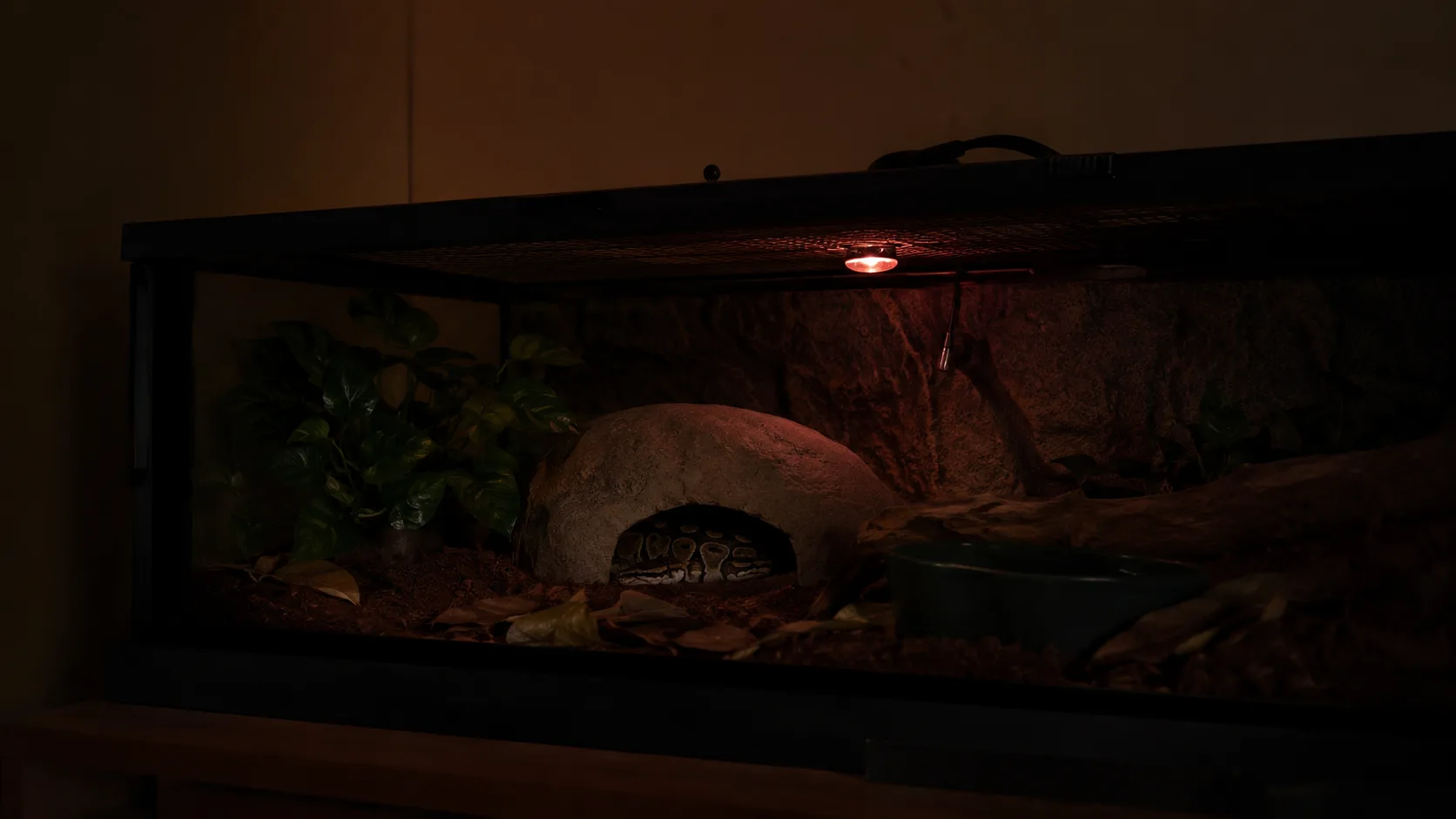
- For viewing — use red or "moonlight" bulbs sparingly for short observation sessions only. Don't leave on overnight.
White light at night disrupts circadian rhythm regardless of how cool the room is. The PetMD beginner reptile guide explicitly notes that day-night cycles are essential to reptile welfare and that lighting needs to support that pattern.
What about red and moonlight bulbs?
Older guidance said reptiles can't perceive red wavelengths, so red bulbs were considered "invisible" to them and safe for overnight viewing. Newer research has revised this. Many reptiles do perceive red light, and overnight red illumination still disrupts circadian rhythm — though less severely than white light.
Current consensus:
- OK: brief use (15–30 minutes) of dim red or "moonlight" bulbs for short observation sessions.
- Not OK: red bulbs left on all night every night as supplemental viewing light.
- Best practice: if you need to check on the reptile at night, use a handheld dim red headlamp for the brief check, then leave.
Night temperature targets
Most reptile species evolved with significant day-night temperature drops. Holding daytime basking temperatures overnight is unnatural and reduces sleep quality.
Care parameters
Night-temperature targets by species
| Parameter | Recommended value | Notes |
|---|---|---|
| Bearded dragon | 65–75 °F / 18–24 °C | Tolerates down to 60 °F briefly; supplemental heat only below 60 °F |
| Leopard gecko | 65–75 °F / 18–24 °C | No heat needed if room stays above 65 °F |
| Crested gecko | 65–75 °F / 18–24 °C | Cool tropical; room temperature usually fine |
| Ball python | 75–78 °F / 24–26 °C | Tropical; needs supplemental ceramic heat in cool rooms |
| Corn snake | 65–72 °F / 18–22 °C | Wide tolerance; brumates if cooled to 55–60 °F |
| Veiled chameleon | 65–75 °F / 18–24 °C | Welcomes a clear night drop for health and breeding |
| Red-eared slider | Water 70–75 °F / 21–24 °C | Aquarium heater holds water temp; basking lights off |
The species that most often need supplemental night heat in normal households are ball pythons and chameleons (when the room drops below the species minimum), and any species in an exceptionally cold room (under-floor heating off, drafty window).
How to add night heat without light
If your room drops below the species minimum, add non-visible heat:
- Ceramic heat emitter (CHE). Screws into a basking dome. Emits infrared, no visible light. Must be on a pulse or on/off thermostat. Cheap, reliable.
- Deep heat projector (DHP). Newer technology; emits IR-A and IR-B (closer to natural sun than CHE). More expensive but more natural heat profile. Must be on a pulse or dimming thermostat.
- Heat mat under tank. Works for ground-dwelling species (leopard geckos, corn snakes). Must be on an on/off thermostat with probe between mat and tank. Avoid for tall enclosures where the reptile isn't on the floor.
The thermostat is non-negotiable. Unregulated ceramic emitters routinely exceed 65 °C / 150 °F and cause severe burns.
Why the night drop is good
Wild reptiles experience natural day-night temperature swings of 5–10 °C / 10–18 °F. Matching this in captivity supports:
- Immune function. Circadian-driven immune cycling is impaired by constant temperatures.
- Metabolic regulation. Resting metabolic rate naturally drops at night; sustained warmth burns reserves.
- Behaviour. Most reptiles are most active at dawn and dusk — the temperature cycle drives the activity cycle.
- Reproductive cues. Breeding behaviour in many species is triggered by seasonal day-night patterns.
- Sleep quality. Reptiles sleep; warm constant rooms reduce sleep depth.
A 24/7 32 °C basking environment isn't "kindness" — it's harder on the reptile than a clean photoperiod with a 22 °C night drop.
What goes wrong at the extremes
The error mode in both directions:
- Too cold consistently — feeding refuses, digestion slows, respiratory infection risk climbs over weeks. Chronic cool nights are the upstream cause of many ball-python and chameleon RI cases.
- Too warm consistently — chronic dehydration, suppressed immune function, reduced sleep, reduced feeding. Bearded dragons on 24/7 basking heat develop chronic stress markers within months.
The sweet spot is species-specific night minimums (per the table above) with a clean dark phase. Verify with a digital probe thermometer, not a stick-on dial.
Seasonal context
For species that brumate or have winter slowdowns, the night cycle matters even more:
- Bearded dragons — brumate Oct–March in cooler households; night minimums can drop to ~55 °F during brumation by design.
- Corn snakes — brumate at 55–60 °F if temperatures naturally drop; cycle off basking heat during brumation.
- Ball pythons — don't brumate, but winter slowdown is a normal response to seasonal cooling.
For full discussion of seasonal cooling cycles, see bearded dragon brumation.
A simple night routine
For most setups:
- Timer on a smart plug controls basking and UVB on a 12-hour day / 12-hour dark schedule.
- Night thermostat on CHE or DHP kicks in only if warm side drops below species minimum.
- No white or strong red light in the reptile room overnight.
- Brief checks with a handheld dim red headlamp if needed; not overnight illumination.
Log the dark-phase start and end times in your husbandry log. The husbandry log primer covers what else to track and why. For the day-side of the temperature/humidity conversation, see the cross-species gradient guide. For the UVB framework that includes when UVB belongs on the schedule (day, never night), see the cross-species UVB guide.
Frequently asked questions
Do any reptiles need UVB at night?
Do reptiles need a heat lamp at night?
What's wrong with white light at night?
Can I use a red 'moonlight' bulb to watch my reptile at night?
What night temperature does my reptile need?
How do I add night heat without disturbing my reptile?
Do night temperature drops actually benefit reptiles?
What happens if my room is too cold at night?
Are nocturnal reptiles different — do they need night light?
Sources
- Reptile Care for Beginners · PetMD
- Bearded Dragon Temperatures & UVB · ReptiFiles
- What Are Ferguson Zones? · Zen Habitats
Quick check
Test what you just learned
A short quiz, just for you. Pick an answer to get instant feedback — there's no pass mark, this is for your benefit.
Quiz questions and answers
Do reptiles need UVB at night?
Correct answer: No — UVB and visible light should both be off during the dark phase
No reptile needs UVB at night. UVB-driven D3 synthesis happens with the basking spectrum during the day. Running UVB after dark offers zero benefit and disrupts circadian rhythm. Modern care across species converges on UVB and visible light both off during the dark phase.
Your ball python's room drops to 70 °F at night. How should you add night heat?
Correct answer: A ceramic heat emitter (CHE) or deep heat projector (DHP) on a thermostat — both produce heat with no visible light
CHE and DHP both produce infrared heat without visible light — the right tools for night warmth. Both must be on a thermostat. White light at night disrupts circadian rhythm; even red 'moonlight' bulbs are now discouraged for overnight use as recent research suggests reptiles perceive red wavelengths.
Should you use a red 'moonlight' bulb to watch your reptile at night?
Correct answer: Sparingly, for short viewing only — modern guidance discourages overnight red light as reptiles do perceive red wavelengths
Older guidance said 'reptiles can't see red' — newer research has revised this. Use red or 'moonlight' bulbs for short observation sessions only, not as overnight lighting. True darkness is what supports circadian rhythm.