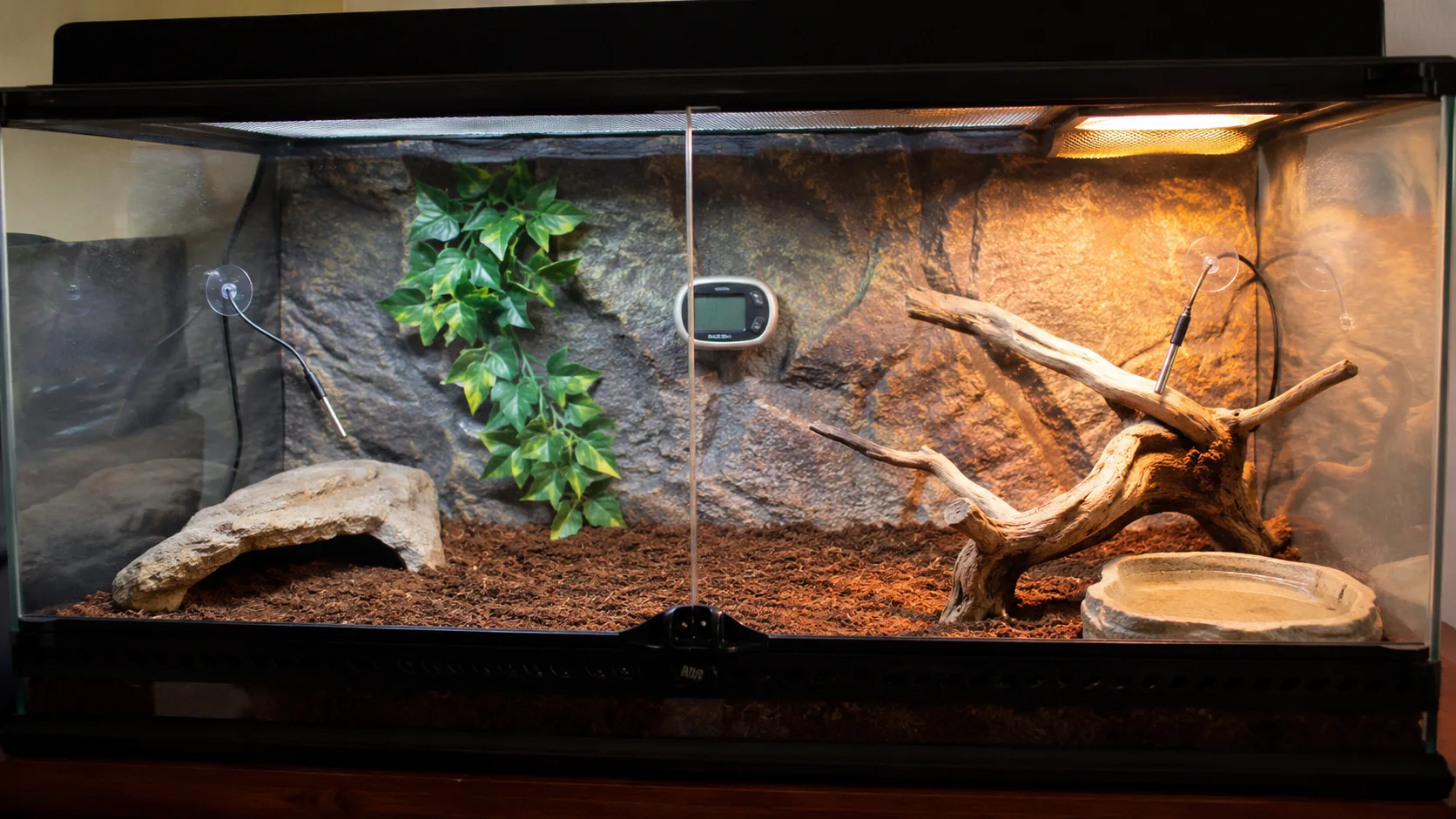
What temperature and humidity does my reptile need?
Short answer
Every reptile needs a temperature gradient — a warm side or basking spot at the species' high end and a cool retreat at the low end — so it can thermoregulate by moving. Pair that with the species-correct humidity range, measured with a digital hygrometer. Bearded dragons: basking 95–110 °F, cool 75–85 °F, humidity 30–40 %. Ball pythons: warm 86–90 °F, cool 75–78 °F, humidity 55–60 %.
- Author
- Reptimo Editorial
- Updated
- Updated
- Reading time
- 7 min read
Why gradient matters
Reptiles are ectothermic — they don't generate body heat internally like mammals and birds. They regulate body temperature by moving between warmer and cooler microclimates. The Merck Veterinary Manual identifies improper temperature gradient as one of the most common husbandry problems in captive reptiles and the upstream cause of a disproportionate share of disease cases.
A single-temperature enclosure forces compromises. Too warm and the reptile is permanently in basking mode — stressed, dehydrated, off feed. Too cool and digestion stops, immune function drops, feeding refuses, susceptibility to respiratory infection climbs. A proper gradient lets the reptile pick its own body temperature minute by minute — which is what husbandry is, mechanically.
The same logic applies to humidity, with one nuance: humidity matters less in absolute terms and more in stability. Holding a species' humidity range within ±10 % consistently matters more than hitting the centre of the range precisely.
Temperature targets by species
Cross-species reference for the most common pet species:
Care parameters
Day temperature targets — basking / warm / cool
| Parameter | Recommended value | Notes |
|---|---|---|
| Bearded dragon | Basking 95–110 °F / 35–43 °C · Cool 75–85 °F / 24–29 °C | Desert basker, Ferguson Zone 3 |
| Leopard gecko | Warm 88–92 °F / 31–33 °C · Cool 70–75 °F / 21–24 °C | Nocturnal, surface heat preferred |
| Crested gecko | Ambient 72–78 °F / 22–26 °C · No basking | Cool tropical, room temperature usually fine |
| Ball python | Warm 86–90 °F / 30–32 °C · Cool 75–78 °F / 24–26 °C | Tropical, gradient critical |
| Corn snake | Warm 85–88 °F / 29–31 °C · Cool 72–78 °F / 22–26 °C | Temperate, brumates if cooled |
| Veiled chameleon | Basking 85–95 °F / 29–35 °C · Cool 70–80 °F / 21–27 °C | Arboreal vertical gradient |
| Red-eared slider | Water 75–85 °F / 24–29 °C · Basking 90–95 °F / 32–35 °C | Semi-aquatic, basking dock above water |
Species-specific deep dives: bearded dragon, leopard gecko, ball python, red-eared slider water.
Humidity targets by species
Three broad bands cover most pet reptiles:
Care parameters
Humidity targets by species
| Parameter | Recommended value | Notes |
|---|---|---|
| Desert species | 30–40 % | Bearded dragon, uromastyx, sand boa |
| Temperate species | 30–50 % | Leopard gecko, corn snake (50–60 % during shed) |
| Tropical species | 55–75 % | Ball python, crested gecko, chameleons |
| Humid-hide microclimate (any species needing one) | 70–80 % | Sphagnum moss inside small lidded hide |
The within-enclosure pattern matters too. A "tropical" species doesn't need uniform 70 % humidity everywhere — what they want is a moisture gradient: a damper end (water bowl, plants, humid hide) and a drier end where they can shed scale water. Uniformly damp enclosures cause scale rot and respiratory infection over months, which catches keepers who overcorrected from "too dry."
How to measure correctly
Three tools used together:
- Digital probe thermometer for ambient air on warm and cool sides. One probe per side. Cheap models work fine.
- Infrared (IR) temperature gun for the basking surface itself. Point at the exact spot the reptile lies on, from a few inches away. Reads the surface, not the air. This is the most important single tool for any basking species.
- Digital hygrometer for humidity. Stick-on analogue dials are notoriously inaccurate — 10–20 % error is normal. Pay for digital.
Place probes where the reptile actually spends time, not at the top of the enclosure or against the back wall. Stick-on dials at the top of the enclosure tell you "the warm air at the ceiling is 26 °C" — which doesn't reflect what the basking reptile experiences.
Night drops
Most reptile species evolved with significant night temperature drops. Targets:
Care parameters
Night-temperature drops by species
| Parameter | Recommended value | Notes |
|---|---|---|
| Bearded dragon | 65–75 °F / 18–24 °C | Room temperature usually fine; supplemental only below 60 °F |
| Leopard gecko | 65–75 °F / 18–24 °C | No heat below 65 °F |
| Crested gecko | 65–75 °F / 18–24 °C | Room temperature |
| Ball python | 75–78 °F / 24–26 °C | Holds higher; ceramic emitter on thermostat if cool |
| Corn snake | 65–72 °F / 18–22 °C | Tolerates wider range |
| Chameleon | 65–75 °F / 18–24 °C | Welcomes the night drop |
Never use white visible light at night for any species — it disrupts circadian rhythm regardless of temperature. If you need supplemental night heat, use a ceramic heat emitter or deep heat projector on a thermostat. See the night-temperatures guide for the full discussion including the "do I need a night bulb?" question.
Holding the gradient — physical layout
The gradient comes from layout, not just bulbs:
- Heat source clustered at one end. Basking bulb, heat mat or emitter — all in the same warm corner.
- Cool retreat at the opposite end with no direct heat source.
- Hides on both sides so the reptile can pick temperature without sacrificing security.
- Humid hide on the warm-to-cool boundary for species that need one.
- Vertical gradient too for arboreal species — chameleons need warm-near-top, cool-near-bottom.
A short enclosure can't hold a real gradient — there isn't enough linear distance between warm and cool ends for them to differ. This is the husbandry case for the "enclosures should be larger" advice that's standard across modern care sheets.
What goes wrong when you get this wrong
The clinical pattern that follows a chronic temperature or humidity mismatch:
- Cool overall — feeding refuses, digestion slows, immune function drops, respiratory infection over weeks.
- Hot overall — thermal stress, dehydration, off feed, potential burns from contact heat.
- Dry (tropical species) — retained shed, dehydration, eye and respiratory irritation.
- Humid (desert species) — scale rot on belly, foot rot in burrowing snakes, respiratory infection.
- No gradient — reptile parks in the worst-of-both compromise, shows none of the above acutely but chronic stress reduces appetite, growth and lifespan.
For symptom-side discussion, see "is my reptile sick?".
A weekly check that catches drift
Three readings, once a week, plus glance at last 8 weeks of data:
- IR gun on basking surface — confirms basking spot still hits species target (bulbs age, distance shifts, the reading drifts).
- Probe thermometer on cool side — confirms cool retreat is actually cool.
- Hygrometer in ambient air and humid hide separately — confirms gradient is intact.
Log all three. The slow drift is what catches keepers out — a basking spot that gradually drops 5 °C over six months as the halogen ages, or a winter humidity collapse when room heating kicks on. The chart catches both weeks before behavior does.
For the full setup walk-through, see how to set up a reptile enclosure. For the UVB side of the lighting conversation, see the cross-species UVB guide.
Frequently asked questions
Why does a reptile need a temperature gradient?
What's the right way to measure reptile temperature?
What humidity does a reptile need?
How do I raise humidity in a reptile enclosure?
How do I measure basking surface temperature?
What's the difference between night and day temperatures?
Why is my humidity reading so different from the actual hide?
Can a thermostat replace gradient design?
What goes wrong when temperature or humidity is off?
Sources
- Disorders and Diseases of Reptiles · Merck Veterinary Manual
- Reptile Care for Beginners · PetMD
- Bearded Dragon Temperatures & UVB · ReptiFiles
Quick check
Test what you just learned
A short quiz, just for you. Pick an answer to get instant feedback — there's no pass mark, this is for your benefit.
Quiz questions and answers
Why does a reptile need a temperature gradient instead of a single set temperature?
Correct answer: Reptiles are ectothermic — they regulate body temperature by moving between warmer and cooler areas, so a gradient lets them pick their own temperature minute by minute
Reptiles don't generate body heat internally; they move between warm and cool areas to thermoregulate. A single-temperature enclosure forces compromises — too warm or too cool — that reduce immune function, digestion and welfare. Gradient is the foundation of every modern reptile setup.
What's the right tool to measure basking surface temperature?
Correct answer: An infrared (IR) temperature gun pointed at the exact spot the reptile rests
An IR gun reads the actual surface — which can be 10 °C hotter than the air around it under a basking bulb. Stick-on dials read distant air temperature and are notoriously inaccurate. The IR gun tells you what the reptile's belly actually touches.
A bearded dragon and a ball python live in the same room. Do they need the same humidity?
Correct answer: No — bearded dragons need 30–40 % (desert species), ball pythons need 55–60 % (tropical species)
Humidity is species-specific. Desert species (bearded dragon, uromastyx) need 30–40 %; tropical species (ball python, crested gecko, chameleons) need 55–75 %. Holding the wrong humidity for the species causes retained shed, respiratory infection or scale rot over months.