What water temperature does a red-eared slider need?
Short answer
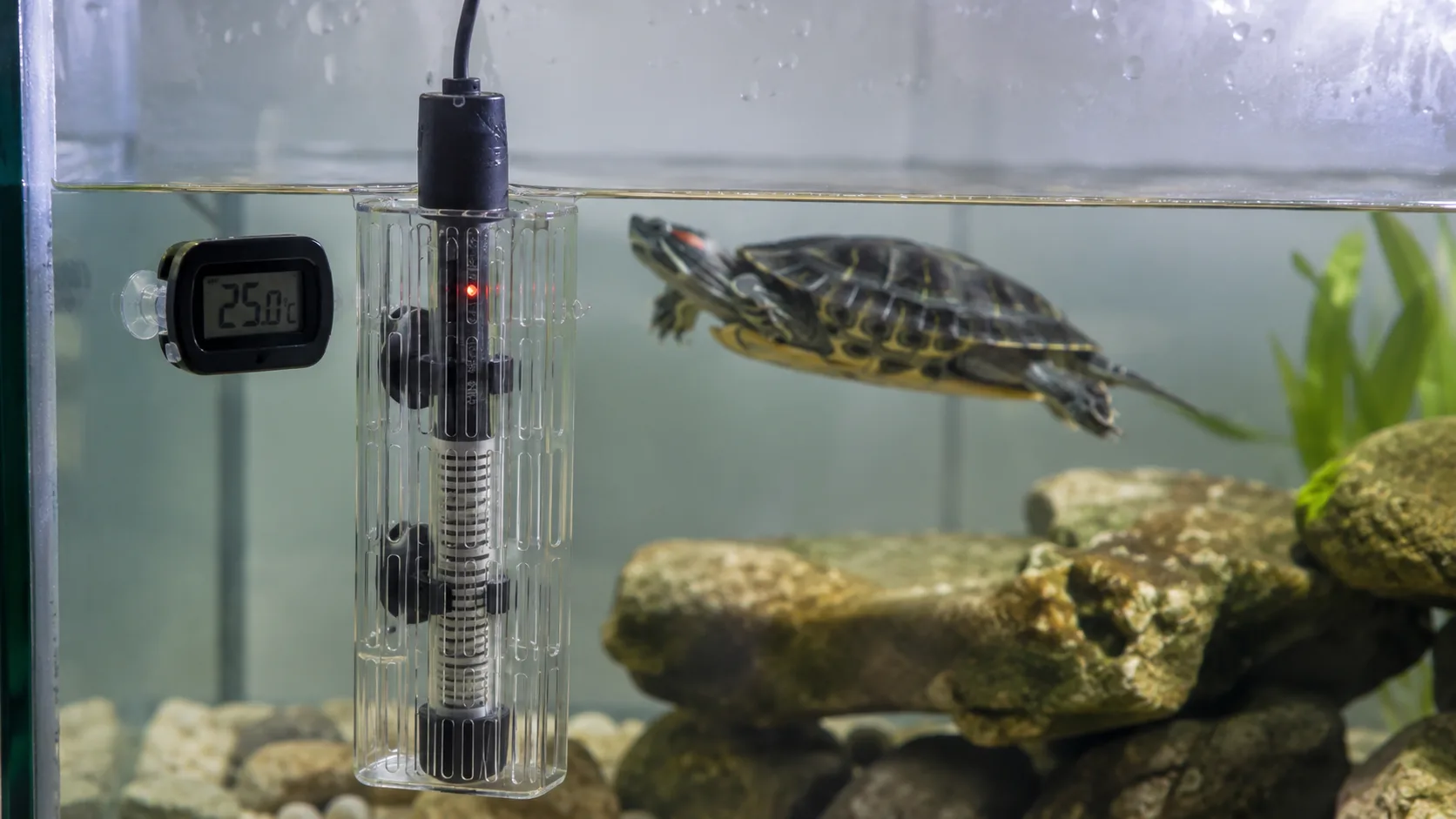
Red-eared sliders need water at 24–27 °C (75–80 °F) for healthy adults and 26–28 °C (78–82 °F) for hatchlings. Use a fully-submersible aquarium heater inside a protective sleeve to prevent the turtle cracking the glass. Two smaller heaters are safer than one large one. Sustained water below 22 °C suppresses immunity and promotes shell rot.
- Author
- Reptimo Editorial
- Updated
- Updated
- Reading time
- 5 min read
Water temperature targets by life stage
Red-eared sliders (Trachemys scripta elegans) are semi-aquatic turtles that spend the majority of their time in the water. Water temperature drives swimming activity, digestion, and immune function. Per PetMD's slider care sheet and The Bio Dude's care sheet, the targets are:
Care parameters
Red-eared slider water temperature by life stage
| Parameter | Recommended value | Notes |
|---|---|---|
| Adult (over 10 cm shell) | 24–27 °C / 75–80 °F | Year-round, 24/7 |
| Hatchling / juvenile (under 10 cm shell) | 26–28 °C / 78–82 °F | Hotter to fuel fast growth |
| Recovering / sick turtle | 26–28 °C / 78–82 °F | Warmer water supports immune function and healing |
| Acceptable floor | ≥ 22 °C / 72 °F | Sustained below this raises shell rot / RI risk |
| Hard ceiling | ≤ 28 °C / 82 °F | Above: turtle basks constantly, ammonia accumulates faster |
Heater choice and safety
Sliders are powerful animals that will eventually crack an unprotected glass aquarium heater. Two safety rules:
1. Always inside a protective sleeve or guard. Polycarbonate guards, stainless mesh sleeves, or titanium-cased heaters are acceptable. A bare glass heater in a slider tank is a when-not-if scenario for cracking — leading to electric shock to the turtle, the keeper, and water damage to the surrounding area.
2. Two smaller heaters beat one large one. Failure redundancy in both directions:
- If one heater fails ON (sticking heating element, broken thermostat), the second smaller one can't single-handedly overheat the tank.
- If one fails OFF, the second keeps the tank stable while you replace.
Distribute the two heaters at opposite ends of the tank for even heating.
Sizing the heater
Rough rule: 5 W per US gallon of tank volume.
Care parameters
Heater sizing for a slider tank
| Parameter | Recommended value | Notes |
|---|---|---|
| 40 US gal (150 L) juvenile tank | 200 W total | 2 × 100 W or 1 × 200 W heater |
| 75 US gal (280 L) adult minimum | 300 W total | 2 × 150 W heaters preferred |
| 100 US gal (380 L) adult standard | 400–500 W total | 2 × 200–250 W heaters |
| Outdoor pond (mild climate) | Pond heater or de-icer | Different gear — consult pond suppliers |
Brands and types:
- Eheim Jäger / Thermo-Control — robust, accurate, with built- in thermostat. Glass with optional protective sleeve.
- Cobalt Aquatics Neo-Therm — polycarbonate body with built-in protection, accurate thermostat. Higher end of the price range.
- Fluval E series — accurate, easy thermostat, with built-in protective casing.
- Aqueon Pro / Hagen Marina — budget options; pair with a separate heater guard.
Always pair any heater with a separate digital aquarium thermometer on the opposite end of the tank — the heater's built-in dial drifts over time and a 2 °C offset is normal.
What happens when water is wrong
Sustained cold water (< 22 °C / 72 °F):
- Suppressed immune function.
- Slow or stopped digestion (refused food, slow growth).
- Significantly raised shell rot risk — see the shell rot guide.
- Raised respiratory infection risk.
- Lethargy, hiding underwater more than usual.
- Reduced basking (cold turtle is too sluggish to climb out).
Sustained hot water (> 28 °C / 82 °F):
- Constant basking as the turtle tries to dry off and warm at a cooler air layer.
- Reduced oxygen solubility (turtles surface to breathe but ammonia builds up faster).
- Stress, possible refusal of food.
- Bacterial growth accelerated.
The middle band (24–27 °C / 75–80 °F adult, 26–28 °C juvenile) is forgiving — small daily fluctuations in this range are fine. The problem is sustained drift outside it.
How to measure correctly
Three tools, used together:
- Digital aquarium thermometer — fully submerged, mounted on the opposite end of the tank from the heater. Cross-checks the heater's thermostat.
- Infrared (IR) temperature gun — for spot-checks at the water surface and the basking platform. Cheap IR guns in the 0–60 °C range work fine.
- Heater's built-in dial — useful for setting the target but unreliable for verification. Recalibrate against the separate thermometer monthly.
Per the Merck Veterinary Manual, inadequate water temperature in semi-aquatic species is a documented contributor to chronic illness — and the most preventable one.
Water temperature alone is not enough
A correctly heated water column is necessary but not sufficient. Sliders also need:
- Strong filtration (2–3× tank volume per hour) to keep water quality high at the warmer temperature (bacteria multiply faster in warm water).
- A dry basking surface at 32–35 °C with strong UVB — see the pillar care guide.
- Regular partial water changes (25–30 % weekly).
- Clean monitoring — water-quality test strips weekly catch ammonia spikes before the turtle is affected.
The broader husbandry context and the rest of the slider care system live in the pillar guide; the early-warning patterns for illness across species are in "is my reptile sick?".
Frequently asked questions
What water temperature should a red-eared slider tank be?
What happens if the water is too cold?
What happens if the water is too hot?
What kind of aquarium heater should I use for a slider?
Why do I need a protective sleeve on the heater?
Should I use one big heater or two smaller ones?
How do I measure the water temperature accurately?
Does a red-eared slider need warm water at night?
Do I need water and basking temperatures both?
Sources
- Red-Eared Slider Care Sheet · PetMD
- Red Ear Slider Care and Maintenance · The Bio Dude
- Red-Eared Slider Shell Rot — Causes, Symptoms & Treatment · TurtleHolic
- Disorders and Diseases of Reptiles · Merck Veterinary Manual
Quick check
Test what you just learned
A short quiz, just for you. Pick an answer to get instant feedback — there's no pass mark, this is for your benefit.
Quiz questions and answers
What's the correct water temperature for an ADULT red-eared slider?
Correct answer: 24–27 °C (75–80 °F)
Adults: 24–27 °C (75–80 °F) year-round. Hatchlings: slightly warmer (26–28 °C). The 32–35 °C target is for the BASKING surface (dry platform), never the water — that hot would cook the turtle.
Why must an aquarium heater for a slider be in a protective sleeve?
Correct answer: Sliders will eventually crack an unprotected glass heater, risking electric shock and tank damage
Sliders are powerful and will crack an unprotected glass heater by collision, deliberate worrying, or levering. A cracked heater shorts to the tank water — electric shock risk, structural damage. A polycarbonate or stainless heater guard is non-negotiable.
Two smaller heaters or one big one?
Correct answer: Two smaller ones — failure redundancy in both directions
Two smaller heaters totalling the right wattage are safer. If one fails ON (overheats) the other keeps the tank from overcooling; if one fails OFF, the other keeps the tank stable. Distributed at opposite ends gives even heating too.
What's the main consequence of sustained cold water?
Correct answer: Suppressed immune function, raised shell-rot and respiratory infection risk
Sustained water below 22 °C suppresses immune function, slows digestion, and significantly raises the risk of shell rot (white/grey patches, soft spots) and respiratory infection. Cold water is the most common driver of preventable slider illness.