What do red-eared sliders eat?
Short answer
Red-eared sliders are omnivores whose diet inverts with age. Hatchlings and juveniles need ~70 % protein (commercial pellets, F/T bloodworms, small earthworms) and ~30 % aquatic plants. Adults shift to ~70 % plants (romaine, dandelion, duckweed) and ~30 % protein (pellets 2–3 times per week, occasional fish or earthworms). Calcium and a UVB-driven D3 supply prevent shell deformities.
- Author
- Reptimo Editorial
- Updated
- Updated
- Reading time
- 5 min read
Diet by life stage
Red-eared sliders (Trachemys scripta elegans) are omnivores whose diet inverts dramatically with age. Hatchlings need protein for fast growth; adults need fibre and calcium-rich plant matter to avoid obesity and shell pyramiding. Per PetMD's slider care sheet and The Bio Dude's care sheet:
Care parameters
Red-eared slider diet by life stage
| Parameter | Recommended value | Notes |
|---|---|---|
| Hatchling (under 8 cm shell, 0–6 months) | ~70 % protein / 30 % plants | Protein daily |
| Juvenile (8–13 cm shell, 6–18 months) | ~60 % protein / 40 % plants | Protein daily |
| Sub-adult (13–18 cm shell, 18–36 months) | ~50/50 | Protein every other day |
| Adult (over 18 cm shell) | ~70 % plants / 30 % protein | Protein 2–3×/week |
| Plants for all stages | Always available | Romaine, dandelion, duckweed, etc. |
Protein sources
For hatchlings and juveniles, protein needs to provide steady growth without excess fat. Modern recommendations from TurtleHolic's care guide:
- Commercial pellets (staple) — Mazuri Aquatic Turtle Diet, Zoo Med Natural Aquatic Turtle Food (Growth Formula for juveniles, Maintenance Formula for adults), Tetra Reptomin. Fortified with calcium and vitamins. The base of the protein side of the diet.
- F/T bloodworms (variety) — small frozen-thawed blood worms available at aquarium stores.
- Earthworms (variety) — F/T or freshly killed, sliced into age-appropriate sizes for juveniles.
- Insects (variety) — F/T crickets, dubia roaches, BSFL — occasional supplements.
- Small fish (occasional treat) — minnows, guppies. NOT goldfish — see below.
- Skip: cat/dog food (wrong protein/fat balance), processed meats, anything human-table.
Why avoid feeder goldfish: goldfish contain thiaminase, an enzyme that destroys vitamin B1 (thiamine). Repeated goldfish feeding causes vitamin B1 deficiency and neurological problems — documented across multiple species of fish-eating reptiles. Per Merck Veterinary Manual, this is one of the few diet-driven reptile health issues with clear causal evidence. Minnows and guppies are safer occasional choices.
Plant matter
Plants make up the increasing share of adult slider diet. Daily- safe staples (always available in the tank or feeding container):
- Romaine lettuce — safe daily; rotates well.
- Dandelion greens — high calcium, safe daily.
- Mustard greens — good calcium:phosphorus ratio.
- Collard greens — daily-safe staple.
- Escarole, turnip greens, endive — variety rotation.
- Aquatic plants (ideal) — duckweed, water lettuce, water hyacinth, anacharis, hornwort. Slider grazes naturally; they're also edible enrichment.
Daily rotation (not daily as the sole green):
- Bok choy, watercress, arugula.
Limit to 1–2 times per week:
- Kale — high oxalate (binds calcium).
- Spinach — high oxalate.
Never feed:
- Iceberg lettuce — nutritionally empty (~96 % water).
- Toxic plants — avocado, rhubarb leaves, onion family.
- Fatty greens that aren't actually greens.
Feeding mechanics
Two approaches:
In-tank feeding (simpler). Drop pellets in the water, allow the slider to eat in its own time. Remove uneaten food after 15–20 minutes to keep water quality high. Plants can stay in for grazing.
Separate feeding container (cleaner). Move the slider to a separate plastic tub of water during meals. Keeps the main tank cleaner. Adds handling stress and an extra step — used by some keepers but not necessary if filtration is adequate.
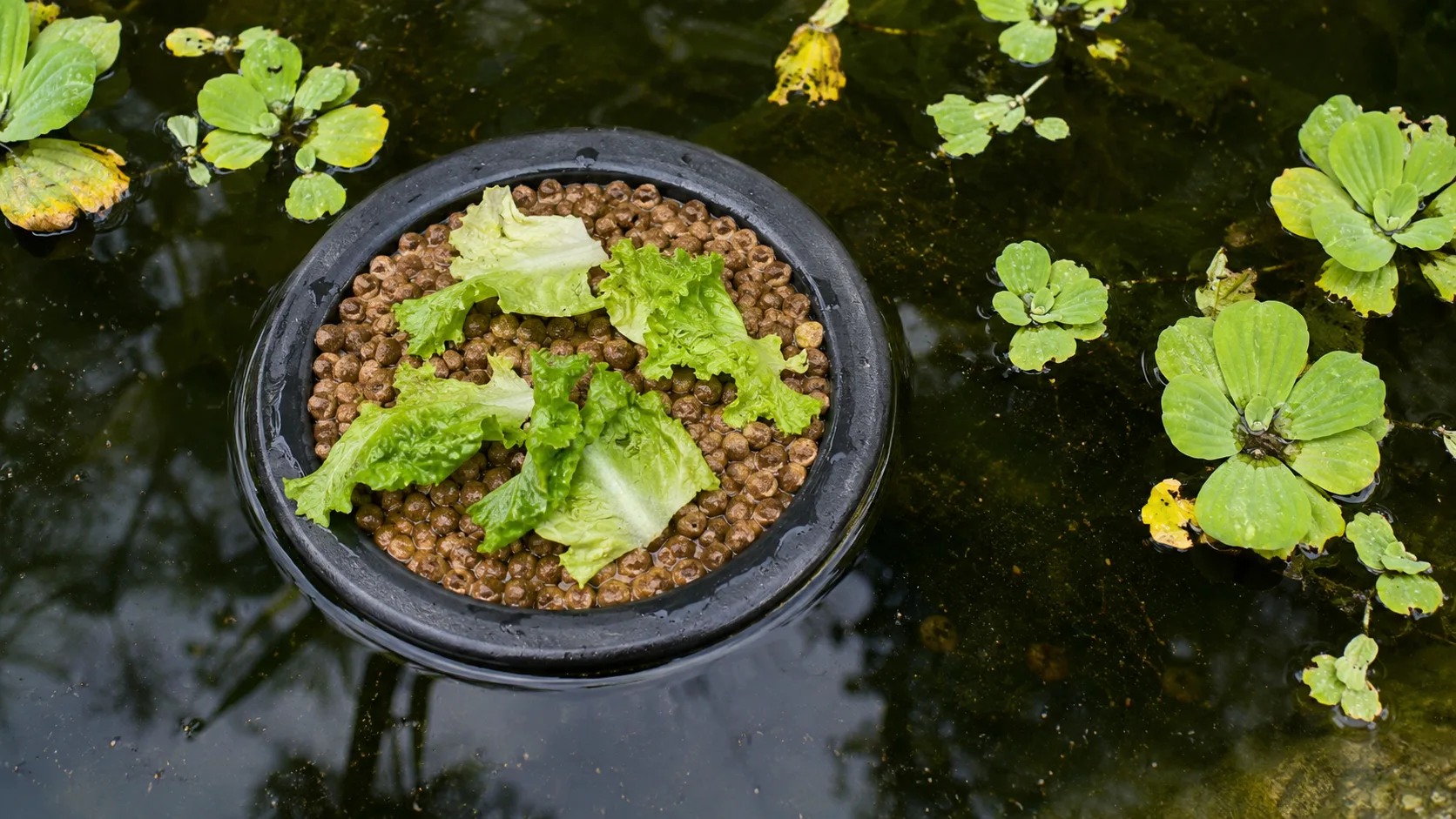
A floating feeding ring (sold at aquarium stores) keeps pellets contained for in-tank feeding — easier to spot-clean uneaten food.
Calcium and D3
Sliders need calcium for shell development and bone health. Two key sources:
- Cuttlefish bone (calcium block) — leave a piece floating in the tank as a free-choice gnawing surface. Slider gnaws as needed.
- Quality pellets are calcium-fortified. Combined with cuttlebone, this usually covers calcium intake.
Calcium absorption requires vitamin D3, which sliders synthesise in their skin under UVB exposure. Without proper UVB, no amount of calcium fixes the deficiency — calcium passes through. See the UVB guide.
Multivitamin powder dusted on pellets occasionally (every 2 weeks) covers trace nutrients. Most commercial pellets include multivitamin in the formula; over-supplementation is the bigger risk than under-supplementation if pellets are the primary food.
Feeding frequency
Care parameters
Red-eared slider feeding frequency by life stage
| Parameter | Recommended value | Notes |
|---|---|---|
| Hatchling / juvenile (under 13 cm shell) | Protein DAILY + plants always available | |
| Sub-adult (13–18 cm shell) | Protein every other day + plants always available | |
| Adult (over 18 cm shell) | Protein 2–3×/week + plants always available | |
| Calcium (cuttlefish bone) | Always available | |
| Multivitamin dust (if pellets aren't fortified) | Every 2 weeks |
Adults often hand a piece of feeder behaviour when fed too often — they become greedy and may bite during pellet drops. Drop frequency to 2 times per week if your adult is showing both behavioural greediness and body condition issues.
Body condition
Check shell condition and weight monthly:
- Healthy shell: smooth scutes, no raised lumps, even coloration, hard surface that doesn't dent.
- Shell pyramiding: raised scutes like a stack of pyramid shapes — signals overfeeding (especially excess protein in juveniles fed adult-frequency pellets).
- Soft, pliable shell in a juvenile — calcium / D3 deficiency, often UVB-driven. See the shell rot guide for related shell signs.
- Visible fat deposits around the legs and base of the shell — obesity, reduce frequency.
What goes wrong
Common diet-related problems in captive sliders:
- Shell pyramiding — too much protein in juvenile phase continued into adulthood. Reduce pellet frequency; introduce more plants.
- Obesity and fatty liver — daily pellets in an adult, lack of swimming exercise (often paired with undersized tank — see the tank size guide).
- Metabolic bone disease — calcium / D3 deficiency, almost always inadequate UVB.
- Vitamin B1 deficiency — neurological issues from feeder goldfish; preventable by avoiding goldfish.
The broader husbandry context is in the pillar care guide; UVB setup in the UVB guide; water temperature in the water temperature guide.
Frequently asked questions
What do baby red-eared sliders eat?
What do adult red-eared sliders eat?
How often do you feed a red-eared slider?
What's the best pellet brand for red-eared sliders?
Can red-eared sliders eat fruit?
What greens are safe for red-eared sliders daily?
Should I feed live fish to my red-eared slider?
How much calcium does a slider need?
Can red-eared sliders eat dog or cat food?
Sources
- Red-Eared Slider Care Sheet · PetMD
- Red Ear Slider Care and Maintenance · The Bio Dude
- Red-Eared Slider Diet · TurtleHolic
- Disorders and Diseases of Reptiles · Merck Veterinary Manual
Quick check
Test what you just learned
A short quiz, just for you. Pick an answer to get instant feedback — there's no pass mark, this is for your benefit.
Quiz questions and answers
What's the right diet ratio for an ADULT red-eared slider?
Correct answer: ~70 % plants (greens, aquatic plants), ~30 % protein (pellets 2–3×/week)
Adults invert the hatchling ratio — ~70 % plant matter and 30 % protein. Daily pellets in an adult cause obesity, fatty liver, and shell pyramiding. The plant-heavy adult diet matches their natural omnivorous shift.
Which fish should you NEVER use as a feeder for a slider?
Correct answer: Feeder goldfish — they destroy vitamin B1 with repeated feeding
Feeder goldfish contain thiaminase, which destroys vitamin B1 (thiamine) in the slider and causes neurological problems over time. Minnows and guppies are safer occasional treats; worms are safer staples.
How often does an ADULT red-eared slider eat protein?
Correct answer: 2–3 times per week (pellets and occasional protein); plants always available
Adults: protein 2–3 times per week, plants always available. Daily protein causes obesity, fatty liver, and shell pyramiding. Hatchlings need daily protein because they're growing; adults need less.
What drives metabolic bone disease in red-eared sliders?
Correct answer: Inadequate UVB combined with calcium deficiency — calcium can't be absorbed without D3
MBD in sliders is a calcium + vitamin D3 deficiency. UVB lighting drives D3 synthesis; D3 enables calcium absorption. Wrong or expired UVB + low-calcium diet = MBD. Correct UVB plus pellets and a calcium block prevents it.