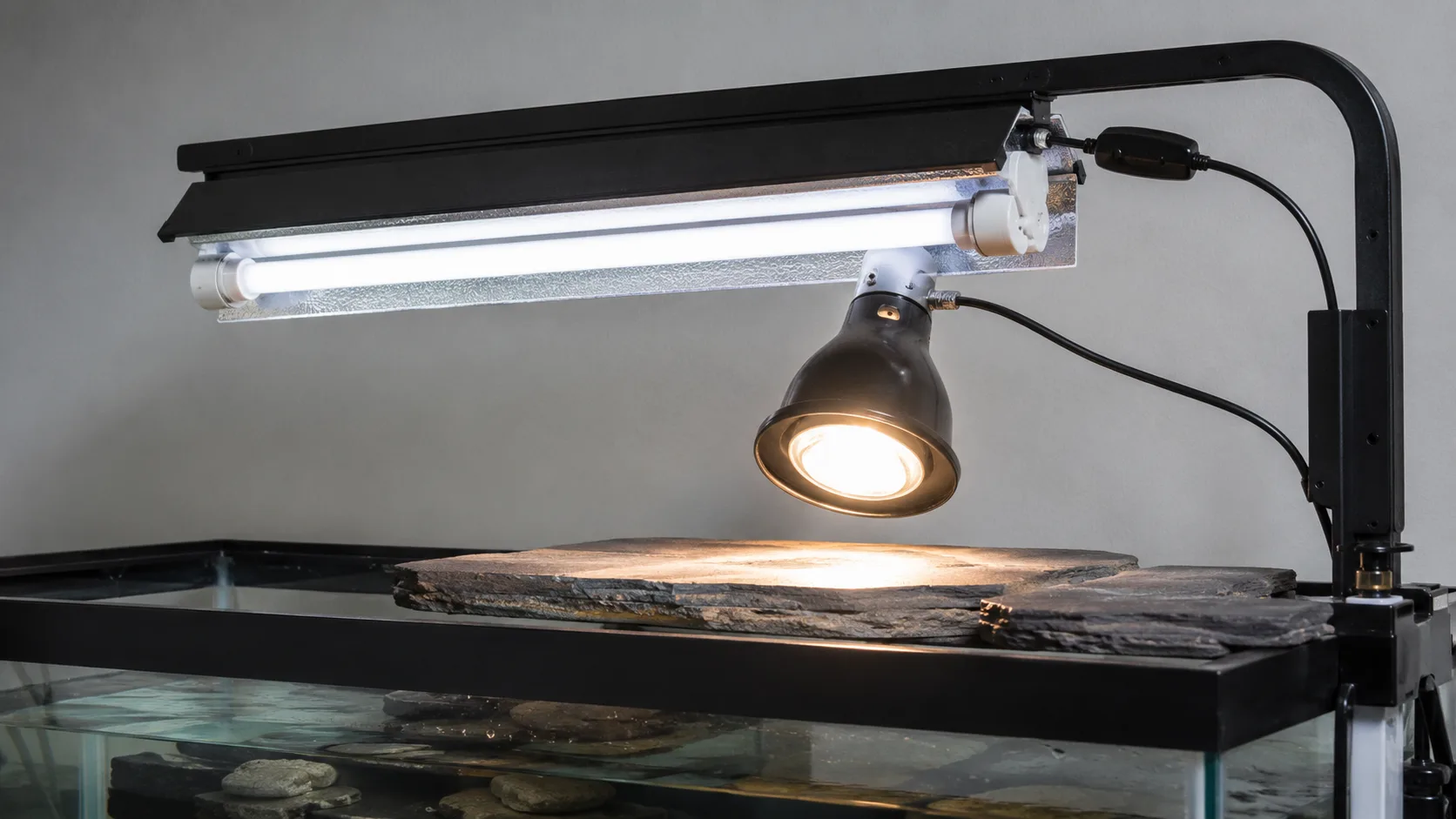
Do red-eared sliders need a UVB light?
Short answer
Yes, strongly. Red-eared sliders need a T5 high-output UVB tube giving UVI 3–4 at the basking surface, mounted inside the enclosure with no glass barrier between bulb and turtle. Replace every 12 months. UVB drives vitamin D3 synthesis that lets the turtle absorb calcium for shell development — without it, metabolic bone disease and soft shell develop within months.
- Author
- Reptimo Editorial
- Updated
- Updated
- Reading time
- 6 min read
Why UVB is non-negotiable
Red-eared sliders (Trachemys scripta elegans) are diurnal freshwater turtles from the sunny southern United States. In the wild they spend hours basking on logs and rocks, soaking up UVB that drives vitamin D3 synthesis in their skin. D3 lets them absorb dietary calcium into bone and shell.
In captivity, UVB is not optional. Per PetMD's slider care sheet and consistent guidance across reputable care literature:
- Without UVB: metabolic bone disease (MBD) develops within months, presenting as soft pliable shell, shell deformities, slow growth, weakness, and eventually fractures.
- With wrong UVB (compact coil, expired tube, behind glass): same result, often slower onset.
- With correct UVB: the slider's shell and bones develop normally, no MBD.
The combination of correct UVB + correct calcium-rich diet is the two-step prevention for the single most common preventable slider illness. See the diet guide for the dietary calcium side; this guide covers the UVB side.
What UVI does a slider need
Red-eared sliders fall in Ferguson Zone 3 (partial-sun basker) in the framework documented by Zen Habitats' Ferguson zone explainer:
Care parameters
Red-eared slider UVB targets
| Parameter | Recommended value | Notes |
|---|---|---|
| UVI at basking | 3.0–4.0 | Solarmeter 6.5 reading on the basking platform |
| Bulb type | T5 HO linear tube | Arcadia Dragon 12 % or Zoo Med ReptiSun 10.0 |
| Bulb length | Cover most of the basking platform width | Longer is better; gives gradient |
| Distance to basking | 25–30 cm / 10–12 in | From reflector to shell surface |
| Replacement | Every 12 months | Log install date; UV drops before visible light |
| Photoperiod | 12 h on / 12 h off | Mechanical timer; same on/off cycle as basking lamp |
Which bulb to buy
Two industry-standard T5 high-output tubes work for sliders:
- Arcadia Dragon 12 % T5 HO — popular in the UK and EU, high UV output, pairs with Arcadia Pro T5 reflector fixture.
- Zoo Med ReptiSun 10.0 T5 HO — common in North America, pairs with Zoo Med T5 HO fixture.
Both produce the right UVI for a slider at the standard 25–30 cm distance from a reflector.
Mercury vapour combo bulbs (basking + UVB in one fixture) are acceptable, especially in deep tanks where mounting a T5 tube at the right distance is harder. Powersun or Solar Glo are the common brands. Trade-offs: less precise UVB control, runs hot, must be replaced every 12 months, more expensive per unit.
Compact UVB coils consistently underperform in independent meter testing and are not recommended. The cross-species UVB guide goes deeper on bulb choice.
Mounting the tube correctly
Per The Bio Dude's care sheet:
- Inside the enclosure or on an external bracket projecting through an opening — no glass between bulb and turtle. Glass blocks ~95 % of UVB.
- With a reflector — without one, half the bulb's UV is wasted. Use the manufacturer's fixture or a quality T5 HO reflector.
- Covering most of the basking platform width so the turtle gets even exposure regardless of where it sits.
- 25–30 cm (10–12 in) from the basking surface measured to the shell of a basking slider. Closer = over-exposure risk; further = insufficient UVB.
- Splash-proof fixture if mounting where water spray might reach. Most reptile fixtures aren't waterproof — keep them protected.
For deep tanks where the basking platform sits high above the water but the lid is also high, mounting brackets that suspend the UVB fixture at the right distance are the solution. Don't just put the bulb on top of the glass lid and hope.
Replacement schedule
T5 HO tubes keep emitting visible light for years, but useful UV output collapses 9–14 months after install. Replace on schedule, not by appearance.
Care parameters
UVB replacement schedule
| Parameter | Recommended value | Notes |
|---|---|---|
| T5 HO tube | Every 12 months | |
| T8 tube (older, lower output) | Every 6 months | |
| Mercury vapour combo bulb | Every 12 months | |
| Compact UVB coil | Every 6 months | Consider replacing with T5 instead |
Practical tips:
- Write the install date on the bulb with permanent marker the day you fit it. Saves arguments months later.
- Set a 12-month calendar reminder the same day. Reptimo's UVB-age tracker handles this automatically.
- Solarmeter 6.5 is the only consumer meter that reads UVI accurately. Verify your bulb's output at the basking surface every few months and replace earlier if it drops below UVI 3.0.
What happens without UVB
The progression of UVB deficiency in sliders is depressingly predictable:
- Months 1–3: no visible signs. Bone density slowly drops as dietary calcium passes through without D3.
- Months 3–6: subtle shell softness (you can dent the shell gently with a fingernail in advanced cases). Slow growth in juveniles.
- Months 6–12: visible shell deformities — flattening, uneven scute patterns, pyramiding combined with softness. Weakness, reduced basking.
- Beyond 12 months: advanced MBD — soft jaw, fractures from minor activity, paralysis, death.
The condition is progressive and often irreversible once advanced. Treatment of moderate-to-severe MBD requires veterinary intervention (calcium injections, D3 supplementation, pain management) and may leave permanent shell deformities even after recovery.
The simplest defence: correct UVB from day one, replaced on schedule.
Co-conditions with shell rot
Per Merck Veterinary Manual, shell-related illnesses often cluster: a slider with chronic shell rot frequently also has inadequate UVB and chronic moisture issues. The shell rot guide covers the moisture and water-quality side; this guide covers the UVB side; together they address the most common slider shell problems.
What to skip
- Window sun — glass blocks UVB. Useless for D3 synthesis.
- "Full-spectrum" non-UVB bulbs — don't deliver biologically meaningful UVB.
- Heat lamp without UVB — heat alone doesn't drive D3 synthesis.
- UVB bulbs older than the replacement schedule — emitting light but not useful UV.
- Compact "coil" UVB bulbs — underperform consistently.
The broader husbandry context is in the pillar care guide; the parallel water temperature setup in the water temperature guide; the diet that complements UVB in the diet guide; and the cross-species UVB framework in the cross-species UVB guide.
Frequently asked questions
Do red-eared sliders really need UVB?
What's the best UVB bulb for a red-eared slider?
How far should the UVB bulb be from the basking platform?
How often should I replace a slider's UVB bulb?
Can a slider get UVB through glass?
What happens if a slider doesn't get UVB?
Can sunlight from a window replace UVB?
Should I use a mercury vapour combo bulb for a slider?
How do I measure if my UVB is working?
Sources
- Red-Eared Slider Care Sheet · PetMD
- Red Ear Slider Care and Maintenance · The Bio Dude
- What Are Ferguson Zones? · Zen Habitats
- Metabolic Bone Disease (MBD) in Reptiles · PetMD
Quick check
Test what you just learned
A short quiz, just for you. Pick an answer to get instant feedback — there's no pass mark, this is for your benefit.
Quiz questions and answers
What UVI does a red-eared slider need at the basking surface?
Correct answer: 3.0–4.0 (partial sun basker)
Red-eared sliders are partial-sun baskers — Ferguson Zone 3 in the UVB framework — needing UVI 3.0–4.0 at the basking surface, verified with a Solarmeter 6.5. Lower causes MBD; sustained higher is unnecessary and can stress.
How often should you replace a T5 HO UVB tube?
Correct answer: Every 12 months, logged from install date
T5 HO tubes lose most of their UV output 9–14 months after install but keep emitting visible light for years. Replace every 12 months and log the install date. Visible light is not a reliable indicator of UV output.
Can a slider get UVB through window glass?
Correct answer: No — glass blocks ~95 % of UVB. Mount the bulb inside the enclosure
Standard glass blocks roughly 95 % of UVB. The bulb must be mounted inside the enclosure with no glass between it and the turtle. Direct outdoor sun (no glass) is excellent UVB; through-window sun is not.
What happens to a slider that doesn't get adequate UVB?
Correct answer: Metabolic bone disease — soft pliable shell, shell deformities, slow growth, eventually fractures
MBD develops within months without proper UVB. Calcium can't be absorbed without vitamin D3 (which the slider synthesises under UVB), so bone and shell demineralise. Progressive and often irreversible once advanced — prevention is the only reliable strategy.