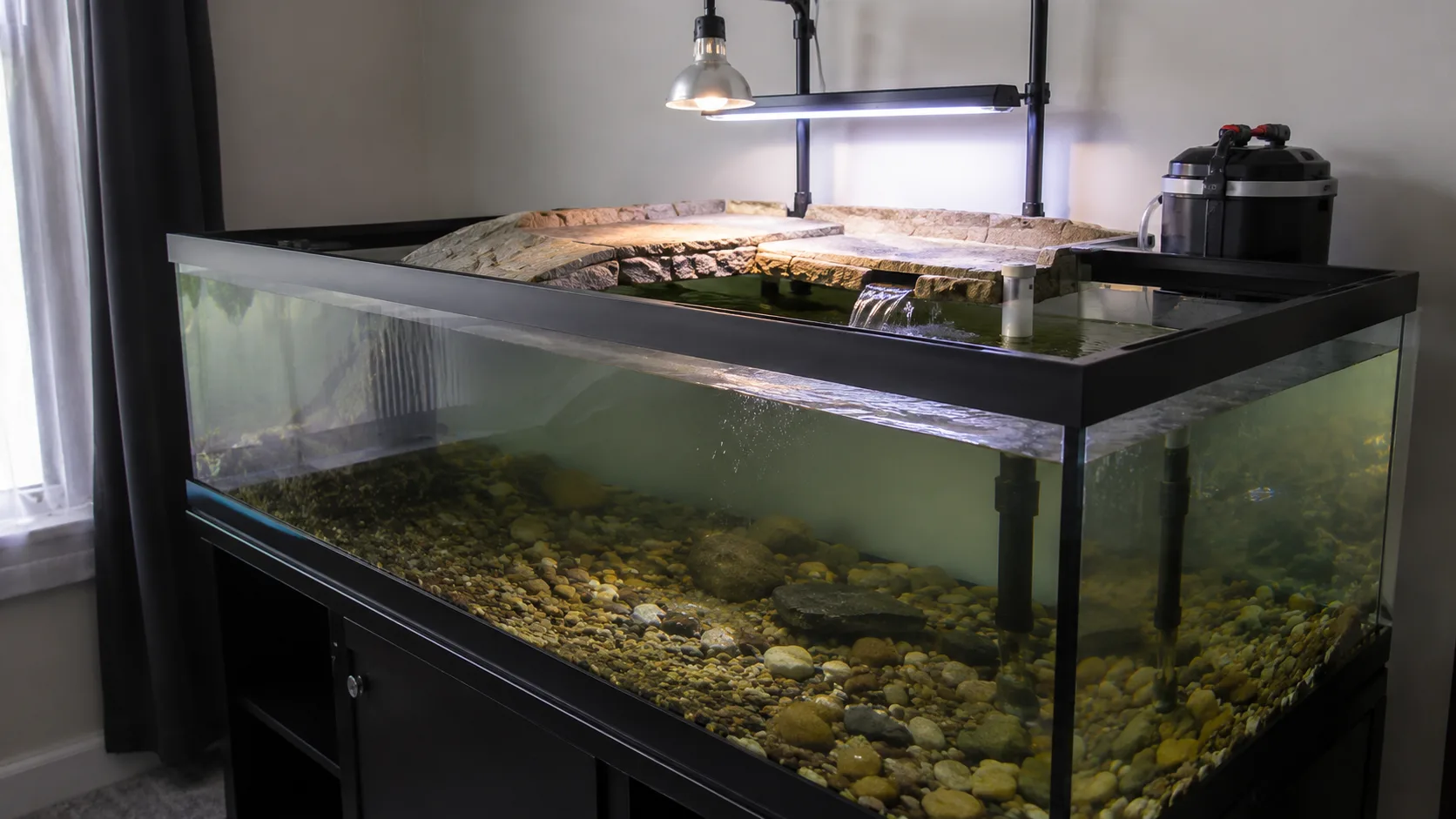
How big a tank does a red-eared slider need?
Short answer
Adult red-eared sliders need at least 280 L (75 US gallons) of swimming water, with 380 L (100 US gal) preferred. Females (25–30 cm shell) need more space than males (15–20 cm). The "10-gallon starter kit" sold for hatchlings is grossly undersized within 6–12 months. Outdoor ponds in mild climates beat any indoor tank.
- Author
- Reptimo Editorial
- Updated
- Updated
- Reading time
- 6 min read
The starter-kit problem
The single most documented red-eared slider (Trachemys scripta elegans) welfare issue is undersizing. The 10-gallon (~40 L) starter kit that pet stores sell with hatchlings is OK for the first few months — and grossly inadequate for the next 20–40 years of the turtle's life. Per PetMD's slider care sheet and The Bio Dude's care sheet:
- A hatchling slider is the size of a coin.
- An adult female is the size of a dinner plate (25–30 cm shell).
- The growth happens in the first 3–5 years and is mostly done by year 5.
A keeper who buys "the small tank with the cute baby" and doesn't plan for upgrade ends up with a stunted, often shell-deformed adult — or surrenders the slider. Both outcomes are preventable with proper sizing from the start.
Tank size by life stage
The standard rule: 38 L (10 US gallons) of swimming water per inch of shell length.
Care parameters
Red-eared slider tank size by life stage
| Parameter | Recommended value | Notes |
|---|---|---|
| Hatchling (under 8 cm shell, 0–6 months) | 40 L / 10 US gal | Brief acceptable; upgrade within 6 months |
| Juvenile (8–13 cm shell, 6–18 months) | 80–150 L / 20–40 US gal | |
| Sub-adult (13–18 cm shell, 18–36 months) | 150–280 L / 40–75 US gal | |
| Adult female (25–30 cm shell) | 280 L MIN, 380 L preferred / 75–100 US gal | |
| Adult male (15–20 cm shell) | 200 L MIN, 280 L preferred / 55–75 US gal | |
| Outdoor pond (mild climate) | 1,000+ L preferred |
The volume above is swimming water only, not total tank volume. A 75-US-gallon tank with a basking platform displacing 10 gallons gives 65 gallons of water — that's the meaningful number.
How to calculate
For a slider at any age:
- Measure the shell length (carapace) in inches.
- Multiply by 10 — that's the minimum US gallons of water.
- Add basking platform volume (5–10 gal typical).
- Choose a tank with total volume of at least step 2 + step 3.
Example: a 10-inch (25 cm) adult female shell × 10 = 100 US gal water minimum. Plus a 5–10 gal basking platform = 105–110 gal tank.
Per TurtleHolic's care guide, this is a floor not a ceiling — sliders thrive with more space.
Water depth
Per most modern care literature: water depth at least 1.5× the shell length. For a 25 cm female, that's at least 38 cm of water depth.
Why depth matters:
- Sliders evolved to swim, not wade. Shallow water restricts natural movement.
- Sliders right themselves in water if they end up belly-up. Shallow water makes this impossible.
- Deep water provides thermal stratification — sliders descend to cooler water and surface to warmer water.
The very shallow "filled-with-just-enough-to-cover-the-shell" setup that some keepers default to is welfare-inadequate.
Indoor housing options
Care parameters
Indoor slider housing options
| Parameter | Recommended value | Notes |
|---|---|---|
| Standard glass aquarium (75–125 US gal) | Visually appealing, expensive | Most common adult choice; heavy |
| Plastic stock tank (Rubbermaid 110+ gal) | Budget-friendly, easy to clean | Less attractive but more water per pound |
| Custom acrylic tank | Excellent but expensive | |
| Modified plastic pond liner indoors | DIY option, very large water volume | |
| Above-ground pond / paludarium | Gold standard if you have space |
Stock tanks (Rubbermaid 110-gallon stock tanks, Behlen plastic ponds) are common among experienced keepers — they hold 400+ L of water for £50–100 / $50–125, far cheaper per litre than glass aquariums, and don't crack if a turtle bumps them.
Outdoor pond — the gold standard
In climates with stable warm seasons (15+ °C overnight, 25–35 °C daytime in summer), an outdoor pond is the best slider housing option:
- Direct unfiltered sunlight — the best UVB source available. No bulb matches it.
- Natural temperature gradient with shaded retreats.
- Pond volume typically 1,000+ L easily.
- Behavioural enrichment beyond any indoor tank.
Requirements:
- Predator-proof: secure mesh top against herons, raccoons, hawks, foxes, cats.
- Escape-proof: secure walls (sliders climb), no overhanging branches the slider can use to leverage out.
- Reliable shaded retreat from peak sun (heat stroke risk).
- Year-round monitoring: in cold winters, bring sliders indoors or provide a heated retreat. Brumation in outdoor ponds requires specific setups not covered here.
Hatchling progression
Plan for two enclosure upgrades in the first 2 years:
- Months 0–6: 40–80 L starter tank with strong filtration.
- Months 6–18: upgrade to 150–280 L (40–75 US gal) tank.
- Months 18–24: upgrade to the adult 280–380 L (75–100 US gal) tank.
Some keepers go straight to the adult tank from day one — works fine if the hatchling has plenty of low-water-depth areas, hides, and a basking platform sized for a small turtle. The trade-off: the small turtle in a big tank can be harder to spot if it gets stuck, so monitor closely.
Female vs male sizing
This is the single most-missed sizing consideration. Females significantly outgrow males:
- Female: 25–30 cm shell, ~1.5–2.5 kg.
- Male: 15–20 cm shell, ~0.5–1 kg.
If you're getting a hatchling and don't know the sex, plan for the female case — buy or build the adult enclosure for a 75–100 US gal female. If the slider turns out to be male, you have welcome extra space; if female, you avoid a second upgrade.
Co-housing — usually no
Per PetMD:
- Two adult females can sometimes coexist in 380+ L, with vigilance for bullying.
- Two males WILL fight, often seriously.
- Mixed-sex pairs result in male harassment of female, forced breeding stress, and unwanted egg production.
The simplest safe default for pet keeping: house adults individually.
What enclosure size enables
A proper-sized enclosure enables the rest of slider care:
- Strong filtration with adequate volume to filter properly.
- Real thermal gradient between warm basking and cool water.
- Quality basking platform that's dry and accessible.
- Natural behaviour — swimming, diving, exploring.
The water temperature, basking, UVB, and diet setup live in the sibling guides: water temperature, UVB, diet. The full husbandry context is in the pillar care guide; the prevention-side for the most common slider illness is in the shell rot guide.
Frequently asked questions
What's the minimum tank size for an adult red-eared slider?
Is a 10-gallon tank enough for a baby slider?
How do you calculate the right tank size for a slider?
Outdoor pond vs indoor tank for a slider?
Do males and females need different tank sizes?
What water depth does a slider need?
Can I keep two red-eared sliders together?
How long can a hatchling slider stay in a small tank?
What about a glass aquarium vs a stock tank for a slider?
Sources
- Red-Eared Slider Care Sheet · PetMD
- Red Ear Slider Care and Maintenance · The Bio Dude
- Red-Eared Slider Care & Maintenance Guide · TurtleHolic
Quick check
Test what you just learned
A short quiz, just for you. Pick an answer to get instant feedback — there's no pass mark, this is for your benefit.
Quiz questions and answers
What's the minimum swimming-water volume for an ADULT FEMALE red-eared slider?
Correct answer: 280 L (75 US gal), with 380 L (100 US gal) preferred
Adult females reach 25–30 cm shell and need at least 280 L of swimming water, with 380 L preferred. The 10-gallon 'starter kit' is grossly undersized — fine for a hatchling for a few months, completely inadequate within a year.
What's the rule of thumb for slider tank sizing?
Correct answer: 38 L (10 US gal) per inch of shell length, water volume only
The 10-gallons-per-inch-of-shell rule (38 L per 2.54 cm) scales with growth. Track shell length and upgrade tank size accordingly. The rule is for water volume — not total tank volume.
What's the best housing for a slider in a mild climate?
Correct answer: Outdoor pond with predator-proof barrier and shaded retreat
Outdoor pond wins in mild climates — direct sunlight provides unmatched UVB, natural temperature cycles support biology, and pond volume is typically several times larger than any indoor tank. Requirements: predator-proof, secure, reliable shaded retreat.
When does a hatchling slider outgrow a 10-gallon tank?
Correct answer: Within 6–12 months — sliders grow fast
Sliders grow fast in their first year. A hatchling outgrows a 10-gallon (40 L) starter kit within 6–12 months. Plan to upgrade to 150+ L by month 12 and to the 75+ US gallon adult enclosure by month 18–24.