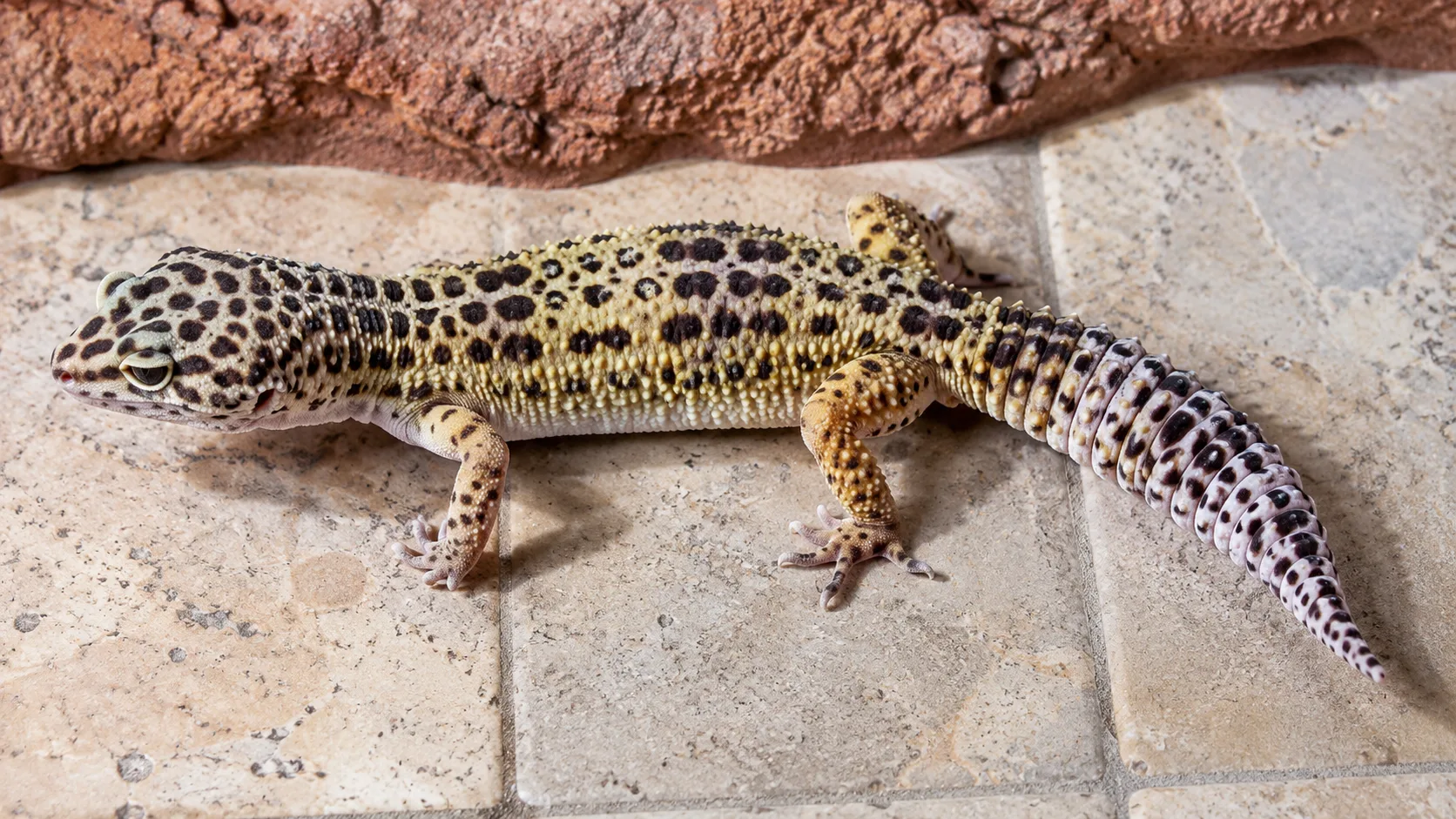
Why is my leopard gecko's tail getting skinny?
Short answer
A leopard gecko's tail is its fat-storage organ. A skinny tail — pencil-thin or narrower than the neck — signals underfeeding, chronic stress, illness, parasites, or wrong husbandry. Track weight weekly and compare to a baseline. Mild thinning corrects with diet and husbandry fixes; persistent loss or weight drop is a same-week reptile-vet appointment.
- Author
- Reptimo Editorial
- Updated
- Updated
- Reading time
- 6 min read
What tail width means
The leopard gecko (Eublepharis macularius) tail is the species' fat-storage organ. It's the single most reliable visible measure of body condition. Per ReptiFiles' care literature and consistent guidance from PetMD's care sheet:
- Healthy adult tail: roughly as wide as the neck, sometimes slightly wider in well-fed individuals. Feels firm and full when very gently touched.
- Mildly thin tail: noticeably narrower than the neck, less full. Audit husbandry and feeding.
- Significantly thin tail: pencil-thin, ribs and pelvis becoming visible. Likely depleted reserves; reptile-vet appointment if not improving in 2–4 weeks of correct husbandry.
The four most common causes
In rough order of frequency:
1. Underfeeding or refused food
A leopard gecko eating less than its life stage needs depletes tail fat over weeks to months. Common patterns:
- Adult fed on hatchling schedule corrected too late — slow weight loss masked by daily small meals.
- Switched feeder insect refused — gecko picky about new prey, eats less, lose weight.
- Stress-driven refusal — recently rehomed, frequent handling, loud environment. See the not-eating guide.
Audit feeding cadence per the feeding guide: hatchlings 3–5 small insects daily, juveniles 5–7 every other day, adults 6–10 insects 2–3 times per week.
2. Wrong husbandry suppressing appetite
Even with correct food offered, a gecko in the wrong conditions won't eat enough to maintain body condition:
- Warm side below 28 °C (82 °F) — digestion slows, food sits undigested, the gecko refuses subsequent meals. Single most common husbandry-driven cause. Verify with an IR temperature gun. See the temperature guide.
- Chronic stress — exposed enclosure with no hides, frequent handling, co-housing conflict, construction noise. Even a well-fed gecko in chronic stress loses tail mass over weeks.
- Inadequate hides — without the three-hide system (warm dry, cool dry, humid), the gecko doesn't thermoregulate properly. See the terrarium setup guide.
3. Parasites
Internal parasites — most commonly nematodes (pinworms), coccidia, and Cryptosporidium — interfere with nutrient absorption. The gecko eats but doesn't gain weight or progressively loses it. Diagnosis requires a reptile-vet faecal test (microscopy plus PCR for crypto).
Indicators that point toward parasites:
- Eating normally but losing weight.
- Watery, smelly, or unusually frequent faeces.
- Regurgitation of partially digested food.
- Visible worms in faeces (occasional).
4. Illness — particularly cryptosporidium
The serious one. Per the Merck Veterinary Manual, Cryptosporidium saurophilum is a parasitic protozoan with no reliable cure that causes progressive weight loss, persistent regurgitation, and tail wasting in leopard geckos. Most affected geckos eventually die from the infection.
- There is no curative treatment as of current veterinary consensus.
- Diagnosis requires PCR testing on a faecal sample at a reptile vet.
- Highly contagious between reptiles — quarantine new acquisitions for 30+ days, never share equipment until tested clean, isolate any suspected case.
This is the worst-case explanation for persistent unexplained weight loss. It is also why the modern care community emphasises strict quarantine and faecal testing of new arrivals.
How to track weight
Weekly weight tracking gives you the trend data that distinguishes "normal variation" from "something is wrong":
Care parameters
Leopard gecko weight tracking
| Parameter | Recommended value | Notes |
|---|---|---|
| Scale | Digital kitchen scale | 0.1 g precision (hatchling) or 1 g (adult) |
| Container | Small lightweight deli cup with vent holes | Tare scale or subtract container weight |
| Frequency | Weekly | Same time of day for consistency |
| What to track | Weight in grams + date | Plus brief note (recent shed, refused meal, etc.) |
| Concern threshold | >10 % loss in 1 month | Vet appointment regardless of other signs |
| Healthy adult range | 45–90 g typical | Trend matters more than absolute number |
A simple weight log — paper notebook, spreadsheet, or app — gives a reptile vet immediate data on a sick visit. See the husbandry log guide for format options. Reptimo's weight-tracking feature graphs the trend against species norms automatically.
What to do when you spot a thin tail
If the tail looks mildly thin and other signs are absent:
- Audit husbandry. Warm-side surface temperature with IR gun (target 28–30 °C). Cool side. Hide setup. Recent stress events.
- Audit feeding. Cadence appropriate for life stage. Variety in offered prey. Insects gut-loaded.
- Offer high-fat treats for 1–2 weeks: occasional wax worm (max 1–2 per week), hornworms (high-water, high-calorie), silkworms.
- Track weight weekly. Log it.
- Reduce stressors. Two weeks of no handling. Add hides if short. Move tank away from high-traffic areas.
- Re-evaluate at 4 weeks. Tail should be visibly fuller and weight should be stable or rising.
If the tail looks significantly thin, weight is dropping, or any of the warning signs from the next section appear — book a reptile-vet appointment within 1–3 days.
The cryptosporidium warning
If you keep multiple leopard geckos, take crypto seriously:
- Quarantine every new gecko for 30+ days minimum in a separate enclosure in a separate room.
- Use separate equipment (feeding tongs, water dish, paper- towel substrate) for quarantine. Don't move décor between enclosures.
- Wash hands and change clothes between handling quarantine gecko and existing collection.
- Test faeces for parasites before integrating — a faecal exam plus crypto PCR at a reptile vet.
- Any suspected case in a multi-gecko home — isolate immediately, test, plan worst-case scenarios.
When to see a vet
Same-week reptile-vet appointment if any of:
- Tail visibly thinner than the neck for more than 4 weeks despite correct husbandry.
- Weight dropped more than 10 % in a month.
- Refusing all food for 4+ weeks (and not in known seasonal slowdown).
- Vomiting / regurgitation, especially repeated.
- White runny faeces, blood in faeces, parasites visible.
- Any neurological signs — head tilt, tremors, loss of grip.
Same-day for:
- Refused food, lethargy, sunken eyes combined.
- Visible spine and pelvis with severe muscle wasting.
Bring a written weight log and husbandry record — see the husbandry log guide for what to track. The broader early-warning patterns across species are in "is my reptile sick?"; the pillar care context is in the pillar care guide.
Frequently asked questions
What does a healthy leopard gecko tail look like?
Why is my leopard gecko's tail thin?
How quickly should a thin tail recover?
How do I weigh a leopard gecko?
What's a healthy weight for a leopard gecko?
Can stress cause weight loss in leopard geckos?
What is cryptosporidium and how do I know if my gecko has it?
Should I force-feed a leopard gecko with a skinny tail?
When should I see a vet for a thin leopard gecko?
Sources
- Leopard Gecko Care Sheet · PetMD
- Leopard Gecko Diet & Health · ReptiFiles
- Cryptosporidiosis in Reptiles · Merck Veterinary Manual
- Disorders and Diseases of Reptiles · Merck Veterinary Manual
Quick check
Test what you just learned
A short quiz, just for you. Pick an answer to get instant feedback — there's no pass mark, this is for your benefit.
Quiz questions and answers
What's the leopard gecko tail FOR, biologically?
Correct answer: Fat storage
The leopard gecko tail is the species' fat-storage organ. A full tail = good body condition and reserves; a thin tail = depleted reserves, signalling underfeeding, illness, or stress. It's the single most reliable visible body-condition indicator.
Your leopard gecko's tail has been thinning over 4 weeks despite correct temperatures and offered food. What's the right step?
Correct answer: Book a reptile-vet appointment — likely needs a faecal test and exam
Persistent thinning despite correct husbandry needs a vet — parasites (especially cryptosporidium) and chronic illness are real possibilities. Force-feeding without diagnosis can worsen the underlying problem.
What weight precision do you need for an ADULT leopard gecko scale?
Correct answer: 1 g precision
Adult leopard geckos weigh 45–90 g; 1 g precision catches meaningful trends. Hatchlings need 0.1 g precision because of their smaller mass. A simple digital kitchen scale works for both.
Crypto (cryptosporidium) in leopard geckos: what's the takeaway?
Correct answer: Serious, often fatal; needs vet diagnosis via faecal PCR; quarantine new geckos 30+ days
Cryptosporidium saurophilum is a serious parasitic infection — no cure, often progressive, eventually fatal. Diagnosis via vet faecal PCR. Quarantine all new geckos for 30+ days and never share equipment between geckos until diagnosed clean.