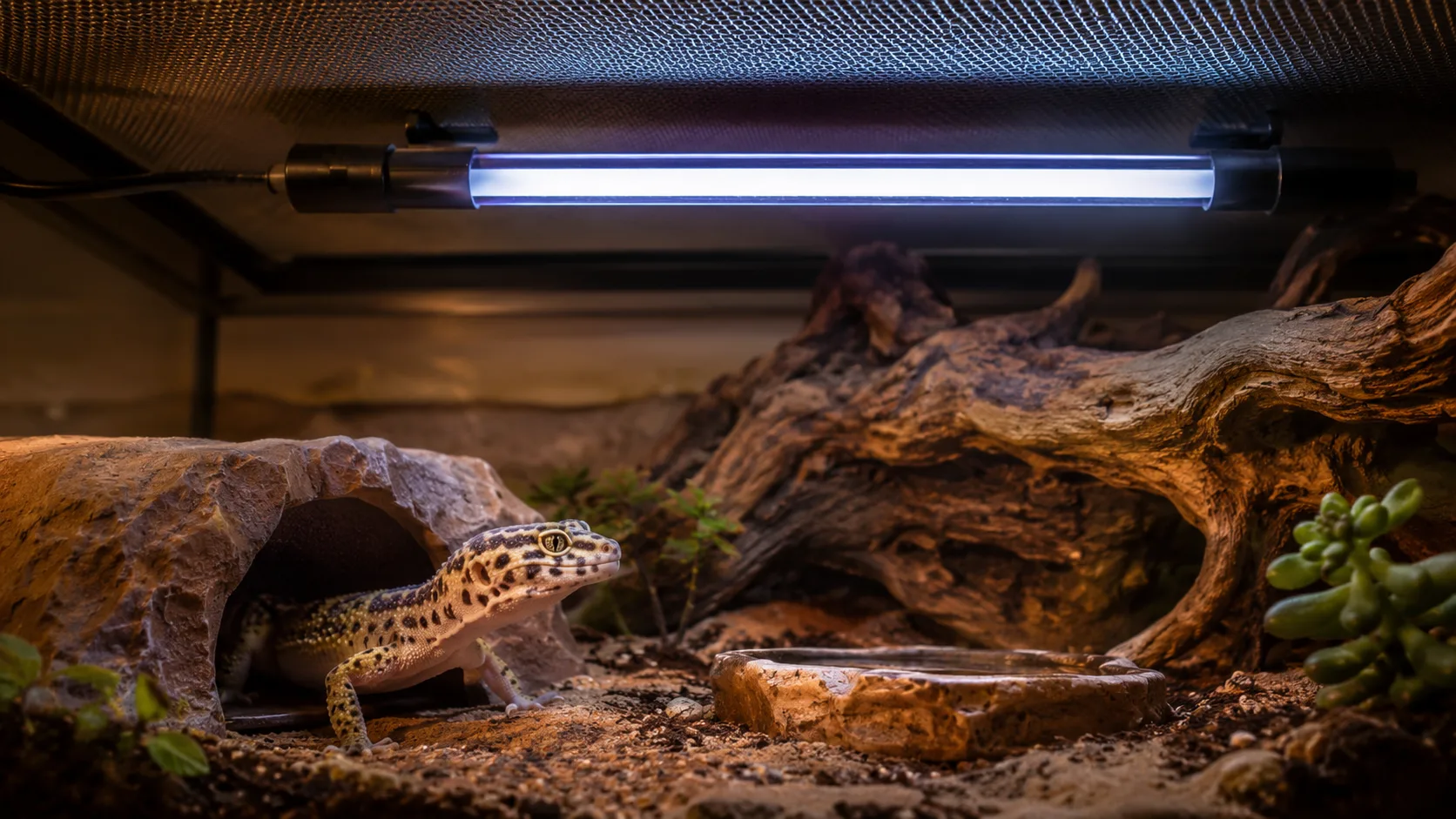
Do leopard geckos need UVB?
Short answer
Modern consensus across reptile vets, ReptiFiles and the keeping community: yes, leopard geckos benefit from low-level UVB even though they were historically kept without it. Provide a T5 HO 5.0 / 7 % tube delivering UVI 0.5–1.0 at basking, mounted inside the enclosure and replaced at 12 months. Calcium-with-D3 supplementation still matters but lighter dusting is needed when UVB is present.
- Author
- Reptimo Editorial
- Updated
- Updated
- Reading time
- 6 min read
Why the consensus shifted
For 30+ years, standard leopard gecko care said UVB wasn't needed — calcium-with-D3 supplementation alone was considered sufficient. Many geckos lived long lives on that protocol, which is part of why the no-UVB belief persisted as long as it did.
The modern shift, documented across the ReptiFiles UVB guide and increasingly in vet-led care advice, reflects two things:
- Crepuscular geckos do get UV exposure in the wild at dawn and dusk, even as shade-dwellers. Ferguson Zone 1 — the framework developed by Dr Gary Ferguson — assigns low-but-non-zero UVI exposure to species like leopard geckos.
- Supplementation-only protocols mask risk rather than eliminate it. A keeper who skips dustings, uses an aged supplement, or feeds a Ca:P-imbalanced diet can produce subclinical D3 deficiency that accumulates over years before MBD shows. UVB acts as a safety margin against human error.
The result: modern care recommends low-level UVB as best practice for leopard geckos, even though they survived without it for decades.
What UVI and bulb
Leopard geckos sit in Ferguson Zone 1 (shade dweller). The target at basking:
Care parameters
Leopard gecko UVB target
| Parameter | Recommended value | Notes |
|---|---|---|
| Ferguson zone | 1 (Shade dweller) | |
| Target UVI at basking | 0.5–1.0 | |
| Recommended tube | Arcadia ShadeDweller (7 %) or Zoo Med ReptiSun 5.0 | |
| Form factor | T5 HO linear tube, not compact coil | |
| Distance to basking surface | 25–30 cm / 10–12 in | |
| Coverage | 1/3 to 1/2 of enclosure length | |
| Replacement | Every 12 months from install date |
The Ferguson zones reference at Zen Habitats covers the framework in full; for cross-species UVB selection, see the cross-species UVB guide.
Mounting the tube correctly
Three rules across reptile species, applied to leopard geckos:
- Inside the enclosure, not on top of glass. Standard glass blocks ~95 % of UVB. Even fine mesh blocks ~30 %. The rated UVI assumes nothing between bulb and gecko.
- With a reflector. Without one, half the bulb's UV output is wasted upward.
- Covering 1/3 to 1/2 of the enclosure length, positioned over the warm side. Creates a UVI gradient — the gecko self-regulates exposure by moving between high and low UVI zones. Don't cover the whole top.
Run the UVB tube on the same timer as visible day lights for a 12-hour day / 12-hour dark cycle. Leopard geckos shelter in hides during peak daylight regardless of lighting; they emerge at dusk when UVB has already started to ramp down to ambient — exactly matching wild exposure patterns.
What changes about supplementation
With UVB providing baseline D3 synthesis, supplementation lightens:
Care parameters
Supplementation cadence — with vs without UVB
| Parameter | Recommended value | Notes |
|---|---|---|
| Adult — without UVB | Ca + D3 4–5×/week · multivitamin 1×/2 weeks | |
| Adult — with UVB | Ca + D3 2–3×/week · plain Ca on other dustings · multivitamin every 1–2 weeks | |
| Juvenile — without UVB | Ca + D3 nearly every feeding · multivitamin 1×/week | |
| Juvenile — with UVB | Ca + D3 3–4×/week · plain Ca on others · multivitamin 1×/week |
Continue to gut-load feeders on calcium-rich greens (collard, mustard, dandelion) for 24–48 hours before offering. Gut-loading is the lever that makes both calcium dusting and UVB-driven D3 actually deposit into bone.
Will UVB disturb sleep?
A common concern from keepers used to the no-UVB protocol: won't a tube on the enclosure disturb a crepuscular gecko?
The answer is no, for two reasons:
- UVB tubes are not bright visible light. Their visible output is a low-blue glow; geckos in hides experience the same darkness as before.
- The schedule matches biology. UVB runs during the day phase when geckos are sheltering in hides; it's off at night when they emerge to hunt. This is identical to wild exposure — low ambient UV during the dawn/dusk activity window.
Mount the tube on the warm side; the gecko can move to the cool side for additional darkness if it wants. Most adult leopard geckos acclimate to UVB within days with no behavioural change.
Replacement schedule
T5 HO tubes keep emitting visible light long after UVB output has fallen below useful levels:
- T5 HO tube — every 12 months from install date.
- Mercury vapour combo bulb (rarely used for leopard geckos) — every 12 months.
- Compact UVB coil — every 6 months (and consider switching to T5).
Write the install date on the bulb itself with a permanent marker, or log it in your tracking app and set a 12-month reminder. The husbandry-log primer covers UVB-replacement logging as a high-ROI practice.
What if I don't add UVB?
Decades of leopard geckos have lived on the supplement-only protocol. Risks if you stay on it:
- Skipped dustings accumulate. A week of missed calcium dustings during a busy stretch is much riskier without UVB as a safety margin.
- Aged supplements lose D3 quickly. Calcium-with-D3 powder loses potency after 6 months opened. The keeper-side correction is fresh powder every 6 months and dating the container.
- Subclinical MBD takes years to surface. When it does, bone changes are largely permanent. See reptile MBD signs.
If you're going to skip UVB, treat supplementation as non-negotiable: 4–5× weekly Ca+D3 on dusted feeders, fresh powder every 6 months, gut-loaded insects, multivitamin every 2 weeks.
The simplest correct setup
For a leopard gecko being moved to UVB-inclusive husbandry today:
- Buy an Arcadia ShadeDweller (7 %) T5 HO tube with reflector and starter kit (or equivalent — Zoo Med ReptiSun 5.0).
- Mount inside the enclosure on the warm side, 25–30 cm above the basking spot, covering 1/3 to 1/2 of the length.
- Run on the day-cycle timer alongside any visible day light.
- Log the install date in your husbandry log.
- Drop calcium-with-D3 dusting from 4–5×/week to 2–3×/week; add plain calcium on the others.
- Replace the tube at 12 months — set a calendar reminder now.
That setup brings leopard gecko care into modern best practice. For the full care plan, see the leopard gecko care guide. For temperature targets, see leopard gecko temperature.
Frequently asked questions
Were leopard geckos really kept for decades without UVB?
What UVI does a leopard gecko need?
What's the best UVB bulb for a leopard gecko?
How do I mount UVB for a nocturnal gecko?
Do I still need to dust calcium if I use UVB?
Can a leopard gecko get MBD without UVB?
Will UVB disturb my gecko's sleep?
Is daytime visible light OK for leopard geckos too?
When should I replace the UVB tube?
Sources
- Leopard Gecko UVB Requirements · ReptiFiles
- Leopard Gecko Care Sheet · PetMD
- What Are Ferguson Zones? · Zen Habitats
Quick check
Test what you just learned
A short quiz, just for you. Pick an answer to get instant feedback — there's no pass mark, this is for your benefit.
Quiz questions and answers
What Ferguson zone and UVI target applies to a leopard gecko?
Correct answer: Zone 1 (shade dweller), UVI 0.5–1.0 at basking
Leopard geckos sit in Ferguson Zone 1 — crepuscular shade-dwellers with brief edge UV exposure at dawn and dusk. The target UVI at basking is 0.5–1.0, achievable with a T5 HO 5.0 / 7 % tube at 25–30 cm. Higher UVI is unnecessary and potentially stressful.
Can a leopard gecko be safely kept on calcium-with-D3 supplementation alone, without UVB?
Correct answer: Modern care recommends adding low-level UVB as a safety margin; supplementation alone can mask risk over years and many vets now consider UVB best-practice
The supplement-only protocol worked for decades but the modern consensus has moved: UVB acts as a safety margin against missed dustings, aged supplements, or chronic low-grade D3 deficiency. Most modern care guides (ReptiFiles, ARAV-affiliated vets) now recommend low-level UVB.
How often should you replace a T5 HO UVB tube on a leopard gecko enclosure?
Correct answer: Every 12 months from install date — UV output collapses 9–14 months in even though visible light continues
T5 HO tubes keep emitting visible light for years after UVB output has fallen below useful levels. Log the install date and replace at 12 months, or verify with a Solarmeter 6.5. 'Looks fine' is meaningless for UVB.