Why won't my reptile eat?
Short answer
Across species, reptile food refusal traces to one of six fixable causes before it's medical: temperature outside species range, humidity outside species range, recent rehoming or husbandry change, an approaching shed, seasonal slowdown or brumation, or stress from handling and disturbance. Re-check husbandry first, log every refusal and weigh weekly. A vet visit is warranted only when weight drops or other warning signs appear.
- Author
- Reptimo Editorial
- Updated
- Updated
- Reading time
- 7 min read
The cross-species pattern
"My reptile isn't eating" is the most common single question across every reptile-keeping community. The PetMD lizard illness reference and the Reptiles Magazine ball python refusal guide both make the same diagnostic point: in the vast majority of cases, refusal is fixable husbandry rather than medical illness. Fix the husbandry first, log every refusal, and escalate to a vet only on specific combinations of signs.
This guide walks the six causes that account for almost every non-medical refusal, plus the warning signs that genuinely change the calculation. For species-specific deep dives, see ball python, leopard gecko, bearded dragon, veiled chameleon, crested gecko, corn snake.
Cause 1 — Temperature outside species range
The single most common upstream cause of food refusal across species. Reptile digestion is temperature-dependent — drop the warm side a few degrees and the animal stops processing food, then stops eating altogether.
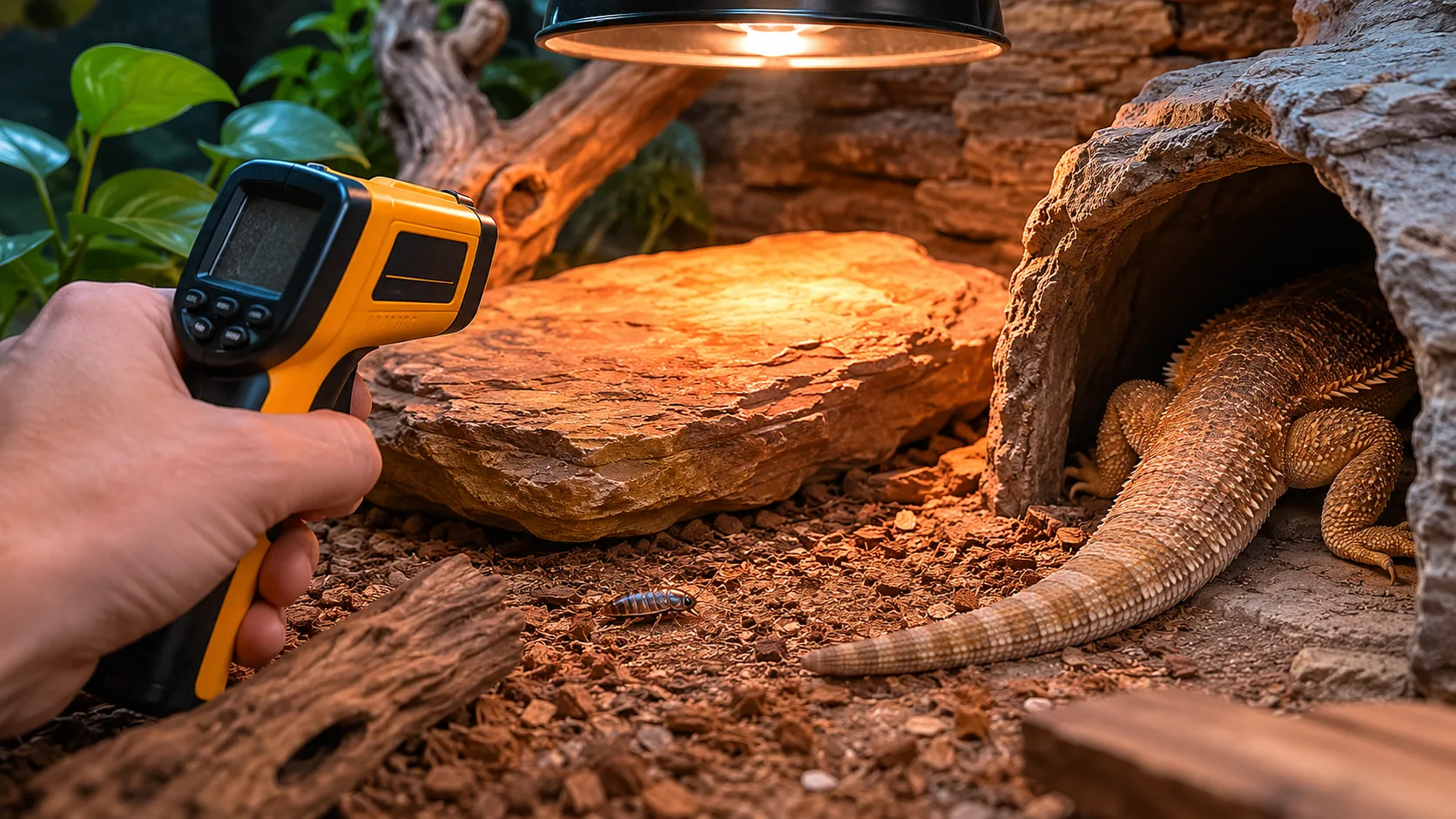
Check with an infrared gun on the actual basking or warm-side surface (not the air around it — bulbs heat the surface 5–10 °C hotter than air). Target ranges for common species in the cross-species temperature guide:
- Bearded dragon basking: 95–110 °F / 35–43 °C
- Leopard gecko warm: 88–92 °F / 31–33 °C
- Ball python warm: 86–90 °F / 30–32 °C
- Corn snake warm: 85–88 °F / 29–31 °C
- Chameleon basking: 85–95 °F / 29–35 °C
The slow-drift cases catch most keepers: a basking bulb that's been aging six months and now hits the surface 5 °C cooler than three months ago. A weekly IR-gun spot-check catches this before the reptile stops feeding.
Cause 2 — Humidity outside species range
The same logic applies to humidity, though it's a slower trigger than temperature for most species:
- Tropical species (ball python, crested gecko, chameleon) — chronically low humidity causes retained shed, dehydration and reduced feeding.
- Desert species (bearded dragon, uromastyx) — chronically high humidity causes respiratory stress and reduced feeding.
Check with a digital hygrometer (not a stick-on dial). Humidity targets in the temperature and humidity guide.
Cause 3 — Recent rehoming or husbandry change
Standard recommendation across species: a new reptile gets 1–2 weeks of zero handling and minimal disturbance before food is offered. Ball pythons specifically may take 4–6 weeks to feed in a new home; this is documented and routine.
The same logic applies to mid-life changes:
- New enclosure (the reptile is processing it as unfamiliar).
- Moved furniture or hides inside an existing enclosure.
- New room or new house.
- New pet in the household (especially dogs or cats with visible presence).
- Sudden change in basking-bulb visible spectrum or photoperiod.
Reset to a quiet, dark, low-disturbance baseline for 2–4 weeks after any of these. Most refusals resolve on their own.
Cause 4 — Approaching shed
Most reptiles refuse food during the active shed cycle:
- Snakes — refuse from "blue eyes" stage through full shed, typically 7–14 days.
- Lizards — often refuse for 2–5 days around shedding.
- Geckos — typically refuse for 1–3 days; many eat the shed itself (this is normal, recycles minerals).
Look for: dulling skin, milky-blue eyes in snakes (the "in blue" stage), pinker skin patches in lizards. Resume normal feeding once shedding completes and the reptile looks alert.
Cause 5 — Seasonal slowdown and brumation
Many reptile species evolved with significant winter slowdowns. This is normal biology, not illness:
Care parameters
Seasonal fasting — common pet species
| Parameter | Recommended value | Notes |
|---|---|---|
| Bearded dragon | Oct–March, partial to full brumation | 1–3 months refusal; weight should hold within 5% |
| Ball python | Oct–March, winter slowdown | Adults can refuse 2–4 months; weight stable |
| Leopard gecko | Dec–Feb, reduced appetite | Eat less, not none; weight stable |
| Corn snake | Nov–March if cooled | Full brumation; adults can fast 2–4 months |
| Crested gecko | Cooler months, slower CGD intake | Often eats less, not none |
| Veiled chameleon | Less seasonal, more weather-driven | Watch for 1–2 week slow periods |
The pattern is what reassures: refusal + stable weight + seasonal timing + correct husbandry = a normal fast. The same refusal in spring or with weight loss is a different case.
Cause 6 — Stress and disturbance
Beyond rehoming, ongoing stressors that suppress feeding:
- Frequent handling, especially during settling-in or shed.
- A high-traffic enclosure location (kitchen, hallway).
- Vibration (TV, washing machine, music).
- Bright direct light or no visual cover.
- Cohabitation conflicts (most pet reptile species should be housed singly).
Reset to a quiet enclosure in a calmer location, add visual cover, reduce handling for 1–2 weeks. Most stress refusals resolve on their own.
When fasting is normal vs. concerning
Quick reference:
Care parameters
Normal fast vs. concerning fast
| Parameter | Recommended value | Notes |
|---|---|---|
| Normal | Refusal + stable weight + known seasonal/shed/rehoming context + correct husbandry | |
| Watch | Refusal past 4 weeks (juvenile) / 3 months (adult) + no obvious cause | |
| Vet visit | Refusal + weight loss over 10% of body weight | |
| Vet visit | Refusal + any warning sign — mucus, sunken eyes, regurgitation, open-mouth breathing, lethargy beyond season | |
| Vet visit | Any feeding refusal in a hatchling lasting over 2 weeks with otherwise correct husbandry |
The triage protocol
A consistent five-step routine for any refusal:
- Verify temperature with an IR gun on the basking surface, warm-side air, cool-side air. Adjust if any are off.
- Verify humidity with a digital hygrometer.
- Check the recent history — rehoming, husbandry change, shed, season, stress trigger.
- Weigh and log. A stable weight buys time; a sustained drop is the actual signal.
- Re-offer at the species' normal cadence. Don't increase frequency to "tempt" — this overlays stress on a stress refusal.
Resist the urge to keep offering daily. Most reptiles resume on their own schedule when conditions are right.
When to see a vet
Specific signs that warrant a vet appointment regardless of how long the refusal has lasted:
- Measurable weight loss over 10% of body weight.
- Visible spine or sunken hips in lizards; visible scales between ribs in snakes.
- Sunken eyes.
- Regurgitation of any meal.
- Mucus or bubbles around mouth or nostrils.
- Open-mouth breathing or audible wheezing.
- Lethargy beyond known seasonal patterns.
- Neurological signs — tremors, abnormal head posture, paralysis.
- Visible swelling, wound or abscess.
For the full cross-species warning-signs checklist, see "is my reptile sick?".
What a vet wants to see
If you do book a vet, the keeper who arrives with a husbandry log shortcuts diagnosis dramatically. A vet seeing "refused 7 of last 10 meals, weight 480 g → 465 g over 5 weeks, basking 38 °C cool 26 °C, humidity 35 %, no shed, no mucus, mid-November" reaches a diagnosis in minutes — compared with the keeper who recalls "he stopped eating a while ago."
For the why-and-how of keeping that log, see the husbandry-log primer. For the tracking-format options, see the format comparison.
Frequently asked questions
How long can a reptile go without eating safely?
Should I force-feed a reptile that won't eat?
What's the first thing to check when a reptile stops eating?
Is winter fasting normal in reptiles?
Why does my new reptile refuse food?
What if my reptile only ate live before — and now I can't get live?
What weight loss is concerning during a fast?
Can stress alone cause a reptile to stop eating?
When should I take a reptile to a vet for not eating?
Sources
- Reasons a Ball Python Won't Eat · Reptiles Magazine
- How to Tell If Your Lizard Is Sick · PetMD
- Disorders and Diseases of Reptiles · Merck Veterinary Manual
Quick check
Test what you just learned
A short quiz, just for you. Pick an answer to get instant feedback — there's no pass mark, this is for your benefit.
Quiz questions and answers
What's the first thing to check when any reptile stops eating?
Correct answer: Temperature — with an IR gun on the actual basking surface, not air
Cool basking is the single most common upstream cause of food refusal across species. An IR gun reads the actual surface the reptile lies on — often 5–10 °C off the air around it. Fix temperature before exploring any other cause.
Your adult ball python hasn't eaten for 8 weeks in November, but weight is stable and husbandry is correct. What's the right next step?
Correct answer: Continue offering at the usual cadence, log every refusal, weigh weekly — this is a normal seasonal fast
Stable weight + correct husbandry + recognised seasonal timing = a normal fast. Force-feeding is harmful and vet-only. Ball pythons routinely refuse food Oct–March; refusal of 2–4 months in adults is documented and benign if weight holds.
Which combination of signs moves a feeding refusal to a vet visit?
Correct answer: Refusal + weight loss over 10 % + lethargy + sunken eyes (or any other warning sign)
Refusal alone with stable weight is rarely a vet visit. Refusal combined with measurable weight loss past 10 %, regurgitation, mucus, open-mouth breathing, neurological signs, or sustained lethargy is. Combinations move the calculation, not the refusal in isolation.