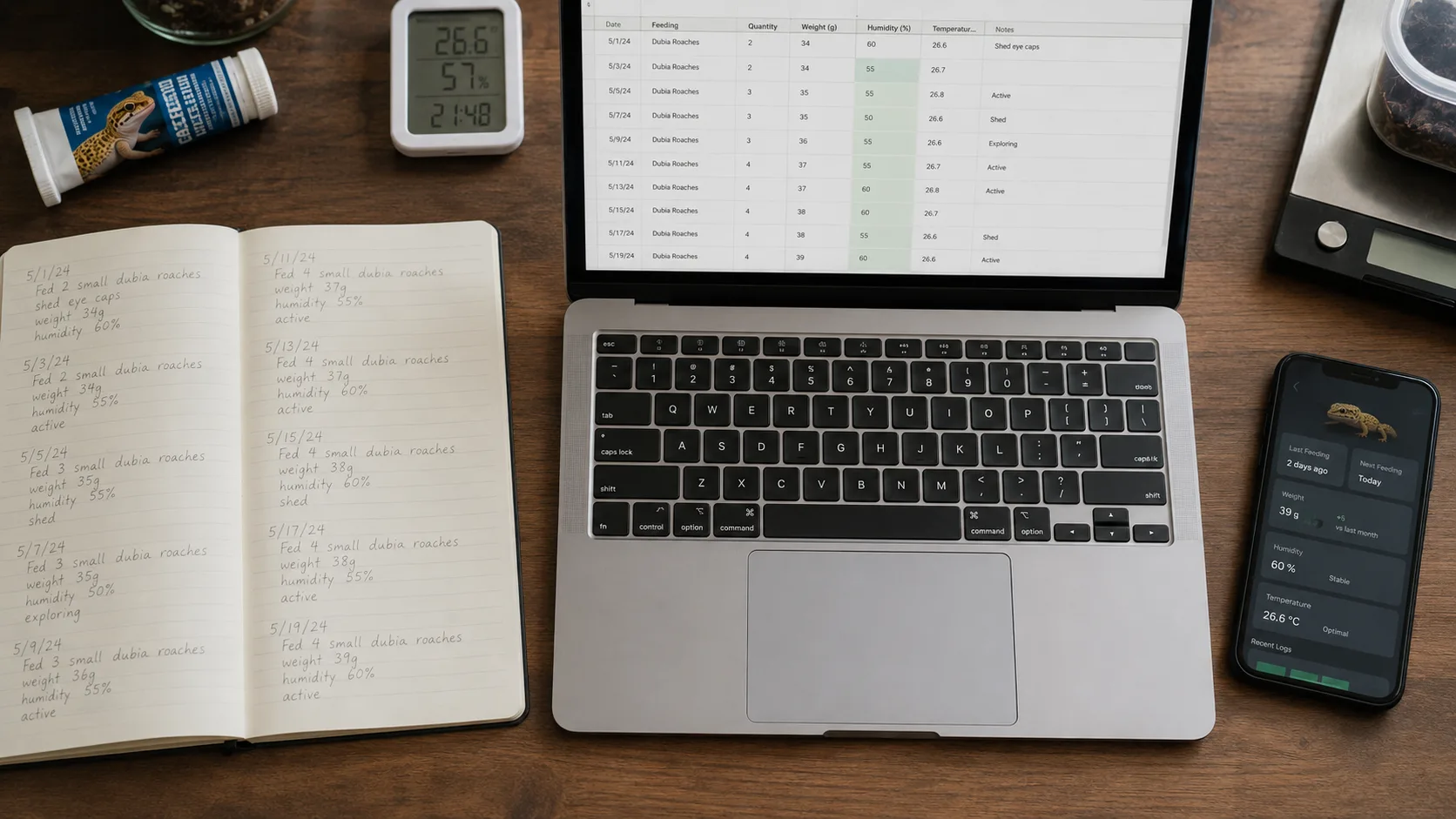
Should I track my reptile in an app, a spreadsheet, or a notebook?
Short answer
All three work; the right one is whichever you'll keep open. Paper notebooks win on durability and zero friction to start, but they're hard to search. Spreadsheets are free, flexible and graph-able but easy to abandon on a phone. A dedicated app like Reptimo cuts the daily logging friction and brings species norms with it — at the cost of lock-in. Pick on whichever matches your habits.
- Author
- Reptimo Editorial
- Updated
- Updated
- Reading time
- 7 min read
The honest framing
There is no "best" reptile-tracking format in the abstract. The best format is the one that survives your weekly routine for years. The Merck Veterinary Manual notes that husbandry-driven illness is the dominant pattern in captive reptiles — and the only counter-measure is a consistent log. What it doesn't care about is whether that log is written on paper, typed into a sheet, or tapped into an app.
This guide compares the three realistic formats on the dimensions that actually matter once you're a few months in: friction, search, reminders, durability and lock-in. There's no winner — there's a match for your habits.
What you're trying to capture
Before comparing formats, agree what a "good" reptile log contains. The bare-minimum useful log, across species:
Care parameters
The bare-minimum husbandry log — across formats
| Parameter | Recommended value | Notes |
|---|---|---|
| Weight | Weekly | Single highest-value signal |
| Feeding | Every offering | Date, item, accepted / refused |
| Shed dates | Every shed | Date, completeness |
| Warm-side / cool-side temperature | Weekly spot-check | IR gun on basking surface |
| Humidity | Weekly spot-check | Especially BPs, chameleons, sliders |
| UVB install date | Once per bulb | Replacement reminder ~11 months later |
| Vet visits / supplementation | As they happen | Brand, dose, date |
For the longer "everything worth capturing" list and per-species parameter targets, see our husbandry log guide.
Paper notebook
A small lined notebook with one page per week is the simplest possible husbandry log. Durable, friction-free to start, and impervious to a company going out of business.
Strengths. Zero setup. Works in the reptile room without a phone. No batteries, no syncing, no service that can disappear. Some keepers genuinely think more clearly with a pen than a keyboard, and that matters when you're noting behaviour or shed quality.
Weaknesses. Search is manual ("when was the last shed?" requires flipping). Trend-spotting is impossible without redrawing data into a graph. No reminders for the boring-but-critical maintenance (UVB tube replacement, vet checkups). Hard to share with a vet without transcribing or photographing.
Pick paper if you have one or two reptiles, a stable routine, and you already journal or take notes by hand. A notebook you'll actually keep open beats an app you eventually stop opening.
Spreadsheet (Google Sheets / Excel / Numbers)
A single spreadsheet — dates down, parameters across — is what many experienced keepers end up using long-term. Free, flexible, graph-able, and yours forever.
Strengths. Free. Owned by you (especially with offline files). Easy to graph weight over time, plot temperature trends, filter to "last 30 days of feedings." Trivially shareable as a PDF for a vet. Survives any app shutting down. Scales fine to a small collection.
Weaknesses. Phone friction is the real killer. Opening Google Sheets on a phone, scrolling to today's row, finding the right cell, typing — it's enough friction that many spreadsheet-starters stop logging within 6–8 weeks. No reminders. No species-norm defaults; you have to know what "good" looks like and check against it manually.
Pick a spreadsheet if you're comfortable with sheets, you have a laptop you sit at most evenings, and you want guaranteed data ownership without an app's species-norm scaffolding.
A dedicated reptile app (e.g. Reptimo)
An app is purpose-built to remove the daily-logging friction that catches up to spreadsheet keepers. It also fills the gap a spreadsheet can't: species norms baked in.
Strengths. One-tap logging from a phone you have anyway. Reminders for the easy-to-forget maintenance — UVB tube replacement, feeding cadence, weight checks. Automatic trend graphs. Species-norm comparisons (e.g. flagging that your warm side has drifted below the species target). Multiple pets in one place. Vet-export bundle.
Weaknesses. Cost (most reptile apps are paid). Lock-in if the export is poor — a reason to test export early. A dependency on the app continuing to exist; for a 30-year tortoise that's a real horizon.
How Reptimo fits. Reptimo is built specifically as a single-pet care assistant rather than a collection-management surface — it brings vet-reviewed species norms with it, suggests a daily plan, flags drift against species targets, and reminds you about the boring-but-critical maintenance. It's the right choice for a new or intermediate keeper who wants the app to bring expertise to the partnership, not just storage. For collection-keepers, the full app comparison covers SnekLog and Reptile Scan in detail.
Side-by-side
Care parameters
Tracking formats — head to head
| Parameter | Recommended value | Notes |
|---|---|---|
| Setup time | Notebook 1 min · Sheet 5 min · App 5–10 min | |
| Daily friction (phone) | Notebook none (off-phone) · Sheet high · App lowest | |
| Search & trends | Notebook poor · Sheet good · App best | |
| Reminders | Notebook none · Sheet none · App built-in | |
| Species norms baked in | Notebook no · Sheet no · App yes | |
| Cost | Notebook ~$5 · Sheet free · App paid | |
| Lock-in risk | Notebook none · Sheet none · App moderate (check export) | |
| Vet share | Notebook photograph · Sheet PDF · App export bundle |
What about lock-in?
The single most-asked question from keepers considering an app: "what happens to my data if the app shuts down?" The honest answer: test the export before committing. Any reputable husbandry app — Reptimo, SnekLog, Reptile Scan — should export your full history to a CSV or JSON file that opens cleanly in a spreadsheet. If you can do that test, lock-in becomes "a one-evening migration to a spreadsheet if the app ever disappears," which is a manageable risk.
Apps that don't offer a clean export are a genuine red flag. For a 30-year-living tortoise or a 20-year-living leopard gecko, your data needs to outlive any single product.
The real deciding factor
Be honest about your habits. Three quick tests:
- Do you log workouts, meals, or sleep in an app already? If yes, a reptile app will fit your routine. If no, an app probably won't either — go spreadsheet or paper.
- Do you sit at a laptop most evenings? If yes, a spreadsheet is low-friction. If you only use a phone, a spreadsheet will accumulate gaps.
- Do you naturally write things by hand? If yes, paper might actually be your best long-term option, especially for a small collection.
The format that survives daily routine for years is the one that wins. A perfectly-maintained notebook beats an abandoned app. A mostly-filled spreadsheet beats a beautifully-set-up app whose reminders you've muted.
Where to start today
If you're undecided, start with whichever has the lowest activation energy for you right now. A blank notebook on the shelf, a fresh Google Sheet copied from a template, or a free trial of a reptile app — pick one and log this week. You can always migrate later.
For the longer form of "what to log and why," see our husbandry log primer. For the head-to-head between the apps in the category, see the best reptile tracking app guide. For the symptom side — what these logged numbers help you spot — see the "is my reptile sick?" checklist.
Frequently asked questions
Is a spreadsheet good enough to track a reptile?
What does a reptile app give me over a spreadsheet?
Is a paper notebook really viable in 2026?
Won't my data get lost if a reptile app shuts down?
Which format do reptile vets prefer?
What's the actual deciding factor between formats?
Can I migrate from one format to another later?
Does Reptimo work for someone who already uses a spreadsheet?
Sources
- Reptile Care for Beginners · PetMD
- Disorders and Diseases of Reptiles · Merck Veterinary Manual
- SnekLog — Intuitive Reptile Tracking App · SnekLog
Quick check
Test what you just learned
A short quiz, just for you. Pick an answer to get instant feedback — there's no pass mark, this is for your benefit.
Quiz questions and answers
Which tracking format is the right one for a reptile keeper?
Correct answer: Whichever one you'll actually keep open consistently
The best format is the one that survives your real routine. A perfectly-maintained notebook beats an abandoned app, and vice versa. Be honest about your habits — if you already log everything in apps, an app will fit; if you avoid apps, paper or a spreadsheet will fit.
What's the biggest weakness of a paper notebook for reptile tracking?
Correct answer: Searchability — answering 'when was the last shed?' or 'how has weight trended?' takes flipping pages instead of seconds of tapping
Paper is durable and friction-free to start, but it's bad at trends. Plotting weight over six months from a notebook is manual work; in a spreadsheet or app it's automatic. Pick paper only if you don't need to spot trends fast.
What should you check before committing to any reptile-tracking app?
Correct answer: Whether it has a clean data export (CSV/JSON) so your data isn't locked in
An app without a clean export is a real lock-in risk — if the company disappears, your years of data go with it. Reputable apps (Reptimo, SnekLog, Reptile Scan) all export to standard formats. Do a test export before committing.