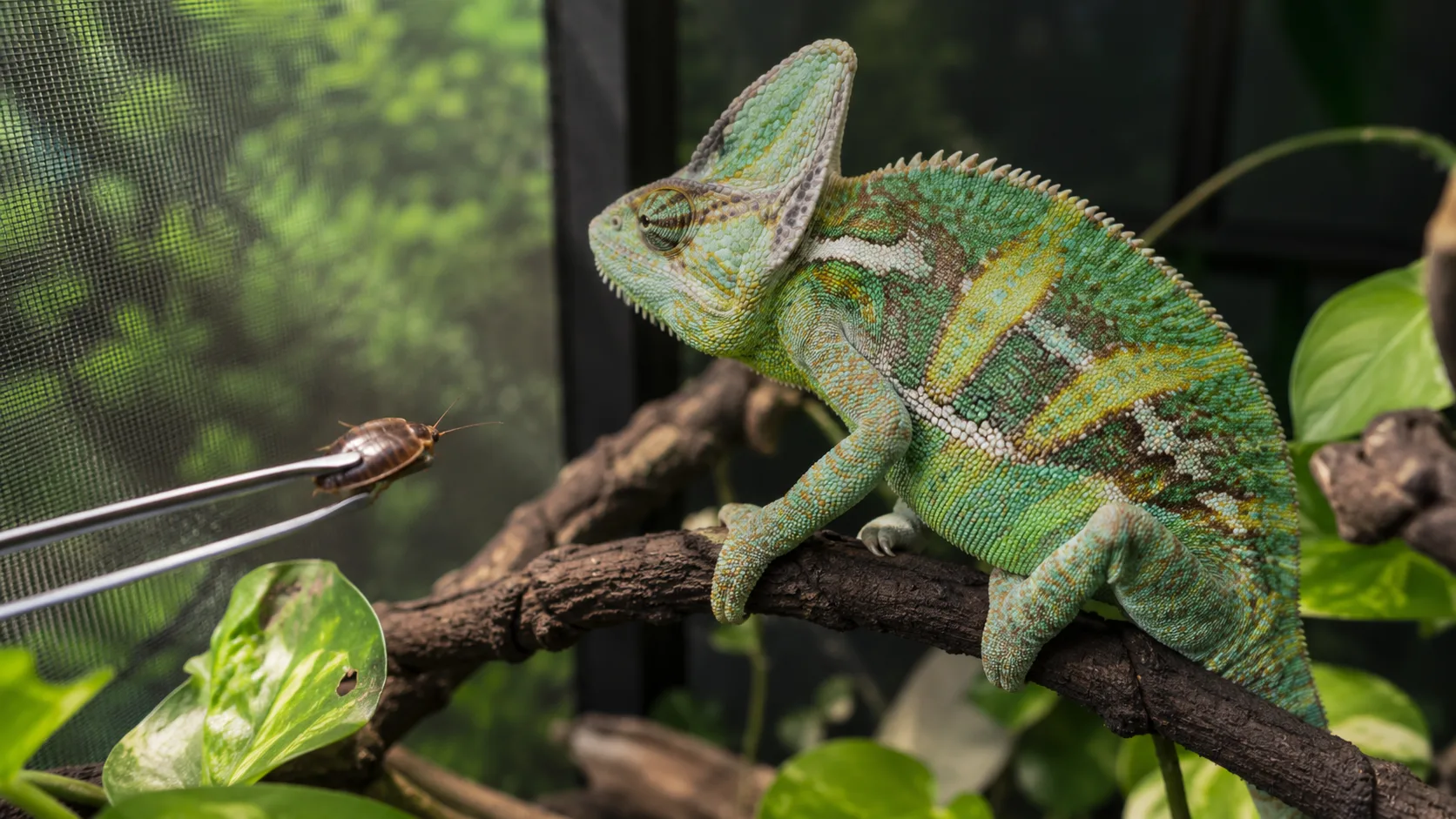
Why is my veiled chameleon not eating?
Short answer
Veiled chameleons refuse food for five main reasons: dehydration (the #1 captive cause of decline), wrong temperature or UVB, parasites, stress from handling or recent moves, or underlying illness. Audit hydration first — sunken eyes or orange urates change the priority. Refusal lasting more than 5–7 days in a healthy adult, or any refusal paired with illness signs, is a same-week reptile-vet appointment.
- Author
- Reptimo Editorial
- Updated
- Updated
- Reading time
- 5 min read
YMYL note
Veiled chameleon (Chamaeleo calyptratus) refused food is more concerning than the same situation in many other reptiles, because the species hides distress until physiological decline is well advanced. This article covers recognition and the husbandry audit that resolves most cases — it is not a substitute for a reptile- experienced vet. If your chameleon shows refused food paired with any of the warning signs in the last section, book a vet within 1–3 days.
Hydration first
Per Chameleon Academy's hydration explainer, dehydration is the documented #1 captive cause of decline in veiled chameleons. Many "not eating" cases trace back to insufficient hydration before they trace to anything else, because a dehydrated chameleon shuts down feeding among other functions.
Quick hydration check before any other diagnostic:
- Eye fullness — eyes should be rounded and full in their turret sockets. Sunken = moderate-to-severe dehydration.
- Urate color — white tip on droppings = healthy, yellow = mild concern, orange = moderate-to-severe dehydration.
- Misting schedule — when was the last cycle? Is the system actually working?
- Dripper schedule — running at least 1 hour daily onto leaves?
If any hydration sign is abnormal, fix the hydration setup first — see the dehydration signs guide and the hydration spoke. The "not eating" problem often resolves once hydration recovers.
The five common causes
In rough order of frequency in captive veiled chameleons:
1. Dehydration
See above. Treat as the default first diagnosis.
2. Wrong temperature or UVB
Per Hopp'in Help's care sheet, sub-optimal basking temperatures or expired UVB suppress feeding. Verify:
- Basking surface 32–35 °C (90–95 °F) males, 29–32 °C females, measured with an IR temperature gun on the actual basking branch.
- Ambient air 24–27 °C (75–80 °F).
- UVB delivering UVI 3–4 at basking (Solarmeter 6.5 check; T5 HO tube replaced every 12 months).
Detail in the temperature & humidity guide and the cross-species UVB guide.
3. Stress
Veiled chameleons are unusually stress-sensitive. Common triggers:
- Recent rehoming — give 1–2 weeks of zero handling and minimal visual disturbance after arrival.
- Handling — treat veiled chameleons as display animals; handling beyond essential health checks is a chronic stressor.
- Visible pets outside the enclosure (cats especially).
- Loud noise near the enclosure (TV, music, slammed doors).
- Co-housing — never recommended for veiled chameleons even in female pairs.
4. Parasites
Especially in wild-caught or recently imported chameleons — internal parasites (nematodes, coccidia, occasionally crypto) cause progressive weight loss, refused food, and watery droppings. Diagnosis requires a reptile-vet faecal test. The cross-species warning about quarantine and faecal testing in the leopard gecko skinny tail guide applies here too — quarantine new chameleons for 30+ days with baseline faecal testing before integrating with any existing collection.
5. Underlying illness
Respiratory infection (often driven by glass enclosure / inadequate ventilation / chronic high humidity), metabolic bone disease, kidney disease, septicaemia — all present with refused food among other signs. The triage section below covers the warning combinations.
Triage by duration
How quickly to escalate depends on how long refusal has lasted and what other signs accompany it:
Care parameters
Veiled chameleon refusal — triage thresholds
| Parameter | Recommended value | Notes |
|---|---|---|
| 1–2 days, no other signs | Re-check husbandry, offer again | Single refusals are normal |
| 3–5 days, no other signs | Audit hydration + temperature carefully | Reduce all stressors |
| 5–7 days, no other signs | Vet appointment within 1–3 days | This species declines fast |
| Any duration WITH sunken eyes or orange urates | Vet within 1–3 days | Dehydration concern |
| Any duration WITH dark coloration sustained all day | Vet within 1–3 days | Stress / illness |
| Any duration WITH gaping, mucus, audible breathing | Vet within DAYS | Respiratory infection |
| Gravid female straining without laying for 24+ h | SAME-DAY vet | Dystocia emergency |
| Closed eyes, neurological signs, unresponsive | SAME-DAY vet | Severe illness |
Female-specific: gravid considerations
Even unmated female veiled chameleons produce infertile eggs. Egg-binding (dystocia) is a documented mortality cause in this species. Signs a female may be gravid and approaching laying:
- Reduced or refused feeding for 1–2 weeks.
- Visibly bulging belly.
- Restless ground exploration, digging at substrate.
- Possible weight loss as eggs draw on reserves.
Provide a deep dig-friendly substrate (sand-soil mix at least 25 cm deep, lightly damp) in one corner of the enclosure for laying. If the female digs but doesn't lay, or strains unproductively for more than 24 hours, that's same-day vet — unresolved dystocia is fatal.
What to do — and what not to do
Do:
- Audit hydration first — eye fullness, urate color, misting and dripper verification.
- Verify temperatures and UVB with proper tools (IR gun, Solarmeter 6.5).
- Reduce all stressors — minimise handling, quiet the room, block visual disturbances.
- Offer a small variety of insects — hornworms (high water content help borderline-dehydrated chameleons), silkworms (soft, high calcium), occasional crickets and dubias.
- Track everything — feeding refusals, weight (weekly), urate appearance. See the husbandry log guide.
Don't:
- Force-feed. Stresses an already-stressed chameleon; rarely solves underlying cause; can cause regurgitation.
- Increase basking temperature above range hoping to trigger feeding. Excessive heat causes dehydration and stress.
- Wait a month "to see" in a chameleon. This species declines faster than ball pythons or bearded dragons; the 5–7 day threshold matters.
- Hand-feed in a stressed environment. Some keepers train hand- feeding successfully — but a stressed chameleon needs less interaction, not more.
The broader husbandry context is in the pillar care guide; cross-species early warning patterns are in "is my reptile sick?".
Frequently asked questions
How long can a veiled chameleon go without eating?
What's the first thing to check when a veiled chameleon won't eat?
Why is my chameleon turning dark and not eating?
Can stress alone cause a veiled chameleon to refuse food?
Should I force-feed a chameleon that won't eat?
What temperature does a chameleon need to eat?
Could my chameleon have parasites?
Why won't my female chameleon eat?
When does refused food become an emergency?
Sources
- Veiled Chameleon Care Sheet · Hopp'in Help
- Hydration for Chameleons · Chameleon Academy
- Veiled Chameleon Care Sheet · PetMD
- Disorders and Diseases of Reptiles · Merck Veterinary Manual
Quick check
Test what you just learned
A short quiz, just for you. Pick an answer to get instant feedback — there's no pass mark, this is for your benefit.
Quiz questions and answers
What's the FIRST thing to check when a veiled chameleon refuses food?
Correct answer: Hydration — eye fullness, urate color, misting and dripper schedule
Hydration first. Dehydration is the #1 captive cause of decline in veiled chameleons and many 'not eating' cases trace back to insufficient water delivery. Check eye fullness, urate color, and audit your misting cycles before assuming illness.
Your veiled chameleon refused food once and the eyes are still full, urates white. What now?
Correct answer: Re-check husbandry, reduce stressors, offer again in 1–2 days; vet only if refusal extends past 5–7 days or illness signs appear
A single refusal in an otherwise healthy chameleon is not an emergency. Audit husbandry, minimise stressors, re-offer in a day or two. Vet appointment becomes warranted at 5–7+ days of refusal OR sooner if illness signs appear.
Your female veiled chameleon stopped eating, has a bulging belly, and is restlessly digging the substrate. What's likely happening?
Correct answer: She's gravid (carrying eggs) and needs deep loose substrate to lay — vet if she strains without laying
Gravid females (even unmated produce infertile eggs) reduce feeding and dig for laying sites. Provide deep loose substrate (25+ cm of sand/soil). If she strains unproductively for more than 24 hours, that's dystocia — same-day vet.
Should you force-feed a veiled chameleon that's refusing food?
Correct answer: No — force-feeding stresses an already-stressed animal and rarely solves the cause
Force-feeding is the wrong response. It stresses a chameleon (already stress-sensitive species), can cause regurgitation, and doesn't address the underlying cause. Audit husbandry; assisted feeding is a vet-supervised intervention, not a home tactic.