What humidity and temperature does a veiled chameleon need?
Short answer
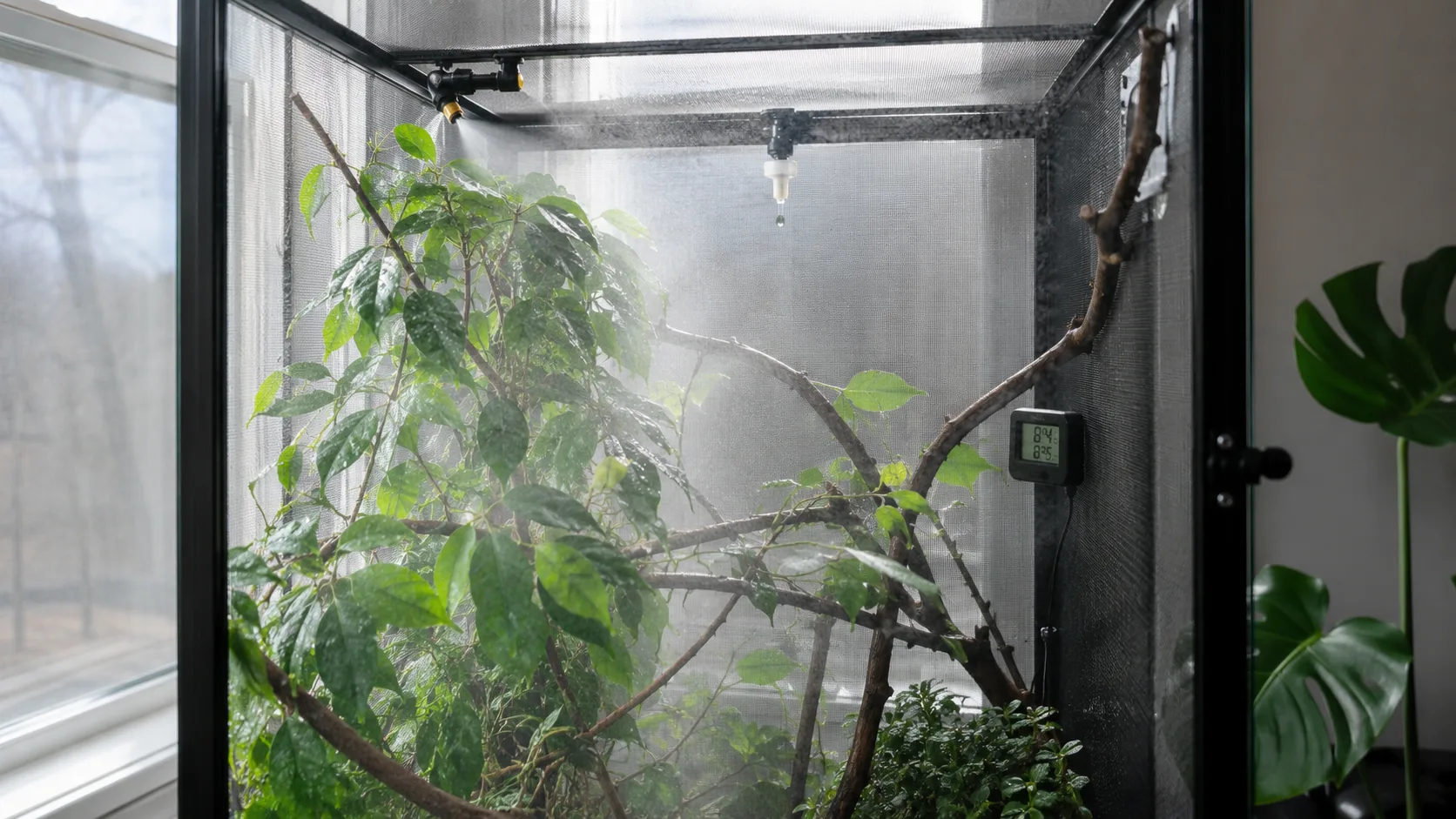
Veiled chameleons need a basking surface of 32–35 °C (90–95 °F) for males (29–32 °C for females), ambient air of 24–27 °C (75–80 °F), a night drop to 18–22 °C (65–72 °F), and humidity of 50–70 % that dries between mistings. Achieve humidity with 2–4 daily misting cycles plus a dripper — never standing wet, never sealed glass.
- Author
- Reptimo Editorial
- Updated
- Updated
- Reading time
- 6 min read
Temperature targets
Veiled chameleons (Chamaeleo calyptratus) come from the mountainous wadis of Yemen and south-west Saudi Arabia — climates with sharp day-night temperature swings and seasonal humidity. Captive husbandry mirrors that with a clear thermal gradient and a real night drop. Per Hopp'in Help's care sheet and PetMD's veiled chameleon care sheet:
Care parameters
Veiled chameleon temperature targets
| Parameter | Recommended value | Notes |
|---|---|---|
| Basking surface (adult male) | 32–35 °C / 90–95 °F | Measured with IR gun on basking branch |
| Basking surface (adult female) | 29–32 °C / 85–90 °F | Slightly cooler to moderate egg production |
| Basking surface (hatchling, under 3 months) | 29–32 °C / 85–90 °F | |
| Ambient air (mid-enclosure) | 24–27 °C / 75–80 °F | |
| Lower enclosure air | 22–24 °C / 72–75 °F | Slightly cooler at the bottom — natural gradient |
| Night-time (whole enclosure) | 18–22 °C / 65–72 °F | All heat and lights OFF |
| Acceptable night floor | ≥ 15 °C / 60 °F | Below this, add ceramic emitter on thermostat |
Heating sources
A halogen flood bulb on a dimming thermostat above the screen top is the modern standard:
- Halogen flood sized for the basking distance — typically 50–75 W for a 24×24×48 in enclosure. The basking branch is positioned 25–30 cm below the top, where the chameleon can climb for direct exposure.
- Dimming or pulse-proportional thermostat with the probe at the basking branch surface (not in the air). Set to the male or female target.
- Cross-check with an IR temperature gun weekly on the actual basking branch.
No heat mats — chameleons don't thermoregulate from below. No bright overnight bulbs — they disrupt circadian rhythm and stress the chameleon. Detail in the cross-species UVB guide.
Humidity targets and the wet-then-dry cycle
This is where veiled chameleon husbandry differs from most other reptiles: humidity should not be constant. Per Chameleon Academy's hydration explainer:
- During and shortly after misting: 50–70 % humidity.
- Between misting cycles: humidity drops to 30–40 % as the enclosure dries.
- Never sustained above 70 % without ventilation — drives respiratory infection.
- Never sustained below 30 % — drives dehydration, the #1 captive cause of veiled chameleon death.
The wet-then-dry pattern mimics natural mountain conditions and prevents both extremes. To achieve it:
- 2–4 misting cycles per day, 1–2 minutes each. Programmable misters (MistKing) remove the daily-burden risk.
- First mist shortly after lights-on; encourages morning drinking from droplets on leaves.
- Last mist at least 1 hour before lights-off so the enclosure has time to dry overnight.
- No standing water on the floor or screen overnight.
For the full hydration setup including dripper logistics, see the hydration guide.
Care parameters
Veiled chameleon humidity profile through the day
| Parameter | Recommended value | Notes |
|---|---|---|
| Morning mist (post-lights-on) | 60–70 % | Decline to ~40 % over 1–2 hours |
| Midday mist | 60–70 % | Decline to ~40 % over 1–2 hours |
| Afternoon mist | 60–70 % | Decline to ~40 % over 1–2 hours |
| Pre-lights-off mist (no later than 1 h before) | Optional | Skip if morning/midday/afternoon already covered |
| Overnight | ~30–40 % | Dry, no standing water |
Why screen enclosures only
Glass tanks (Exo Terra style with sealed glass on all sides) are the wrong housing for veiled chameleons:
- Stagnant air — no cross-ventilation allows the wet-then-dry cycle to work. Humidity stays high all day.
- Respiratory infection driver — the documented combination (high humidity + no ventilation + warm temperatures) is the setup that drives bacterial RI.
- Limited evaporative cooling for the chameleon during hot basking periods.
Screen enclosures (Reptibreeze, DIY mesh, ZooMed ReptiBreeze) on all sides provide:
- Cross-ventilation between misting cycles, supporting the wet-then-dry humidity pattern.
- Heat layering — the basking spot warms, the cool side stays ventilated.
- Drainage when paired with a sloped tray base.
Standard size: minimum 24 × 24 × 48 in (60 × 60 × 120 cm) for an adult, 36 × 24 × 72 in (90 × 60 × 180 cm) preferred. See the pillar care guide.
Night temperatures
Veiled chameleons need a real night with a temperature drop, just as their native Yemen environment provides:
- Target 18–22 °C (65–72 °F) night-time across the whole enclosure.
- All heat and lights off — no red, blue, or white bulbs at night.
- Only add a low-wattage ceramic heat emitter if the room itself drops below 15 °C (60 °F) for sustained periods. Set on its own thermostat to switch in only at the floor temperature.
Skipping the night drop — running heat all night, leaving bulbs on — stresses the chameleon and disrupts hormone cycles.
How to measure correctly
Three tools, used together:
- Infrared (IR) temperature gun — point at the actual basking branch surface; that's the meaningful reading. Stick-on dials read air and lie about basking.
- Digital thermometer + hygrometer at mid-height for ambient air and humidity. Mount on the screen wall, not stuck to the glass.
- Cross-check monthly and after any equipment change.
Per the Merck Veterinary Manual, inadequate husbandry in chameleon care is a documented contributor to chronic illness — and the most preventable one with proper monitoring tools.
What goes wrong
Two patterns drive most preventable veiled chameleon illness:
1. Constant high humidity + sealed glass = respiratory infection. The chameleon presents with gaping mouth, mucus, audible breathing, lethargy. Fix the enclosure (switch to screen, fix the mist schedule), see a reptile vet within days.
2. Constant low humidity / missed misting = dehydration. The chameleon presents with sunken eyes, sustained dark coloration, orange urates, lethargy. See the dehydration signs guide — the #1 captive cause of death.
Both are preventable with the correct enclosure (screen), correct misting schedule (2–4 cycles with drying between), and weekly verification of temperature and humidity readings. The broader husbandry baseline is in the pillar care guide.
Frequently asked questions
What basking temperature does a veiled chameleon need?
What ambient air temperature does a veiled chameleon need?
Do veiled chameleons need a night temperature drop?
What humidity does a veiled chameleon need?
How often should I mist a veiled chameleon's enclosure?
Why screen enclosure instead of glass?
How do I measure temperatures and humidity accurately?
Why is gravid female basking temperature cooler?
What happens if humidity is too low for too long?
Sources
- Veiled Chameleon Care Sheet · Hopp'in Help
- Hydration for Chameleons · Chameleon Academy
- Veiled Chameleon Care Sheet · PetMD
- Disorders and Diseases of Reptiles · Merck Veterinary Manual
Quick check
Test what you just learned
A short quiz, just for you. Pick an answer to get instant feedback — there's no pass mark, this is for your benefit.
Quiz questions and answers
What basking temperature does an ADULT MALE veiled chameleon need?
Correct answer: 32–35 °C (90–95 °F)
Males bask at 32–35 °C (90–95 °F) measured on the actual basking branch. Females sit slightly cooler (29–32 °C) to moderate egg production. Hatchlings under 3 months also at 29–32 °C.
What humidity pattern does a veiled chameleon need?
Correct answer: Wet-then-dry cycle: 50–70 % during/after misting, drying to 30–40 % between
The wet-then-dry cycle mimics natural conditions and prevents respiratory infection. Constant high humidity without ventilation is the most common driver of chameleon RI. Constant low humidity drives dehydration.
Why must veiled chameleons live in SCREEN enclosures, not glass?
Correct answer: Screen provides cross-ventilation that prevents respiratory infection from trapped stagnant high humidity
Glass tanks trap stagnant high-humidity air without ventilation — the perfect setup for respiratory infection in this species. Screen enclosures allow the wet-then-dry humidity cycle to work properly. Glass is wrong for veiled chameleons.
Should you keep heat and UVB on at night for a veiled chameleon?
Correct answer: No — real night drop to 18–22 °C with all heat and light off; only ceramic emitter if room drops below 15 °C
Veiled chameleons need a real night with a temperature drop, mirroring native Yemen mountain conditions. All heat and lights off at night. Only escalate to a low-wattage ceramic emitter if the room itself drops below 15 °C.