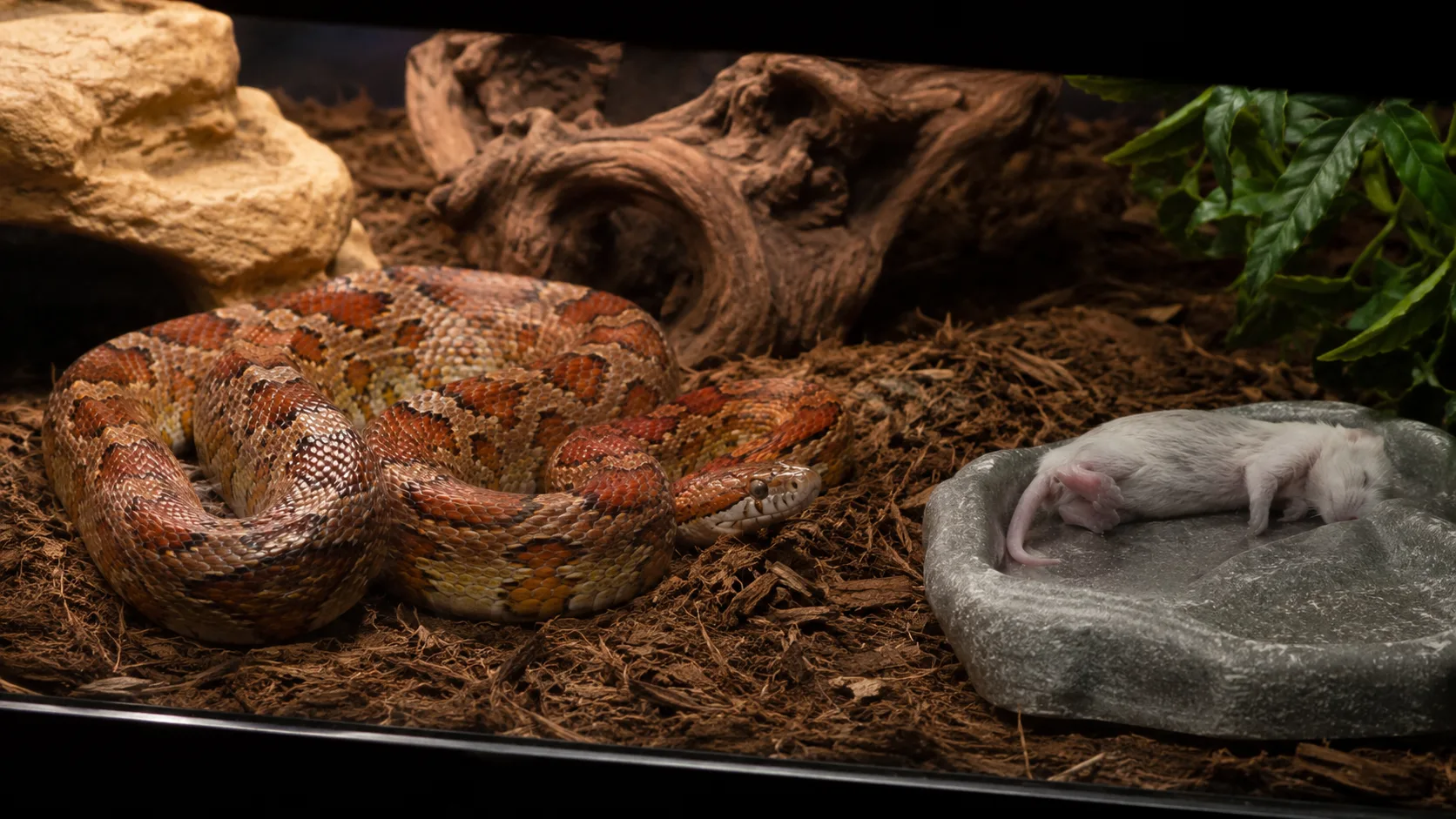
Why is my corn snake not eating?
Short answer
Corn snakes refuse food most commonly because of one of five fixable causes: warm-side temperatures below 29 °C (85 °F), recent rehoming or handling stress, an upcoming shed (cloudy eyes), seasonal winter slowdown, or prey too cool or too large. Audit husbandry first. A healthy corn snake can safely skip several meals if weight is stable.
- Author
- Reptimo Editorial
- Updated
- Updated
- Reading time
- 6 min read
The 30-second triage
A corn snake refusing food is almost always one of five fixable husbandry or seasonal issues. Per PetMD's corn snake care sheet and consistent guidance from ReptiFiles' corn snake guide:
Care parameters
Corn snake refusal — quick triage checklist
| Parameter | Recommended value | Notes |
|---|---|---|
| 1. Warm-side surface temperature | 29–32 °C / 85–90 °F | Verify with IR gun on substrate |
| 2. Recently rehomed or handled? | Give 1–2 week settle, no handling | |
| 3. Cloudy 'blue' eyes? | In shed cycle — wait until completion + 24 h | |
| 4. Time of year? | Oct–Mar slowdown normal in adults | |
| 5. Prey temperature / size? | Warm to ~38 °C, diameter matches snake's thickest body |
If all five check out and the snake is healthy with stable weight, keep offering at the normal cadence. If the refusal continues beyond expected duration or is paired with illness signs, the back-half of this guide covers escalation.
Cause 1 — Temperature out of range
The most common single cause. Per the Merck Veterinary Manual, chronic under-heating suppresses snake immune function and feeding response.
A corn snake's feeding response is body-temperature-driven. Below ~26 °C (79 °F) on the warm side, the snake won't strike at offered prey — its digestion is too slow and the heat-sensing pits don't register the warm prey as worth pursuing.
Common heating mistakes:
- Heat mat without a thermostat — drifts above 40 °C, snake abandons the warm side.
- Heat mat covered by thick substrate — the snake never feels the warmth.
- Radiant heat panel set too low — the air feels warm but the substrate stays cool.
- Stick-on dial thermometer reading 28 °C while the actual substrate reads 22 °C with an IR gun.
Verify with an infrared temperature gun on the actual warm-side substrate. The full setup is in the pillar care guide.
Cause 2 — Rehoming or handling stress
A newly-acquired corn snake almost always refuses the first 1–3 meals. The pattern is biology, not your fault:
- New enclosure scent, layout, and temperature gradient.
- Travel stress from collection / shipping.
- Visible humans, pets, or motion in the new environment.
Standard rehoming protocol:
- First 5–7 days: no offered food. Let the snake explore and thermoregulate.
- Days 7–10: minimal handling, brief checks only.
- Day 10: first feeding attempt in the late afternoon, lights dimmed, room calm.
- Don't handle for 48 hours after first accepted meal.
After the settle period, refusals usually resolve. If the snake refuses 4+ consecutive offerings, audit husbandry (back to Cause 1).
Cause 3 — Shed cycle
A snake entering its shed cycle stops eating reliably. Recognise the cycle:
- Cloudy / "blue" eyes — lenses fog as the cycle begins. First sign.
- Skin dulls noticeably.
- More hiding than usual.
- Possible soaking in the water dish to support skin loosening.
Duration: 7–10 days from blue eyes through clear eyes to the actual shed. Don't offer food during this cycle — most snakes refuse, and feeding right at shed time stresses the body.
Wait 24 hours after the shed completes, then offer at the next regular feeding date. Most snakes accept the post-shed meal normally.
Cause 4 — Winter slowdown
Adult corn snakes (typically 2+ years) often reduce feeding from October through February, mirroring their natural breeding cycle. This is normal seasonal behaviour, not illness, if:
- The snake is otherwise healthy (alert, normal posture, no illness signs).
- Weight stays stable (weigh weekly).
- Husbandry is correct.
The slowdown can last weeks to months in adults. Keep offering at normal cadence, weigh weekly, and most snakes resume feeding in February–April. The parallel pattern in ball pythons is documented in the ball python guide.
Hatchlings and juveniles (under 1 year) should NOT enter winter slowdown. A young corn snake refusing food in winter is a husbandry audit, not "let it brumate."
Cause 5 — Prey issues
Sometimes the refusal is the prey, not the snake:
- Too cool — re-warm the prey in a sealed bag of warm water until surface temperature reaches ~38 °C (100 °F) with an IR gun.
- Too large — prey diameter wider than the snake's thickest body section triggers refusal. Size down.
- Different provider — frozen mice from a new source sometimes scent differently. Try the snake's regular provider.
- Old / freezer-burned — frozen mice stored too long lose scent appeal. Use within 6 months of freezing.
Per The Bio Dude's care sheet, scenting techniques can convert picky eaters: rub the thawed mouse on a thawed pinky, brain the mouse to release fresh scent, or try freshly-killed prey (rare last resort, never live for defensive reasons).
When to see a vet
Refusal alone in a healthy snake isn't a vet emergency. These signs change the picture — book a reptile vet within 1–3 days if any of:
- Open-mouth breathing or audible wheezing (respiratory infection).
- Mucus or bubbles at the nostrils or in the mouth.
- Regurgitation of a previous meal.
- Weight loss exceeding 10 % of body weight over a month.
- Lethargy at warm-side temperatures (snake doesn't move when warm, doesn't tongue-flick).
- Blood in faeces or unusually pale / runny faeces.
- Tiny black or red specks on scales + persistent water-bowl soaking = mites. Treat with Provent-a-Mite-style spray and vet for severe infestations.
- Neurological signs — head tilt, tremors, loss of coordination.
Same-day for severe cases (combined signs, sustained refusal in juveniles, dramatic weight loss).
Bring a written husbandry log and weight trend. The full husbandry context is in the pillar care guide; the feeding mechanics in the feeding frequency guide; cross-species early warning patterns in "is my reptile sick?".
How to track refusals
A simple feeding log catches patterns earlier than memory:
- Date of each offered meal.
- Accepted / refused.
- Prey type and approximate weight.
- Brief notes (shed cycle, recent handling, weather change, weight).
The trend tells the story. Sporadic refusals at random times suggest husbandry drift; clustered refusals in October–February suggest winter slowdown; refusals paired with weight loss suggest the deeper investigation. See the husbandry log guide.
Frequently asked questions
How long can a corn snake safely go without eating?
What temperature does a corn snake need to feed?
My new corn snake isn't eating — what should I do?
Why won't my corn snake eat in winter?
Should I change the prey type if my snake won't eat?
Is it OK if my corn snake skips one meal?
What should I do if my corn snake refuses meals AND loses weight?
Can substrate cause a corn snake to refuse food?
Should I take a corn snake refusing food to a vet?
Sources
- Corn Snake Care Sheet · PetMD
- Corn Snake Caresheet · The Bio Dude
- Corn Snake Care Guide · ReptiFiles
- Disorders and Diseases of Reptiles · Merck Veterinary Manual
Quick check
Test what you just learned
A short quiz, just for you. Pick an answer to get instant feedback — there's no pass mark, this is for your benefit.
Quiz questions and answers
What's the FIRST thing to check when a corn snake refuses food?
Correct answer: Verify warm-side surface temperature with an infrared gun (target 29–32 °C)
Temperature first. Warm-side below ~26 °C suppresses feeding response — the single most common husbandry-driven refusal cause. Verify with an IR gun on the actual substrate, not a stick-on dial.
Your healthy adult corn snake hasn't eaten for 4 weeks in November. What does that suggest?
Correct answer: Probably winter slowdown — re-check husbandry, weigh weekly, keep offering at normal cadence
4-week winter refusals in healthy adult corn snakes are common and normal if husbandry is correct and weight is stable. Re-check temperatures, weigh weekly, keep offering. Vet only if other signs appear.
Cloudy 'blue' eyes on your corn snake means…?
Correct answer: Snake is in the shed cycle — won't eat until shed completes, that's normal
Cloudy/blue eyes signal the snake is in shed cycle. Don't offer food until the shed completes (eyes clear, 24+ hours after the shed event). Refusing during shed is normal and expected.
When does a corn snake's refusal become a vet appointment?
Correct answer: When paired with open-mouth breathing, mucus, weight loss >10 %, regurgitation, or other illness signs
Single refusals are routine. Vet appointment within 1–3 days when refusal is paired with illness signs: open-mouth breathing, mucus, regurgitation, weight loss exceeding 10 %, lethargy at warm temperatures, blood in faeces. Husbandry-driven refusal alone isn't a vet emergency.