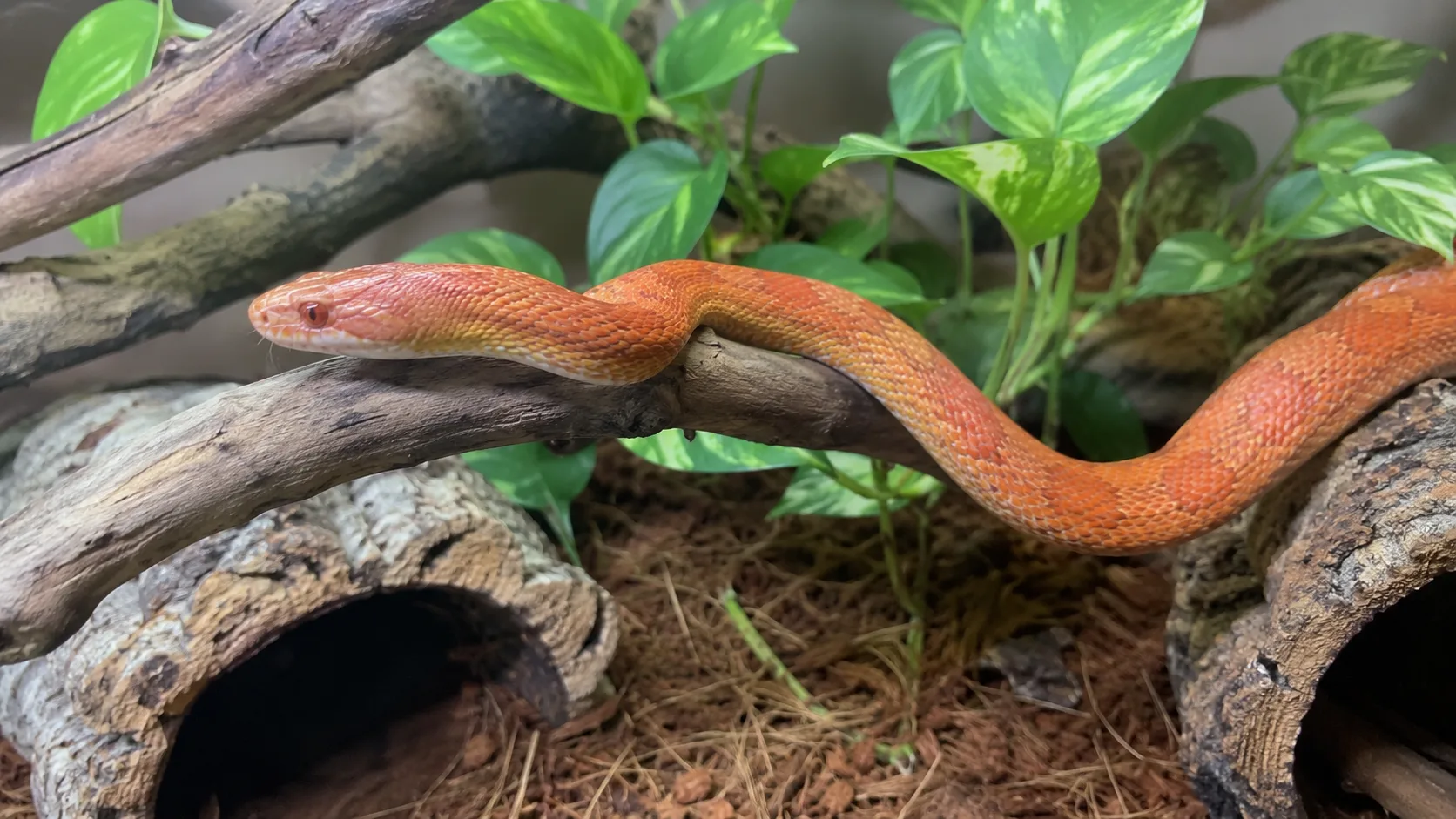
How do you care for a corn snake?
Short answer
Corn snakes need a 120 × 60 × 60 cm (4 × 2 × 2 ft) enclosure with a warm-side surface of 29–32 °C (85–90 °F), a cool side of 22–24 °C (72–75 °F), 40–60 % humidity, secure hides on both ends, and an appropriately sized frozen-thawed rodent every 7–10 days as adults. They tolerate handling and live 15–20 years with correct husbandry.
- Author
- Reptimo Editorial
- Updated
- Updated
- Reading time
- 6 min read
What you're signing up for
Corn snakes (Pantherophis guttatus) are colubrid snakes native to the south-eastern United States — woodlands, fields, abandoned barns. In captivity they are the most widely-recommended beginner snake because they tolerate handling, eat reliably from frozen-thawed mice, accept a range of husbandry, and reach a modest adult size (120–180 cm). Modern welfare-focused care, captured by ReptiFiles' corn snake guide and PetMD's care sheet, has moved on from the old "20-gallon tank, single hide" recommendations that still appear in pet-store rack cards.
This pillar guide is the entry point. Quick parameter table first; detail sections below.
Care parameters
Corn snake — care parameters at a glance
| Parameter | Recommended value | Notes |
|---|---|---|
| Adult enclosure | 120 × 60 × 60 cm / 4 × 2 × 2 ft | Minimum; bigger is better |
| Warm-side surface | 29–32 °C / 85–90 °F | |
| Cool side | 22–24 °C / 72–75 °F | |
| Night (acceptable drop) | 20–22 °C / 68–72 °F | |
| Humidity | 40–60 % | Spike to 65–70 % during shed |
| Adult diet | Adult F/T mouse or small rat every 7–10 days | |
| Handling | 2–4 ×/week, 10–20 min | Not within 48 h of meal or during shed |
| Lifespan | 15–20 years (often longer) | |
| Adult length | 120–180 cm / 4–6 ft |
Enclosure
A 4 × 2 × 2 ft (120 × 60 × 60 cm) enclosure is the modern minimum for an adult corn snake. Older guidance recommending 20-gallon long tanks (75 × 30 × 30 cm) is outdated — corn snakes are active climbers and explorers, and the "snakes don't need much space" myth doesn't survive contact with how they actually behave in larger enclosures.
PVC enclosures are easiest to keep escape-proof and hold heat better than glass. Glass aquaria work if the mesh top has clip locks and no gaps the snake can press through. A hatchling can start in a smaller faunarium (≥ 40 L) for 6–12 months while it grows into the adult cage, but most experienced keepers buy the adult enclosure upfront and add extra hides to make it feel secure for a small snake.
The deep-dive on heating principles in the ball python guide largely applies to corn snakes too — different target numbers, same setup philosophy.
Heating
Two zones, controlled by a thermostat:
- Warm side surface at 29–32 °C (85–90 °F) — provided by a radiant heat panel (RHP), overhead halogen flood, or ceramic heat emitter, all on a dimming or pulse-proportional thermostat with the probe taped to the substrate.
- Cool side ambient at 22–24 °C (72–75 °F) — usually room temperature with no extra heat.
- Night drop to 20–22 °C (68–72 °F) is fine and even helpful. Corn snakes are crepuscular and active at dawn/dusk; they tolerate larger night drops than tropical species.
Measure with an infrared (IR) temperature gun on the actual basking surface, not a stick-on dial. A heat mat under the warm side as supplemental belly heat is fine on its own thermostat — never as the sole heat source for an adult in a 4 ft enclosure.
Humidity and shedding
Corn snakes are happy at 40–60 % ambient humidity, with brief spikes to 65–70 % during shed cycles. The Bio Dude corn snake caresheet describes the practical setup: cypress mulch or coconut fibre substrate holds moisture without going soggy, plus a humid hide (a small box with damp sphagnum moss) on the warm side that the snake uses voluntarily when it needs more humidity.
A bad shed (skin coming off in patches, retained skin on the tail tip or eye caps) almost always traces to low humidity during the shed cycle, not a permanent humidity problem. Mist the enclosure once or twice during the blue-eyed phase and offer a 15-minute shallow soak in lukewarm water if the snake retains skin after the shed completes.
Feeding
Frozen-thawed (F/T) rodents are the modern standard, recommended across every reputable care sheet including PetMD. Live prey carries real risk: a defensive mouse can injure a snake that doesn't strike immediately, particularly with younger snakes.
Sizing rule: prey diameter should match the snake's thickest body section. Anything narrower than the snake is too small; anything much wider risks regurgitation.
Care parameters
Corn snake feeding schedule by life stage
| Parameter | Recommended value | Notes |
|---|---|---|
| Hatchling (0–3 months) | Pinky mouse every 5–7 days | |
| Juvenile (3–9 months) | Fuzzy or hopper mouse every 5–7 days | |
| Sub-adult (9–18 months) | Adult mouse every 7 days | |
| Adult (18 months+) | Adult mouse or small rat every 7–10 days |
Thaw prey in the fridge overnight, then warm in a sealed bag in warm water (never the microwave — it cooks the inside and ruins the prey). Offer with feeding tongs, never bare-handed. Don't handle the snake within 48 hours of a meal — regurgitation from premature movement is a common rookie mistake.
Humidity, shedding, and water
A shallow ceramic water dish large enough for the snake to soak in should sit on the cool side. Refresh every 1–2 days. Soaking is normal behaviour and supports shedding; persistent soaking, especially with loose scales, can indicate mites or temperature problems and is worth investigating.
Handling and temperament
Corn snakes are among the most handleable pet snakes. After a settle-in period (1–2 weeks, no handling, no food for the first 5–7 days, then offer once), 2–4 handling sessions per week of 10–20 minutes each is plenty. Support the snake's body along its length — don't grab mid-body or restrain. Avoid handling within 48 hours of a meal and during a shed cycle.
Bites are rare and minor. A hatchling occasionally bluff-strikes from defensive stress; this fades with consistent gentle handling.
Common problems
The Reptimo cross-species warning signs checklist covers the universal red flags. Corn-snake-specific patterns:
- Refusing food in winter — common seasonal slowdown, especially in older snakes. Re-check temperatures and humidity; if husbandry is correct and weight is stable, wait it out. See the parallel logic in ball python not eating.
- Stuck shed, eye caps retained — low humidity during the shed cycle. Offer a humid hide and a 15-minute shallow soak; don't pull skin off.
- Open-mouth breathing, mucus, wheezing — respiratory infection, often a temperature-or-humidity problem. Reptile vet within days.
- Persistent soaking + tiny black/red specks on scales — mites. Treat with a Provent-a-Mite-style spray (follow label) and consult a vet for severe infestations.
This guide compiles husbandry from authoritative sources and is not veterinary advice. Any health concern is a reptile-vet appointment, ideally with a written husbandry log.
Frequently asked questions
How long do corn snakes live?
Are corn snakes good for beginners?
What size enclosure does an adult corn snake need?
What temperature does a corn snake need?
What humidity does a corn snake need?
What do corn snakes eat?
How often do you feed a corn snake?
Are corn snakes friendly and OK to handle?
How do I keep a corn snake from escaping?
Sources
- Corn Snake Care Sheet · PetMD
- Corn Snake Caresheet · The Bio Dude
- Corn Snake Care Guide · ReptiFiles
Quick check
Test what you just learned
A short quiz, just for you. Pick an answer to get instant feedback — there's no pass mark, this is for your benefit.
Quiz questions and answers
What's the minimum adult enclosure for a corn snake by modern welfare standards?
Correct answer: 120 × 60 × 60 cm (4 × 2 × 2 ft)
Modern guidance is 120 × 60 × 60 cm (4 × 2 × 2 ft) minimum for an adult corn snake. The old 20-gallon recommendation is outdated — corn snakes are active climbers and explorers that benefit from real horizontal space and a true thermal gradient.
What's the safest prey to feed a corn snake?
Correct answer: Appropriately sized frozen-thawed rodents
Frozen-thawed (F/T) rodents are the modern standard — no risk of the prey biting the snake (live mice can injure a snake that doesn't strike immediately), easier to source and store, and welfare-friendly. Prey diameter should match the snake's thickest body section.
What's the right humidity range for everyday corn snake care?
Correct answer: 40–60 % ambient, with brief 65–70 % spikes during shed cycles
40–60 % ambient is the everyday target. Spike to 65–70 % during a shed cycle (cloudy eyes, dull skin) with misting or a humid hide. Sustained high humidity raises respiratory infection risk; sustained low humidity causes stuck sheds.
How often should you handle a corn snake?
Correct answer: 2–4 times per week, 10–20 minutes, avoiding within 48 hours of a meal
Corn snakes tolerate handling well. 2–4 sessions of 10–20 minutes per week is plenty. Don't handle within 48 hours of a feeding (regurgitation risk) or during a shed cycle (skin is fragile and the snake is stressed).