How often should I feed my corn snake?
Short answer
Hatchling corn snakes (under 50 g) eat a pinky mouse every 5–7 days. Juveniles (50–150 g) take a fuzzy or hopper mouse every 5–7 days. Sub-adults (150–400 g) eat an adult mouse every 7 days. Adults (over 400 g) take an adult mouse or small rat every 7–10 days. Always frozen-thawed, prey diameter matching the snake's thickest body section.
- Author
- Reptimo Editorial
- Updated
- Updated
- Reading time
- 6 min read
Schedule by life stage
Corn snakes (Pantherophis guttatus) are colubrids native to the south-eastern United States, eating small rodents in the wild on roughly weekly intervals. Captive feeding schedules mirror this biology and slow with age. Per PetMD's care sheet and ReptiFiles' corn snake guide:
Care parameters
Corn snake feeding schedule by life stage
| Parameter | Recommended value | Notes |
|---|---|---|
| Hatchling (under 50 g) | Pinky mouse every 5–7 days | 1 pinky per feeding |
| Juvenile (50–150 g) | Fuzzy or hopper every 5–7 days | |
| Sub-adult (150–400 g) | Adult mouse every 7 days | |
| Adult (over 400 g) | Adult mouse or small rat every 7–10 days | |
| Established adult (3+ years) | Adult mouse or small rat every 10 days | Some keepers do every 14 days for older adults |
Prey sizing
The sizing rule across reptile keeping: a feeder rodent's diameter should match the snake's thickest body section, not its head. The snake's jaw stretches; the gut needs to digest. Per The Bio Dude's corn snake caresheet:
- Same width as snake's thickest body section = safe.
- Narrower than the snake = always fine; smaller prey beats oversized.
- Wider than the snake = regurgitation risk; avoid.
Practical sizes by life stage:
- Pinky (~3 g, hairless newborn mouse) — for hatchling corn snakes.
- Fuzzy (~5–7 g, just-furred) — for small juveniles outgrowing pinkies.
- Hopper (~10 g, fully furred but small) — for larger juveniles.
- Weaned mouse (~15 g) — for late juveniles.
- Adult mouse (~20–30 g) — sub-adults and most adult corn snakes.
- Small rat (~30–50 g) — for the largest adult corn snakes (over 1.5 m / 5 ft body length).
Length matters less than girth. A slightly longer pinky of the right diameter is fine for a hatchling.
Frozen-thawed: thawing technique
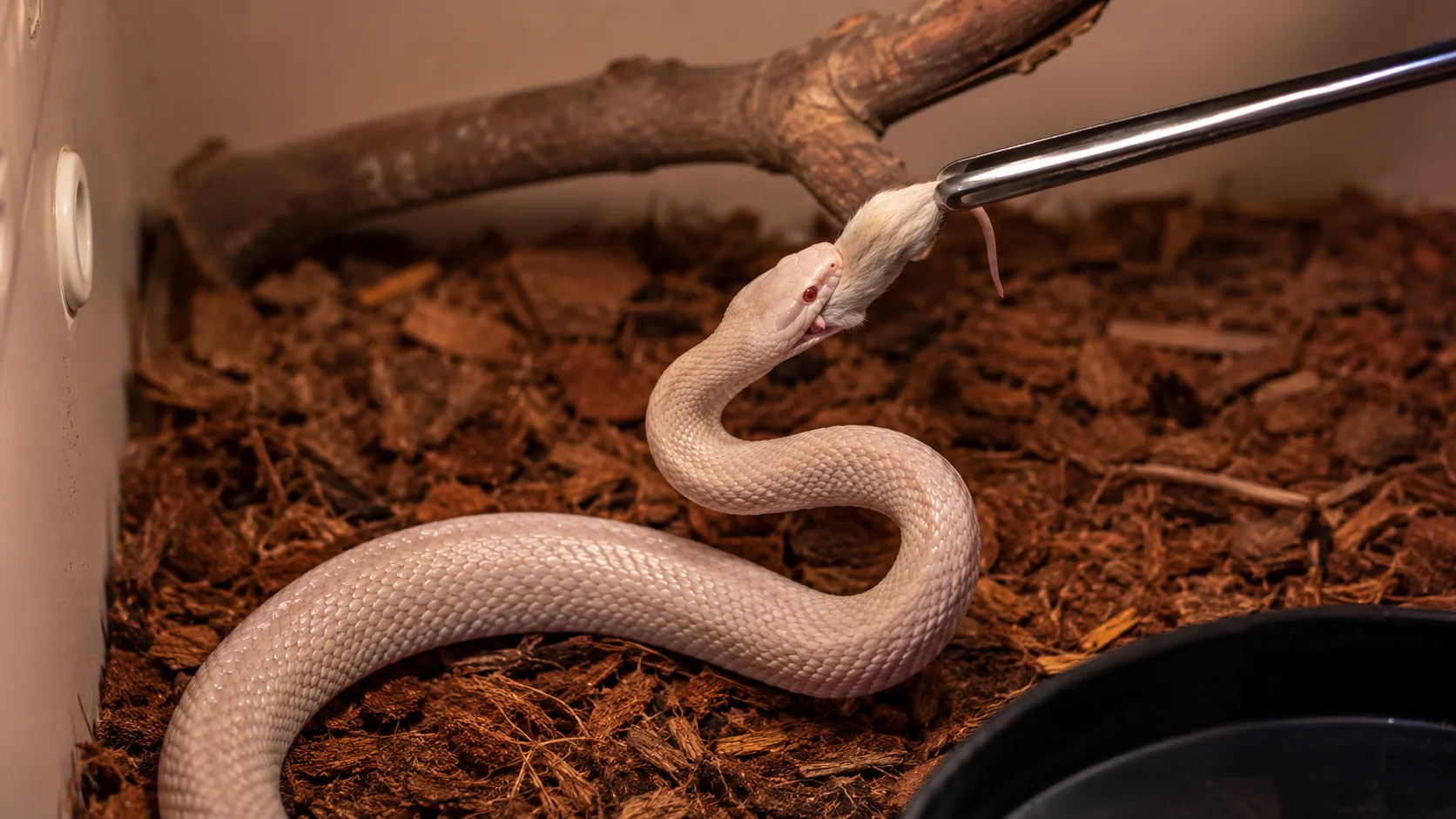
Frozen-thawed (F/T) rodents are the modern standard, recommended across every reputable care sheet. The thawing sequence:
- Move from freezer to fridge for 24 hours (overnight). The slow thaw protects the rodent's internal organs.
- Warm the rodent in a sealed plastic bag immersed in warm (not hot) water for 15–30 minutes until warm throughout. Target surface temperature ~38 °C (100 °F) — the heat-sensing pits on the snake's face read warm prey as live and trigger the strike response.
- Pat dry briefly so the rodent isn't dripping.
- Offer with long feeding tongs — never bare-handed (a striking corn snake can mistake your warm hand for prey at close range).
- Wiggle realistically if the snake doesn't strike immediately — movement triggers the response in addition to warmth.
Never microwave a frozen rodent — it cooks the inside, ruptures internal organs that contaminate the meal, and kills any heat signal the snake reads.
When to feed during the day
Corn snakes are crepuscular and accept food well in the evening when the room is quiet and lights are dimmed. Most keepers feed:
- Late afternoon or early evening, 1–2 hours before lights-off.
- After the snake is settled in its enclosure (not just after handling).
- With minimal room activity around the enclosure.
Avoid:
- Within 1 hour of lights-on or lights-off — disrupts digestion timing.
- Right after handling — snake's not in feeding mode.
- Within 24 hours of handling beforehand — same reason.
After a meal, don't handle the snake for 48 hours. Premature movement of a recently-fed snake causes regurgitation, which is stressful and bad for the gut.
Where to feed
Two equally valid approaches:
In-enclosure feeding (recommended for corn snakes). Use long feeding tongs to offer the prey. Most corn snakes don't develop substrate-eating habits when fed this way. Simpler — no extra handling stress before or after the meal.
Separate feeding container. A small lidded plastic tub dedicated to feeding. Slightly reduces substrate-ingestion risk but introduces two extra handling events (moving the snake in and out), which can stress some individuals and reduce feeding response. Use this approach only if the snake regularly eats substrate during in-enclosure feeding.
Most modern care guidance defaults to in-enclosure with tongs.
How often vs how much
The "how often" answer is more important than the "how much" answer for corn snakes. A single appropriately sized prey item per feeding is the standard — not multiple prey per session.
Why not feed more per session and less often? Because:
- Two appropriately sized prey items in one meal can overload digestion and cause regurgitation.
- The schedule is calibrated around the rodent's nutritional content — a single F/T mouse of the right size provides appropriate calories for the gap between feedings.
- Daily small meals stress digestion in a constrictor evolved for occasional large meals.
Stick to one prey per feeding at the right size for the snake's stage.
When the snake refuses
A corn snake refusing food is usually a husbandry or environmental issue, not a feeding-amount problem. Check first:
- Warm-side surface temperature at 29–32 °C (85–90 °F) verified with an IR temperature gun.
- Recent shed cycle — cloudy eyes signal the snake is in shed and won't feed; wait 7–10 days for completion.
- Recent rehoming or handling — give a 1–2 week settle period.
- Winter slowdown — older corn snakes sometimes reduce feeding October–March, similar to ball pythons.
- Prey temperature — re-warm and try again if the first offering feels cool.
Full diagnostic walkthrough in the corn snake not-eating guide. The broader feeding-refusal logic, especially the ball-python parallel, is in the ball python guide.
Tracking feedings
Logging every feeding pays off — short-term it lets you spot a refused-meal pattern early, long-term it gives a reptile vet structured data on a sick visit. Even a simple paper log of:
- Date and time
- Prey species and approximate weight
- Accepted / refused
…lets you see seasonal patterns and the early warning of any husbandry drift. See the husbandry log guide. Reptimo's feeding logger removes the friction of opening a spreadsheet on your phone after a feeding.
The broader husbandry context and full corn snake care system live in the pillar care guide.
Frequently asked questions
How often does a corn snake eat?
What prey size for a corn snake?
Should I feed live or frozen-thawed mice to a corn snake?
How do I thaw a frozen mouse for a corn snake?
When should I feed my corn snake — day or night?
Why won't my corn snake eat?
Can I feed two small prey items instead of one large?
Should I feed in the snake's enclosure or in a separate container?
How can I tell if my corn snake is overweight?
Sources
- Corn Snake Care Sheet · PetMD
- Corn Snake Caresheet · The Bio Dude
- Corn Snake Care Guide · ReptiFiles
Quick check
Test what you just learned
A short quiz, just for you. Pick an answer to get instant feedback — there's no pass mark, this is for your benefit.
Quiz questions and answers
How often should an ADULT corn snake eat?
Correct answer: Every 7–10 days
Adult corn snakes (over 400 g): one appropriately sized adult mouse or small rat every 7–10 days. More frequent feeding causes obesity. Less frequent in a healthy adult is also fine — many keepers do every 10 days for established adults.
What's the right prey size for a corn snake?
Correct answer: Same diameter as the snake's thickest body section
Prey diameter matches the snake's thickest body section (not head). Same width = safe; narrower is fine; wider risks regurgitation. The jaw stretches; the gut needs to digest.
Live mice or frozen-thawed?
Correct answer: Frozen-thawed — safer for snake, more humane, easier to source
Frozen-thawed (F/T) is the modern standard for corn snakes. Live prey can bite the snake — a defensive mouse can do real damage. F/T is safer, more humane, easier.
How do you correctly thaw a frozen mouse?
Correct answer: Fridge overnight, then sealed bag in warm water for 15–30 min until warm throughout
Slow thaw in fridge overnight, then warm-water bath in a sealed bag. NEVER microwave — it cooks the inside, ruptures organs, and kills the heat signal that triggers the snake's strike response.