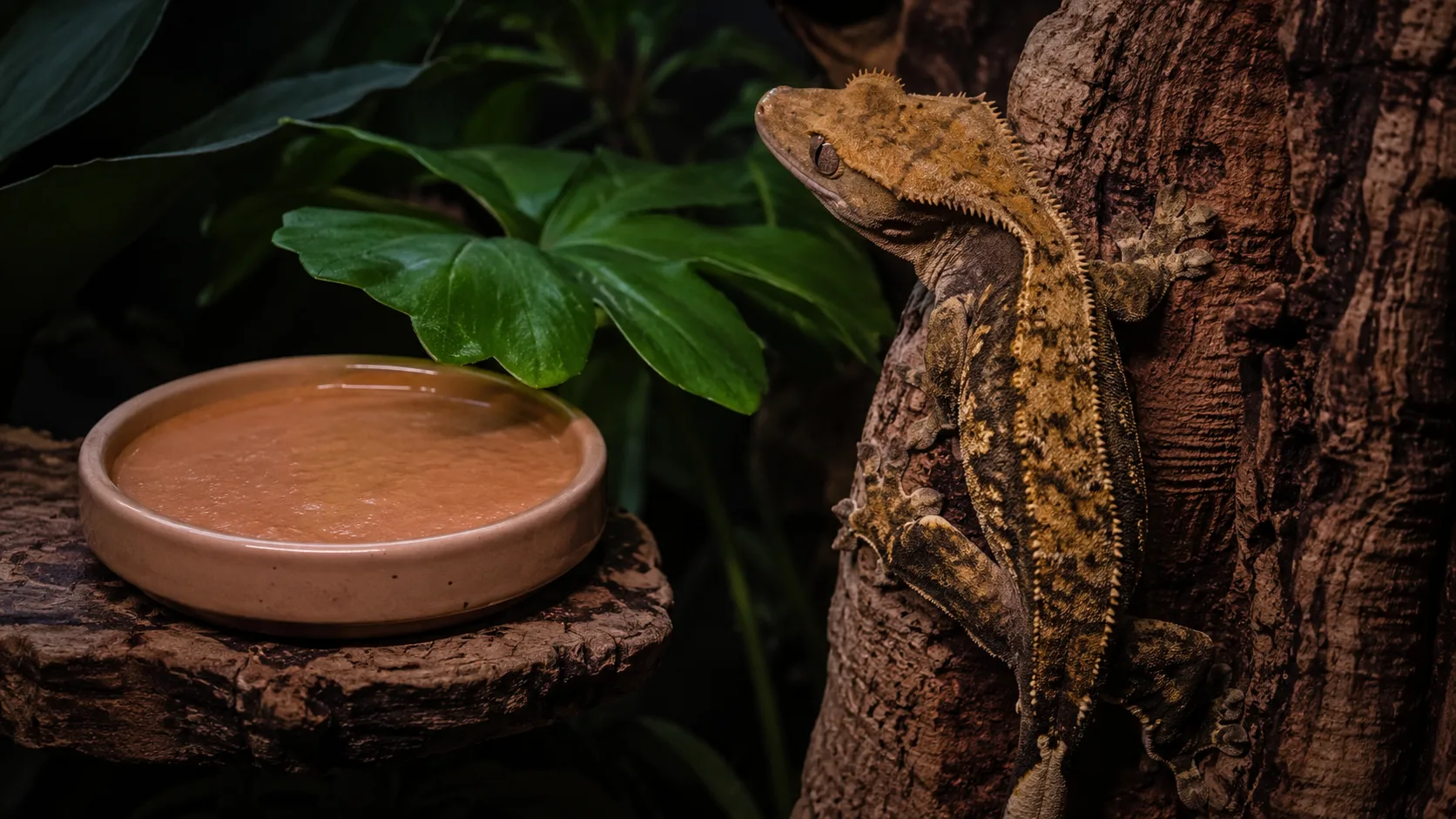
Why is my crested gecko not eating?
Short answer
Crested geckos refuse food most commonly because of recent rehoming stress, temperature too high (sustained over 28 °C is dangerous), a rejected CGD flavour or brand, an upcoming shed cycle, or under- stimulating handling. Audit temperature first, then offer a different CGD flavour. Most refusals resolve within a week. Refusal past 2 weeks in an adult, or weight loss, is a reptile-vet appointment.
- Author
- Reptimo Editorial
- Updated
- Updated
- Reading time
- 5 min read
Temperature first — this species is heat-sensitive
Unlike most reptile diagnostics where "is the warm side too cold?" is the first question, with crested geckos (Correlophus ciliatus) the first question is "is the room too warm?". Per ReptiFiles' care guide and Zen Habitats' Q&A:
- Comfort range: ambient 22–26 °C (72–78 °F).
- Genuinely dangerous: sustained above 28 °C (82 °F).
- Often fatal: sustained above 30 °C (86 °F).
Crested geckos evolved in cool New Caledonian forests. They cannot thermoregulate at high temperatures the way desert reptiles can — heat stress is the documented #1 captive mortality cause.
Quick check before any other diagnostic:
- Room temperature with a digital thermometer.
- If approaching 28 °C, cool the room (open windows, AC, frozen water bottles wrapped in towels placed near but not in the enclosure).
- Sustained refusals in summer almost always trace to heat stress before they trace to anything else.
The five common causes
In rough order of frequency:
Cause 1 — Heat stress
See above. Most common cause in summer or in warm homes.
Cause 2 — Rehoming stress
A newly-acquired crested gecko almost always reduces or refuses feeding for 1–2 weeks. Standard protocol:
- First 2 weeks: zero handling. Brief visual checks only.
- Offer CGD nightly in a shallow dish on the feeding ledge, remove untouched portion in the morning.
- Calm room conditions — no loud noise, no pets visible through the glass, low traffic.
- Dim red night light is fine for observation if you want it; never white light at night.
Most new geckos accept food by the end of the second week. If refusal extends past 2 weeks with a new arrival, audit temperature and humidity, and consider a vet check.
Cause 3 — CGD flavour rejection
Crested geckos can be flavour-picky. Per PetMD's care sheet, commercial CGD comes in multiple flavours and brands:
- Repashy Crested Gecko MRP (multiple flavours).
- Pangea Fruit Mix Complete (multiple flavours, with and without insects).
- Black Panther Zoological Complete Gecko Diet.
- Lugarti Premium Crested Gecko Diet.
If your gecko has been on one flavour and stalls, rotate to a different flavour at the next feeding. Many keepers maintain a 2–3 flavour rotation to prevent this. Don't switch entirely to a new brand overnight — gradual rotation keeps the gecko adapted.
Cause 4 — Shed cycle
Crested geckos shed every few weeks (juveniles) to every 1–2 months (adults), and often refuse food for a day or two around the shed event. They typically eat the shed skin. Single-day refusals around obvious shed cycles are routine. See the humidity guide for shed cycle management.
Cause 5 — Underlying illness or husbandry issue
Less common but worth ruling out:
- Metabolic bone disease (rare with proper CGD) — soft jaw, weak grip, kinked spine.
- Floppy tail syndrome — tail rests bent forward over the body. Often calcium-related; can also indicate poor vertical climbing space.
- Parasites — uncommon in captive-bred but possible in wild- origin geckos.
- Stuck shed — toes or tail tip with retained shed, sometimes interfering with movement and feeding.
- Recent tail drop — see the dropped tail guide; gecko often refuses food for several days post- drop.
Triage by duration and signs
Care parameters
Crested gecko refusal — when to act
| Parameter | Recommended value | Notes |
|---|---|---|
| 1–2 days, no other signs | Re-check temperature, offer again | Single refusals are normal |
| 3–7 days, new gecko, no other signs | Continue normal protocol; this is rehoming stress | |
| 1 week, established gecko, no other signs | Audit temperature and CGD flavour; consider live insects | |
| 2 weeks, established adult, weight stable | Vet appointment within 1–3 days | |
| 1 week+, hatchling under 5 g | Vet within 1–3 days regardless | |
| Any duration + sustained dark coloration | Vet within 1–3 days | |
| Any duration + floppy tail / kinked spine / weak grip | Vet within DAYS (MBD) | |
| Any duration + recent dropped tail | Wound care first; vet if not eating after 5 days | |
| Weight loss exceeding 10 % | Vet within 1–3 days | |
| Closed eyes, neurological signs | SAME-DAY vet |
What to do — and what not to do
Do:
- Check temperature first with a digital thermometer.
- Try a different CGD flavour at the next feeding.
- Offer live insects (2–3 appropriately sized crickets, dubias, or BSFL) in the evening as a feeding-trigger experiment.
- Reduce all stressors — handling, visible pets, loud noise.
- Weigh weekly during any refusal period. A simple digital kitchen scale and a deli cup work.
- Track everything — see the husbandry log guide.
Don't:
- Heat the enclosure in response to refusal. The opposite is more often needed in this species.
- Force-feed — stresses an already-stressed animal.
- Switch entirely to insects. CGD provides complete fortified nutrition; an all-insect crested gecko diet eventually causes calcium deficiency.
- Handle a refusing gecko "to check it" beyond a brief visual.
When to see a vet
The thresholds above. Bring a written husbandry log and weight trend to any reptile-vet visit — significantly speeds diagnosis. The pillar care context is in the pillar care guide; the cross-species early warning patterns are in "is my reptile sick?"; the humidity setup that's often involved is in the humidity guide.
Frequently asked questions
How long can a crested gecko go without eating?
What's the first thing to check when a crested gecko won't eat?
Why does my crested gecko refuse one CGD flavour but eat another?
What temperature should a crested gecko be at?
Why won't my new crested gecko eat?
Should I offer live insects if my crested gecko won't eat CGD?
Is it normal for a crested gecko to refuse food during shed?
When should I take a crested gecko refusing food to a vet?
Can stress cause weight loss in crested geckos?
Sources
- Crested Gecko Care Sheet · PetMD
- Crested Gecko Care Guide · ReptiFiles
- Most Asked Crested Gecko Questions · Zen Habitats
- Disorders and Diseases of Reptiles · Merck Veterinary Manual
Quick check
Test what you just learned
A short quiz, just for you. Pick an answer to get instant feedback — there's no pass mark, this is for your benefit.
Quiz questions and answers
What's the FIRST thing to check when a crested gecko refuses food?
Correct answer: Temperature — sustained heat above 28 °C is dangerous for this species
Temperature first. Crested geckos genuinely cannot tolerate sustained heat above 28 °C — heat stress is the most documented mortality cause in captivity. If the room is warm, that's the priority before any other diagnostic.
Your crested gecko refuses one CGD flavour. What's the right next step?
Correct answer: Try a different CGD flavour or brand at the next feeding
CGD comes in multiple flavours and brands (Repashy, Pangea, Black Panther Zoological, Lugarti). Rotating flavours often resolves a stalled feeder. Don't switch entirely to insects — CGD provides complete fortified nutrition that an all-insect diet can't match.
Your new crested gecko hasn't eaten in 5 days. What does that suggest?
Correct answer: Likely rehoming stress — give 1–2 weeks of zero handling, continue offering CGD nightly
Recent rehoming almost always causes 1–2 weeks of reduced or refused feeding. Zero handling, dim conditions, nightly CGD with morning cleanup. Most new geckos accept food by the end of week 2.
When does a crested gecko refusal become a vet appointment?
Correct answer: After 2 weeks in an adult, OR 1 week in a hatchling, OR sooner with weight loss / illness signs
Adult: 2 weeks of refusal is the threshold (sooner with weight loss). Hatchling: 1 week is the threshold because they're higher-risk. Sooner if paired with signs like sustained dark coloration, lethargy, floppy tail syndrome, or dropped tail.