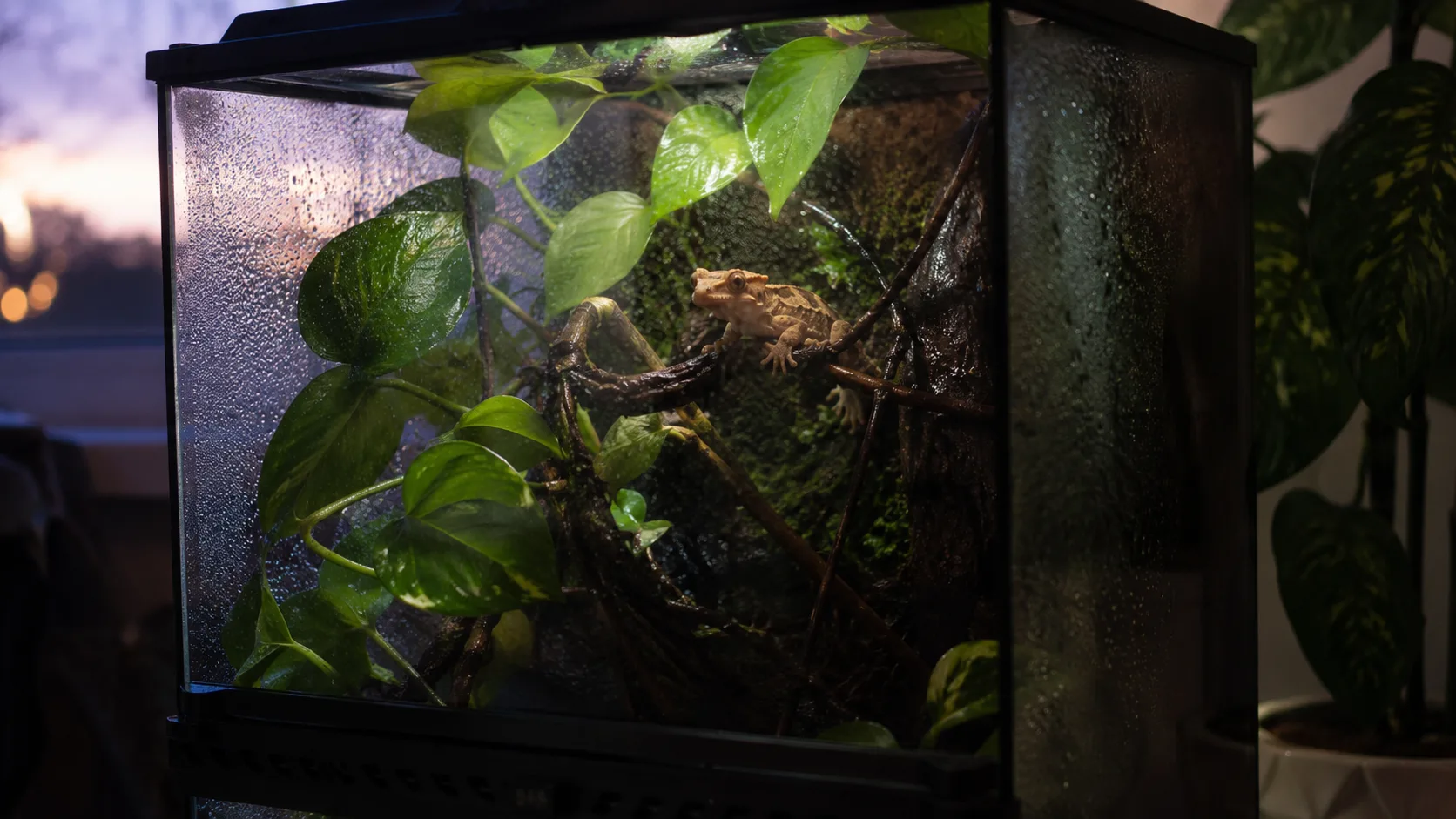
What humidity does a crested gecko need?
Short answer
Crested geckos need 60–80 % humidity that briefly spikes to ~90 % after misting and drops to 40–50 % between mistings — the wet-then-dry cycle is critical. Mist heavily once or twice a day with a pressure sprayer. Use a moisture-holding substrate like coconut fibre and sphagnum moss. Sustained constant high humidity drives respiratory issues; sustained low humidity causes stuck sheds.
- Author
- Reptimo Editorial
- Updated
- Updated
- Reading time
- 5 min read
Humidity targets and the wet-then-dry cycle
Crested geckos (Correlophus ciliatus) come from the rainforests of New Caledonia, where humidity is high but the air still moves and foliage dries between rain events. Captive husbandry mirrors that. Per ReptiFiles' crested gecko guide and consistent guidance from Zen Habitats' Q&A:
Care parameters
Crested gecko humidity profile through the day
| Parameter | Recommended value | Notes |
|---|---|---|
| Right after evening mist | 85–90 % | Brief peak; gecko drinks droplets from leaves |
| Late evening / overnight | 70–80 % | Slowly drops as enclosure dries |
| Mid-morning | 50–60 % | |
| Just before next mist | 40–50 % | Low end of cycle; substrate still slightly damp |
| Sustained ceiling | ≤ 85 % | Above: respiratory issues, fungal growth |
| Sustained floor | ≥ 40 % | Below: stuck sheds |
Misting cadence
Per PetMD's care sheet, the standard misting schedule:
- Evening mist (primary) — heavy misting once daily, just before or just after lights-off. Crested geckos are nocturnal and drink the post-mist droplets at night.
- Morning mist (optional) — light second misting if the enclosure dries fast. Skip if humidity is still above 50 % when you check.
- NOT throughout the day — multiple mistings prevent the enclosure from drying, which is the actual point.
Use a pressure sprayer (Solo One-Hand Sprayer, similar) for an even heavy mist. A handheld trigger spray bottle is fine for small enclosures but tires fast.
Automatic mister systems (MistKing) are overkill for crested geckos but useful if you're away frequently or have multiple enclosures. Program for a 60–90 second cycle once per evening.
Substrate that helps
The substrate's job is to act as a humidity buffer between mistings:
- Coconut fibre (coir) — primary moisture-holding component.
- Orchid bark — chunks add structure and drainage.
- Sphagnum moss — pockets of higher local humidity, gecko- friendly texture.
- Leaf litter (oak, magnolia) — top layer for naturalism and micro-fauna habitat.
A common bioactive mix: 50 % coco coir, 25 % orchid bark, 25 % sphagnum moss, with a top layer of dried botanical leaves and a clean-up crew of tropical springtails and isopods.
Substrates that DON'T support humidity:
- Paper towel (fine for hatchlings/quarantine, but needs more frequent misting).
- Reptile carpet (dries fast).
- Aspen / wood shavings (totally wrong for tropical species).
- Pure sand (zero moisture retention).
Stuck shed and how to prevent it
Crested geckos shed every few weeks (juveniles) to every 1–2 months (adults). They typically eat the shed skin in one go, so you may only catch the start and end of a cycle. When humidity is right, shed comes off cleanly.
When humidity is too low during the shed cycle, shed gets stuck — most commonly on:
- Toes — small surface area, dries fast. Retained shed can constrict and damage tissue over time.
- Tail tip — same issue.
- Around the eyes — gecko has reduced vision and may struggle to feed.
How to address stuck shed:
- 10-minute shallow soak in lukewarm water (max 1 cm depth) in a small container.
- Very gently wipe stuck pieces off with a damp cotton bud or soft cloth. NEVER pull dry shed off — risks tearing skin.
- If toe constriction is visible or retained shed isn't coming off, reptile-vet appointment — constricted toes can lose circulation and require veterinary intervention.
After the immediate cleanup, audit the humidity cycle to prevent recurrence. The parallel logic for leopard gecko stuck sheds is in the leopard gecko stuck shed guide.
How to measure correctly
Two tools:
- Digital hygrometer mounted at mid-height inside the enclosure on the screen wall or a branch. NOT stuck to the outside glass — reads inaccurately.
- Multiple checks per day to confirm the cycle is working:
- Right after evening mist: target 85–90 %.
- Late evening: 70–80 %.
- Just before next mist: 40–50 %.
Re-verify monthly and after any equipment change (new mister, substrate change, room ventilation change).
Analog dial hygrometers drift badly and are unreliable. A simple digital hygrometer-thermometer combo (Govee, ThermoPro, or any basic model) gives the readings that matter.
Ventilation matters
Often overlooked: crested gecko enclosures need ventilation to support the wet-then-dry cycle. A sealed glass terrarium with no top vent traps humidity at 90 % constantly, defeating the cycle.
Standard front-opening glass terrariums (Exo Terra, Zoo Med) have top screens that provide ventilation by default. If you're using a modified or sealed enclosure, ensure there's airflow — without it, no amount of misting management gets the wet-then-dry cycle.
What goes wrong
Two extremes drive most humidity-related crested gecko problems:
Constant high humidity (sustained 80 %+ with no drying):
- Respiratory issues over weeks to months.
- Fungal growth on substrate and décor.
- Skin issues, including unusual lesions.
- Stressed behaviour: hiding constantly, refusing food.
Fix: improve ventilation, reduce misting volume, allow substrate to dry slightly before re-watering.
Constant low humidity (sustained under 50 %):
- Stuck sheds (toes, tail tip, eyes).
- Reduced drinking (gecko relies on leaf droplets).
- Dehydration over weeks.
- Reduced appetite.
Fix: increase misting frequency or duration, switch to a more moisture-holding substrate, add live plants for humidity buffering.
The broader husbandry context is in the pillar care guide. For food refusal that may overlap with humidity issues, see the not-eating guide.
Frequently asked questions
What's the right humidity for a crested gecko?
How often should I mist a crested gecko's enclosure?
What's the best substrate for crested gecko humidity?
Why is humidity important for shedding?
What humidity is too high for a crested gecko?
How do I measure humidity in a crested gecko enclosure?
Why is my crested gecko's tail or toes stuck in shed?
Should I bath my crested gecko for humidity?
What humidity does a hatchling crested gecko need?
Sources
- Crested Gecko Care Sheet · PetMD
- Crested Gecko Care Guide · ReptiFiles
- Most Asked Crested Gecko Questions · Zen Habitats
Quick check
Test what you just learned
A short quiz, just for you. Pick an answer to get instant feedback — there's no pass mark, this is for your benefit.
Quiz questions and answers
What humidity pattern does a crested gecko need?
Correct answer: Wet-then-dry cycle: 60–80 % with spikes to 90 % after misting, drying to 40–50 % between
The wet-then-dry cycle mirrors natural New Caledonian forest conditions. Constant high humidity drives respiratory issues; constant low humidity causes stuck sheds. The cycle of misting + drying is what works.
When's the best time to mist a crested gecko enclosure?
Correct answer: Once or twice daily, with the main mist in the evening before lights-off
Crested geckos are nocturnal — they drink post-mist droplets from leaves at night. One heavy evening mist (with optional morning) is the standard. Multiple daily mistings prevent the enclosure from drying and cause respiratory issues.
Your crested gecko has stuck shed on its toes. What's the right response?
Correct answer: 10-minute shallow lukewarm soak, then gently wipe with a damp cotton bud — never pull
Stuck shed needs gentle removal via short shallow soaks and careful wiping with a damp cotton bud — never pull (risks tearing skin). Retained shed constricting a toe is a vet visit; otherwise, address the underlying humidity issue so the next shed comes off cleanly.
How do you accurately measure crested gecko enclosure humidity?
Correct answer: Digital hygrometer mounted at mid-height inside the enclosure
Digital hygrometer at mid-height inside the enclosure gives reliable readings. Analog dials drift badly; foggy glass is a snapshot not a measurement. Check at multiple times of day to confirm the full wet-then-dry cycle.