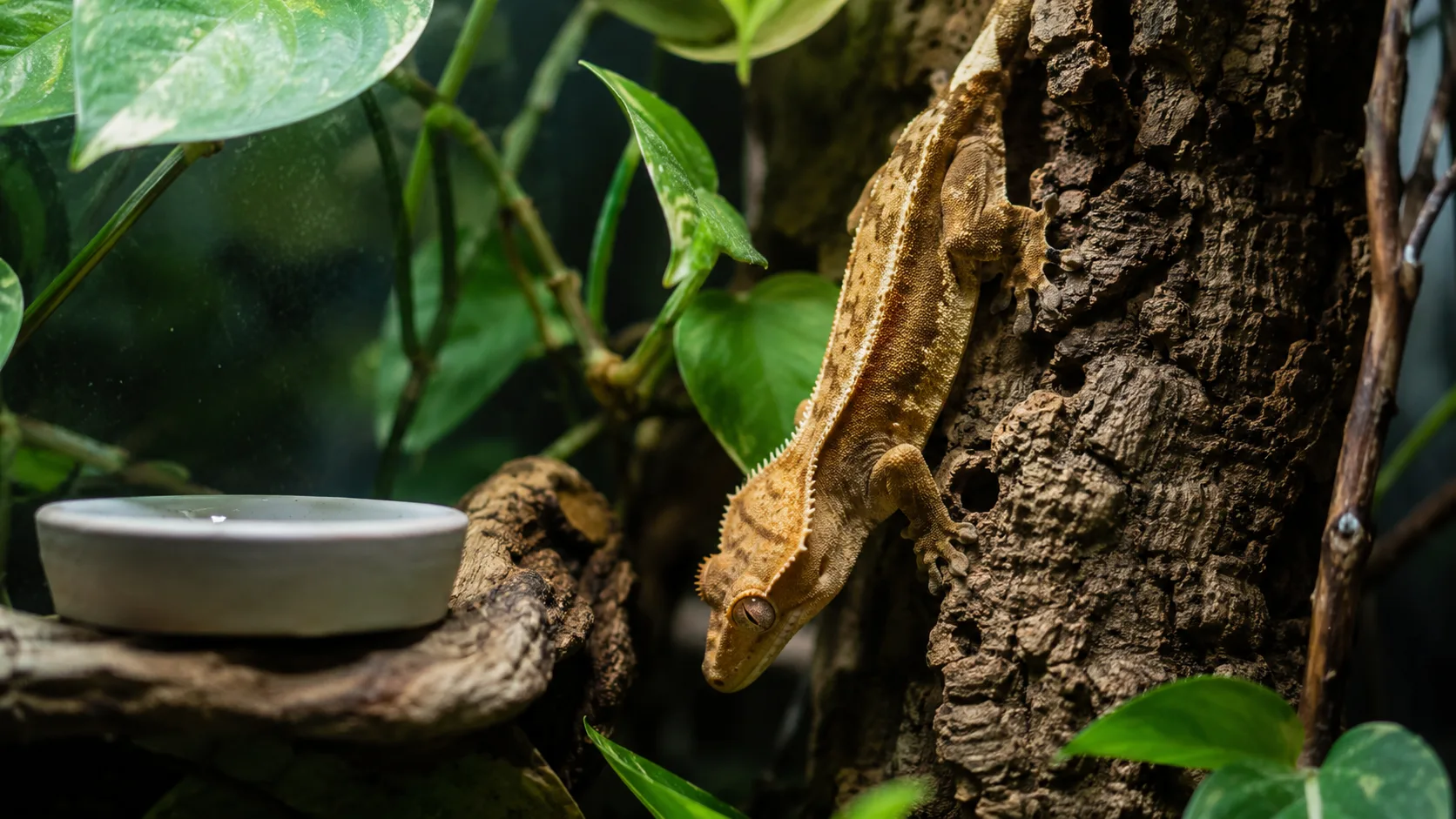
How do you care for a crested gecko?
Short answer
A crested gecko needs a vertical enclosure of at least 45 × 45 × 60 cm (18 × 18 × 24 in), ambient temperature 22–26 °C (72–78 °F), 60–80 % humidity dropping between mistings, a commercial crested gecko diet (CGD) like Repashy or Pangea 3 times per week, climbing branches and cover, and no required UVB or heat lamp in a normal heated room.
- Author
- Reptimo Editorial
- Updated
- Updated
- Reading time
- 6 min read
What you're signing up for
Crested geckos (Correlophus ciliatus) are arboreal geckos from the forests of New Caledonia. The species was thought extinct until rediscovered in 1994, and the captive-bred hobby has exploded since. For most first-time reptile keepers, crested geckos are the lowest- friction starter species: they live at room temperature, eat a complete commercial powdered diet (no live insects required), need minimal lighting, and tolerate brief handling. The trade-off is they are jumpy, drop their tails permanently, and prefer climbing over being held.
If you're choosing between species, the beginner comparison guide covers crested geckos against leopard geckos, corn snakes, ball pythons and bearded dragons.
Care parameters
Crested gecko — care parameters at a glance
| Parameter | Recommended value | Notes |
|---|---|---|
| Adult enclosure | 45 × 45 × 60 cm / 18 × 18 × 24 in (vertical) | One adult; larger for pairs |
| Adult size | 35–55 g, 20–25 cm head-to-tail | |
| Ambient temperature | 22–26 °C / 72–78 °F | Never sustained above 28 °C |
| Night temperature | 18–22 °C / 65–72 °F | |
| Humidity | 60–80 % | Dries between mistings |
| UVB | Optional low-level (UVI 0.5–1.0) | If using, T5 HO 5–7 % bulb |
| Diet | Commercial CGD 3×/week + occasional insects | |
| Handling | 10–15 min, few times/week | Hand-walking technique; avoid the tail |
| Lifespan | 15–20 years |
Enclosure
A vertical enclosure of at least 45 × 45 × 60 cm (18 × 18 × 24 in) is the modern minimum for one adult crested gecko. Vertical orientation matters because they're arboreal — they spend most of their time climbing, jumping between branches and resting head-down on vertical surfaces. Per ReptiFiles' care guide, a properly furnished vertical enclosure beats a larger horizontal one for this species.
Inside, build a 3D climbing network:
- Vertical cork bark slabs mounted on the back wall (their favourite perch is usually head-down on cork).
- Branches and vines crossing the enclosure at multiple heights.
- Live or silk plants — pothos, philodendron, ficus pumila — for cover and humidity buffering.
- Feeding ledge at mid-height holding a shallow dish of CGD.
- Moisture-holding substrate at the bottom: coconut fibre, orchid bark, sphagnum moss mix. Paper towel works for hatchlings and during quarantine.
Front-opening glass terrariums (Exo Terra, Zoo Med Naturalistic) are the standard housing.
Heating and lighting
Crested geckos are the rare reptile that genuinely thrives at room temperature. Most heated homes (22–26 °C / 72–78 °F) need no additional heating. The Zen Habitats Q&A flags this clearly: heat lamps are only needed if the room itself runs cold (under 20 °C / 68 °F sustained).
If you do add heat:
- A low-wattage halogen on a dimming thermostat creating a basking spot at no more than 27 °C (80 °F).
- Never use heat mats on the floor — crested geckos rarely descend, so a floor heat source achieves nothing useful and risks overheating the enclosure if it does come down.
UVB is a longer debate. Per PetMD's care sheet and most modern keepers' practice: low-level UVB (UVI 0.5–1.0 with a T5 HO 5–7 % tube) is beneficial but optional, because commercial crested gecko diet is fortified with vitamin D3. If you skip UVB, keep CGD as the primary diet.
Diet
Commercial crested gecko diet (CGD) is one of the strongest arguments for keeping this species as a beginner reptile: a single complete powdered diet covers full nutrition.
- Repashy Crested Gecko MRP (multiple flavours).
- Pangea Fruit Mix Complete (multiple flavours).
- Black Panther Zoological Complete Gecko Diet.
- Lugarti Premium Crested Gecko Diet.
Mix 1 part powder with 2 parts water to a ketchup consistency. Offer in a shallow ceramic or silicone dish on the feeding ledge, 3 times per week, in the evening (crested geckos are nocturnal). Remove uneaten food after 24 hours.
Live insects 1–2 times per month for variety: appropriately sized crickets, dubia roaches, BSFL (calciworms). Dust with calcium-with- D3 powder if UVB isn't running. Detailed feeder logistics live in the leopard gecko feeding guide — the insect-handling principles transfer.
Handling and tail loss
Crested geckos tolerate brief handling well, but they're jumpers rather than cuddlers. After a 2-week settle-in (no handling, just observation), introduce sessions of 10–15 minutes a few times per week. Standard technique: open the enclosure, let the gecko walk onto your hand of its own accord, then hand-walk (pass it hand over hand as it walks). Don't grab; don't restrain.
The tail rule. Crested geckos drop their tails (autotomy) as a defence response — and unlike most gecko species, the tail does NOT regenerate. A tailless ("frog-butt") crested is otherwise perfectly healthy and many adults in the captive trade are tailless. But the loss is permanent and a sudden drop is a sign of significant stress. Don't grab the tail; don't tug.
Humidity and shedding
60–80 % humidity, with the enclosure drying briefly between mistings rather than staying constantly saturated. Achieve with:
- Heavy misting 1–2 times per day with a pressure sprayer.
- Moisture-holding substrate (coconut fibre + sphagnum moss).
- Live plants buffering humidity.
- Front-opening glass terrarium retains humidity well.
Shedding happens every few weeks for juveniles, every 1–2 months for adults. Crested geckos eat their shed skin — you'll often see the start and end of a shed but not the middle. Stuck shed on toes or tail tip is a humidity warning sign; mist more, check humidity with a hygrometer.
Common problems
The cross-species warning signs checklist covers universal red flags. Crested-gecko- specific patterns:
- Heat stress — the #1 mortality cause in captive crested geckos. Open-mouth panting, dark coloration, lethargy in a warm room: emergency cooling required.
- Floppy tail syndrome (FTS) — tail rests bent forward over the body, suggesting calcium deficiency, vertebral weakness or inadequate vertical climbing space. Audit calcium/D3 and add more vertical surfaces. Vet appointment if persistent.
- Stuck shed on toes — humidity too low; mist more and offer a brief shallow soak. Don't pull dry shed off.
- Sudden tail drop — significant stress event; identify and remove cause (recently rehomed, frequent handling, tank-mate conflict). Tail does not regrow.
- MBD (rare with CGD diet) — usually only seen in geckos fed fruit-only or insect-only diets without supplementation. Switch to commercial CGD.
This guide compiles husbandry from authoritative sources and is not veterinary advice. Any health concern is a reptile-experienced vet appointment.
Frequently asked questions
How long do crested geckos live?
Are crested geckos good for beginners?
What size enclosure does an adult crested gecko need?
What temperature does a crested gecko need?
What do crested geckos eat?
Do crested geckos need UVB?
What humidity does a crested gecko need?
Can I handle a crested gecko?
What's the best substrate for a crested gecko?
Sources
- Crested Gecko Care Sheet · PetMD
- Crested Gecko Care Guide · ReptiFiles
- Most Asked Crested Gecko Questions · Zen Habitats
- Disorders and Diseases of Reptiles · Merck Veterinary Manual
Quick check
Test what you just learned
A short quiz, just for you. Pick an answer to get instant feedback — there's no pass mark, this is for your benefit.
Quiz questions and answers
What enclosure orientation does a crested gecko need?
Correct answer: Vertical, at least 45 × 45 × 60 cm tall
Crested geckos are arboreal — they climb. A vertical enclosure of at least 18 × 18 × 24 in (45 × 45 × 60 cm) with branches, cork bark and plants gives them the use of three dimensions, which is what they're built for.
What temperature range should a crested gecko be at?
Correct answer: 22–26 °C (72–78 °F), NEVER sustained above 28 °C
Crested geckos prefer 22–26 °C — basically room temperature in a heated home. Sustained heat above 28 °C is genuinely dangerous for this species; above 30 °C can be fatal. Most setups need no additional heating.
What's the staple diet for a crested gecko?
Correct answer: A commercial powdered crested gecko diet (CGD) 3 times per week
Commercial CGD (Repashy, Pangea, Black Panther Zoological, Lugarti) is a complete fortified diet — mix 1 part powder with 2 parts water, offer 3 times per week. Live insects are an occasional 1–2×/month variety, not a staple.
What happens if a crested gecko drops its tail?
Correct answer: It does NOT regenerate — the gecko stays tail-less for life
Unlike many other gecko species, crested geckos do NOT regenerate dropped tails. A tailless ('frog-butt') crested is otherwise perfectly healthy, but the loss is permanent. Avoid grabbing the tail when handling — drops are usually stress-driven.