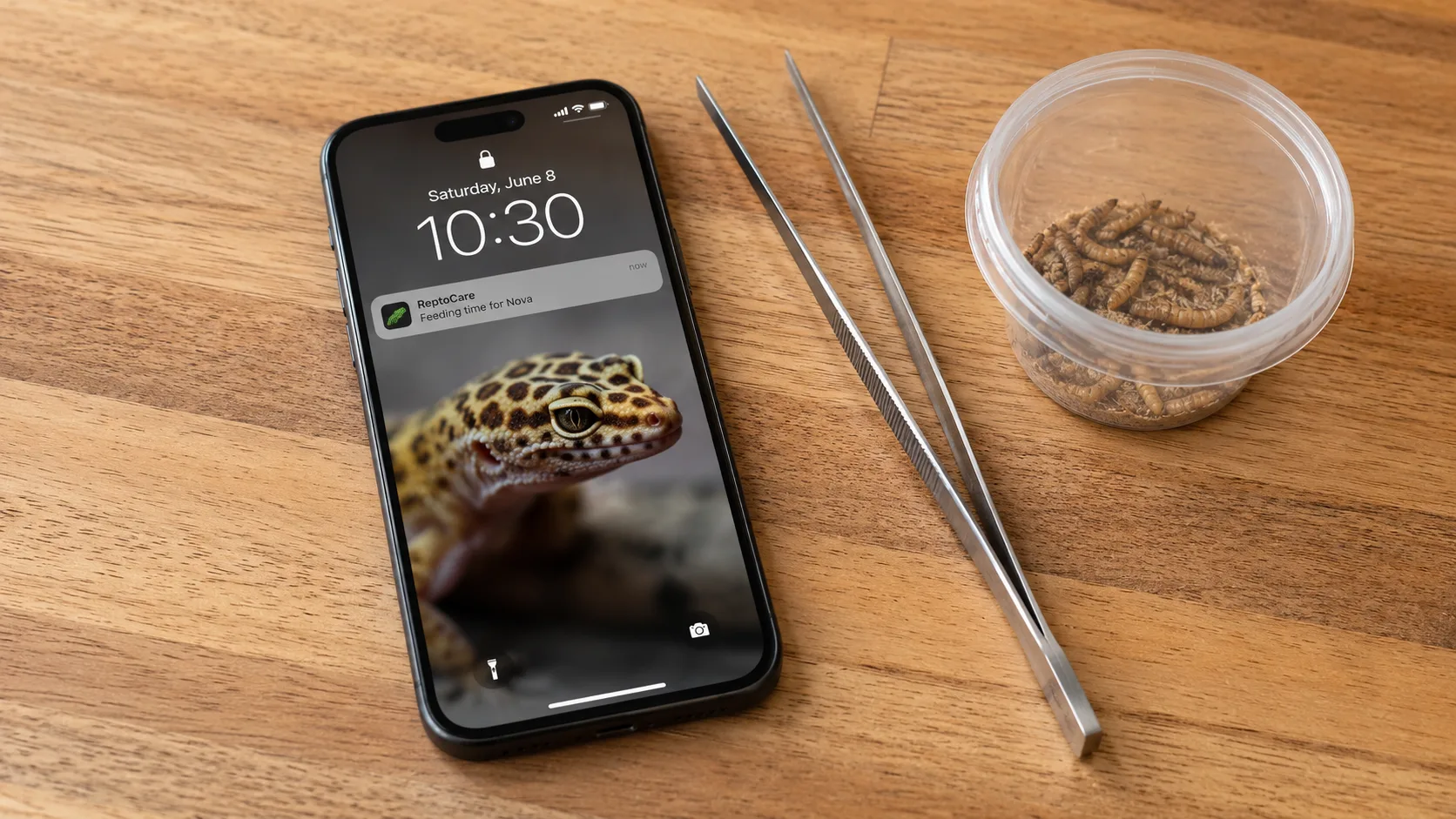
How do I set feeding reminders for my reptile?
Short answer
Reptile feeding cadence is species- and age-specific — daily for hatchling bearded dragons, every 10–14 days for adult ball pythons, 3 times a week for crested geckos. A dedicated reptile app like Reptimo lets you set species-aware reminders that respect this variation, track refusals, and notice patterns. Phone calendars work as a basic fallback; both beat memory.
- Author
- Reptimo Editorial
- Updated
- Updated
- Reading time
- 5 min read
Why feeding reminders matter for reptiles
Reptile feeding schedules are unusually easy to lose track of — because they vary so much by species and age that no two animals in a collection eat on the same cadence. Per PetMD's reptile-keeping intro, the most common feeding mistake is consistency drift: a keeper intends to feed an adult ball python every 10 days, then "I'll do it tomorrow" turns into 21 days quietly. Sometimes that's fine (seasonal slowdown), sometimes it isn't (a missed meal in a growing juvenile is meaningful).
A reminder system solves three problems at once:
- Consistency — feedings happen on the schedule the species actually needs.
- Tracking — every offering (accepted or refused) is logged.
- Early warning — clustered refusals show up as a pattern before they show up as a visible health problem.
Cadence by species
The cadences your reminder system needs to encode:
Care parameters
Adult feeding cadences across common reptile species
| Parameter | Recommended value | Notes |
|---|---|---|
| Bearded dragon (adult) | Insects 3–5×/week + greens daily | |
| Bearded dragon (hatchling) | Insects 2–3×/day + greens always | |
| Leopard gecko (adult) | Insects 2–3×/week | |
| Leopard gecko (hatchling) | Insects daily | |
| Crested gecko | CGD 3×/week + occasional insects | |
| Ball python (adult) | F/T rodent every 10–14 days | |
| Ball python (juvenile) | F/T mouse every 7 days | |
| Corn snake (adult) | F/T rodent every 7–10 days | |
| Corn snake (juvenile) | Fuzzy / hopper every 5–7 days | |
| Red-eared slider (adult) | Protein 2–3×/week + greens always | |
| Veiled chameleon (adult) | Insects every other day |
Each species detail lives in its sibling guide: bearded dragon, leopard gecko, ball python, corn snake.
Don't try to remember all these. Encode them in a reminder system.
What to log with each feeding
The minimum useful entry per feeding:
- Date and time (often auto-captured by the app).
- Prey offered — species and approximate size/weight.
- Accepted / refused (yes/no).
- Brief note if anything was notable — recent shed, weight change, behavioural difference, husbandry change.
That's 30 seconds per feeding. The data pays off the first time you bring it to a vet visit or notice a pattern you couldn't have held in memory.
Format options
Three reasonable formats:
Phone calendar with recurring reminders. Free, works fine for a single reptile with stable cadence. Set up a recurring event: "Feed ball python — every 10 days". When the reminder fires, swipe to mark done. Limitations: no log of accepted vs refused, no trend graphs, manual rescheduling when feedings shift.
Spreadsheet (Google Sheets, Excel). More structured than a calendar — rows for dates, columns for what was offered and accepted. Searchable, graph-able. Limitation: friction of opening the sheet on a phone after a feeding.
Dedicated reptile app (Reptimo). Species-aware default cadences, one-tap logging, automatic refusal tracking, trend graphs, weight integration, UVB-replacement reminders, export for vet visits. Optimised for the minimum-friction case so 30-second logging actually happens.
For a deeper comparison see the best reptile tracking app guide and the broader log-keeping philosophy in the husbandry log guide.
How Reptimo handles this
A few specific things the Reptimo app does that pure calendars don't:
- Species- and age-aware defaults. Pick the species; the app pre-loads the right feeding cadence. When the reptile transitions age stages (hatchling → juvenile → adult), the cadence updates automatically.
- One-tap log from notification. When the feeding reminder fires, swipe to mark accepted or refused right from the notification. No app open required.
- Weight integration. Logged feedings sit alongside weekly weight entries, so trend graphs show how feeding patterns correlate with body condition.
- Refusal clustering. The app flags when multiple refusals cluster, surfacing the warning before you'd notice manually.
- UVB-replacement reminder. A separate countdown on the install date of the current UVB tube, prompting replacement before output collapses.
- Vet-visit export. One tap exports the last 1–3 months as a PDF or shareable summary you can email a reptile vet ahead of an appointment.
Setting up reminders — first time
For a single reptile, day one:
- Identify the species and current life stage.
- Look up the cadence — sibling species feeding guides linked above.
- Set a recurring reminder for the offered-feeding day. If your reptile is on a 10-day cadence, use the calendar's "every 10 days" recurrence; if 3-times-a-week, use a specific day pattern.
- After each feeding, log accepted/refused. Even a one-line note in Apple Notes works if calendar + log feels heavy.
- Schedule a weekly 5-minute review of the log so patterns register.
For a multi-reptile collection, the app approach becomes significantly more time-efficient than calendars or spreadsheets.
Why this isn't optional for serious keepers
A keeper who:
- Skips logging
- Relies on memory for last-feeding date
- Doesn't track refusals
...is the keeper who shows up at a reptile vet 6 weeks into a problem they couldn't see coming, asking "I think she stopped eating, but I'm not sure when?" The vet has to guess at husbandry, run more tests to compensate for missing context, and prescribe treatment based on less information.
A keeper who logs every feeding for the same animal arrives at the vet with: "She refused her last 4 meals across 6 weeks. Weight dropped from 580 g to 540 g over that period. Temperature on warm side has been stable at 31 °C verified weekly. No husbandry changes." The vet can rule out husbandry causes in two minutes and focus on actual diagnostic work.
The 30 seconds per feeding is the cheapest welfare investment in reptile keeping. The cross-species early warning patterns are in "is my reptile sick?"; the broader husbandry log philosophy in the husbandry log guide; the app comparison in the best app guide.
Frequently asked questions
Why do reptiles need feeding reminders?
What's the best app for tracking reptile feedings?
Can I just use my phone calendar?
How often should I feed different reptiles?
Should I log refused meals?
Do feeding reminders matter for adult snakes that eat infrequently?
What about hatchlings vs adults?
How do feeding logs help vet visits?
Do I need to log every single feeding?
Sources
- Reptile Care for Beginners · PetMD
- Disorders and Diseases of Reptiles · Merck Veterinary Manual
- Bearded Dragon Feeding & Care · ReptiFiles
Quick check
Test what you just learned
A short quiz, just for you. Pick an answer to get instant feedback — there's no pass mark, this is for your benefit.
Quiz questions and answers
Why are reptile feeding reminders different from dog/cat feeding reminders?
Correct answer: Reptile schedules are highly species- and age-specific — adult snakes eat every 10–14 days, hatchling dragons multiple times daily — easy to drift from without prompting
Reptile feeding cadences vary enormously by species and age. Without a reminder system tied to the right cadence, keepers default to convenient (usually wrong) schedules — daily for adults that should eat weekly, or weekly for hatchlings that should eat daily.
What's the right cadence for an adult ball python?
Correct answer: Every 10–14 days, sometimes longer in winter
Adult ball python: one appropriately sized F/T rodent every 10–14 days, sometimes longer in winter. Daily feeding causes obesity and shortens lifespan.
Should you log REFUSED meals as well as accepted ones?
Correct answer: Yes — refusals are diagnostic data and catch husbandry drift weeks before visible symptoms
Log every offering, accepted or refused. A clustered pattern of refusals signals husbandry drift (temperature, humidity, recent stress) before any visible symptom. The data catches problems weeks earlier than waiting for signs.
What's the minimum useful information for a feeding log entry?
Correct answer: Date, prey offered, accepted/refused, optional brief note (recent shed, weight, etc.)
Minimum useful entry: date + prey offered + accepted or refused + brief note if anything was notable. 30 seconds per feeding. The detail is for later — when a vet asks 'when was the last meal?' your answer is data, not memory.