How often should I feed my bearded dragon?
Short answer
Hatchlings (under 4 months): live insects 2–3 times daily, greens always available. Juveniles (4–12 months): insects once daily, greens always available. Adults (12+ months): fresh greens daily, insects 3–5 times per week. Calcium-with-D3 dusted on most insect feedings; multivitamin every 1–2 weeks. Adjust down if the dragon is overweight.
- Author
- Reptimo Editorial
- Updated
- Updated
- Reading time
- 5 min read
Frequency by age
Bearded dragon feeding frequency shifts dramatically across the first 12–18 months of life. Hatchlings need protein for fast growth; adults need restricted calories and plant-heavy diets to avoid obesity and fatty liver. Per PetMD's care sheet and ReptiFiles' diet guide:
Care parameters
Bearded dragon feeding frequency by life stage
| Parameter | Recommended value | Notes |
|---|---|---|
| Hatchling (0–4 months) | Insects 2–3×/day | Greens always available; 10–15 min sessions |
| Juvenile (4–9 months) | Insects 1×/day | Greens always available |
| Sub-adult (9–12 months) | Insects 5–6×/week | Greens daily; transition to adult schedule |
| Adult (12+ months) | Insects 3–5×/week | Greens daily |
| Established adult (3+ years) | Insects 2–3×/week | Greens daily; some keepers do 2× weekly |
| Greens | Always available | Refresh daily |
| Calcium + D3 dust | 4–5 of 7 meals (juv) / 3 of 7 (adult) | |
| Multivitamin | Hatchlings weekly, adults every 1–2 weeks |
Feeding session mechanics
Each insect feeding is a focused 10–15 minute event, not free access:
- Set a timer. 10–15 minutes from first offered insect.
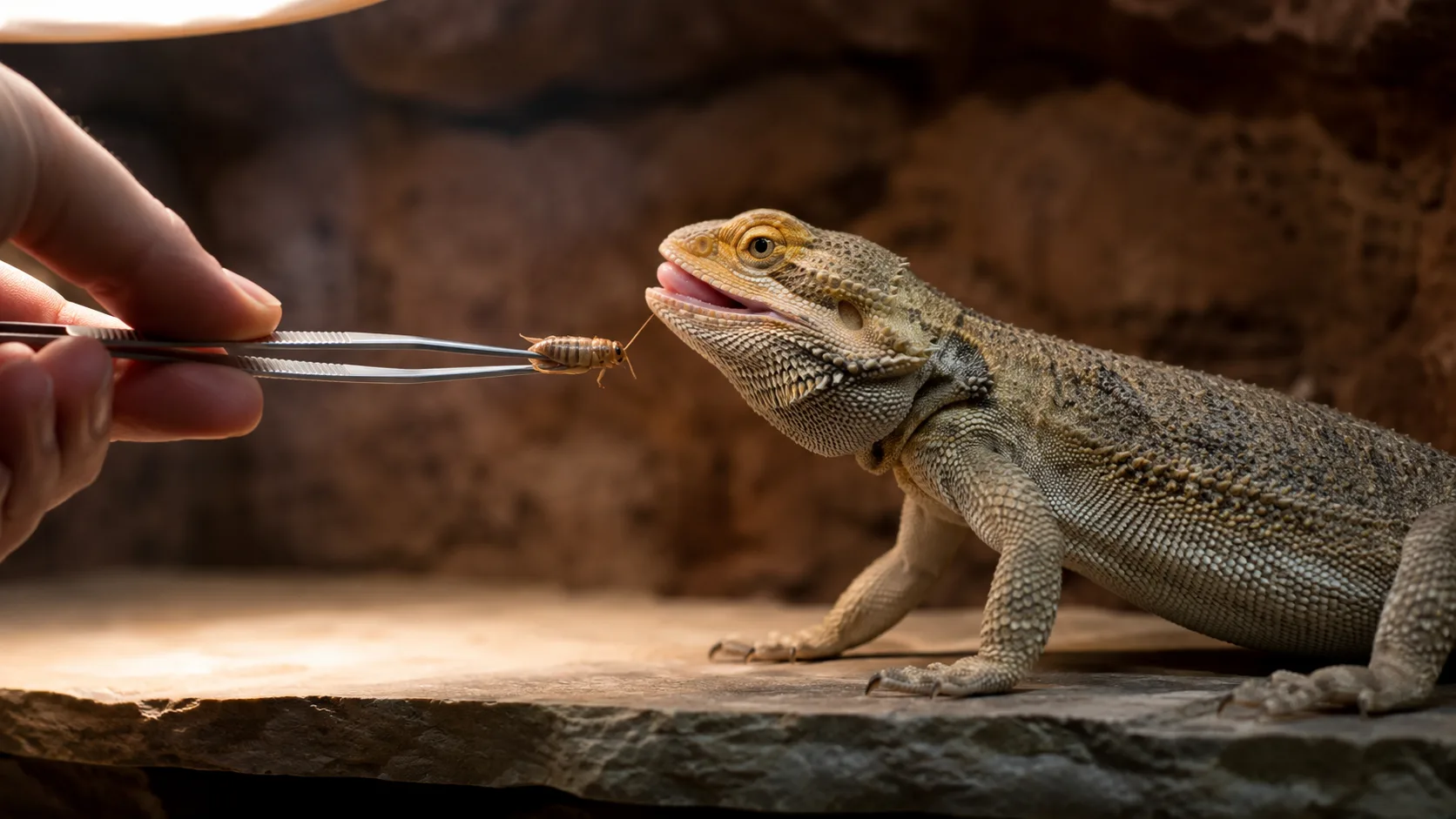
- Offer with tongs or by dropping insects one at a time into the feeding dish. Don't dump the whole batch.
- Remove uneaten insects after the session, especially crickets — left loose they harass the dragon at night and can bite during sleep, causing stress and small wounds.
- Greens stay in the dish for the day; refresh in the morning.
Hatchlings get 2–3 of these sessions per day; adults get them on the 3–5 times per week schedule. The "as much as it'll eat in 15 minutes" approach prevents both overfeeding (dragon stops when full) and undercounting (no need to count individual prey).
How to tell overfeeding from underfeeding
Body condition reads more reliably than scale weight at any given moment. Per BeardedDragon.org's care guide:
Overweight (reduce insect frequency):
- Fat pads behind the back legs visible as jelly-bean-shaped bulges.
- Body wider than the head from a top-down view.
- No defined "waist" between ribs and hips.
- Sausage-shaped cross-section instead of teardrop.
- Reduced activity, reluctance to climb.
Underweight (audit husbandry FIRST, then increase feeding):
- Visible spine and ribs from above.
- Hollow-looking sides.
- Prominent pelvic bones.
- Hatchlings/juveniles that feel thin to the touch.
Important nuance: an underweight bearded dragon, especially a young one, is usually a temperature or UVB problem before it's a feeding amount problem. Cold dragons don't digest food efficiently, no matter how much you offer. Verify basking surface 40–43 °C (104–110 °F) with an IR temperature gun before increasing food — see the temperature guide.
Calcium and supplement cadence
The supplementation schedule is tied to feeding frequency:
Care parameters
Supplement dusting schedule by life stage
| Parameter | Recommended value | Notes |
|---|---|---|
| Hatchling (insects 2–3×/day) | Ca+D3 on 4–5 of 7 meals | Plain Ca on additional meals if desired |
| Juvenile (insects 1×/day) | Ca+D3 on 4–5 of 7 meals | |
| Adult (insects 3–5×/week) | Ca+D3 on 3 of 7 meals (≈ 2 of 5) | |
| Multivitamin (all life stages) | Every 1–2 weeks | Repashy Supervite, Arcadia EarthPro-A |
The supplement schedule and the UVB schedule work together — see the UVB guide and the deficiency-recognition guide MBD signs.
When to feed during the day
Bearded dragons digest food efficiently only when warm. Practical rules:
- First feed at least 1–2 hours after lights-on so the dragon is fully warmed up. Cold dragons coming off a 65 °F overnight drop need time to reach digestion-ready body temperature.
- Last feed at least 1 hour before lights-out so food has time to digest before the basking lamp goes off.
- Mid-morning to early afternoon is the typical feeding window.
For hatchlings on 2–3 feedings per day: space at least 3 hours apart, with the last feeding by mid-afternoon at the latest.
What to feed (cross-reference)
This guide covers when and how often. For what to feed (staple greens, staple insects, treat-only items, never-feed list), see the diet guide. For the specific insects ranked, the same logic that applies to leopard geckos in the leopard gecko feeder guide transfers (dubia and BSFL as staples, mealworms as treats only).
Tracking feedings
Logging every feeding pays off twice — short-term it lets you spot a refused-meal pattern early, long-term it gives a reptile vet structured data on a sick visit. Even a simple paper log of:
- Date and time
- Insects offered (species and approximate number)
- Insects eaten / refused
- Calcium / multivitamin dusted
…lets you see seasonal patterns, growth-driven appetite shifts, and the early warning of brumation onset. The husbandry log guide covers format options.
When food refusal extends beyond a normal pattern, the diagnostic walkthrough is in the not-eating guide; for autumn/winter refusal in adults, see the brumation guide. The broader husbandry context lives in the pillar care guide.
Frequently asked questions
How often does a baby bearded dragon eat?
How often do juvenile bearded dragons eat?
How often does an adult bearded dragon eat?
What's the difference between hatchling and adult diet?
How long should each feeding session last?
Can I free-feed insects to a bearded dragon?
How do I tell if my bearded dragon is overweight?
How do I tell if my bearded dragon is underweight?
Should I feed at a specific time of day?
Sources
- Bearded Dragon Care Sheet · PetMD
- Bearded Dragon Diet & Nutrition · ReptiFiles
- Bearded Dragon Care Guide · BeardedDragon.org
Quick check
Test what you just learned
A short quiz, just for you. Pick an answer to get instant feedback — there's no pass mark, this is for your benefit.
Quiz questions and answers
How often does a HEALTHY ADULT bearded dragon eat insects?
Correct answer: 3–5 times per week
Adults: insects 3–5 times per week, fresh greens daily. Daily insects in an adult cause obesity and fatty liver. The most common feeding mistake is feeding an adult on the hatchling schedule.
How often does a HATCHLING bearded dragon need to eat insects?
Correct answer: 2–3 times per day in short feeding sessions
Hatchlings (under 4 months): 2–3 short feeding sessions per day. They double in size in the first months and need consistent protein. Underfeeding hatchlings is one of the most common reasons for stunted growth and slow MBD development.
How long should each insect feeding session last?
Correct answer: 10–15 minutes, then remove uneaten insects
10–15 minutes is the standard session. The dragon eats what it wants in that window. Leaving insects loose (especially crickets) means they harass the dragon at night and chew on it during sleep.
Your adult bearded dragon has fat pads behind its back legs. What does this tell you?
Correct answer: It's overweight — reduce insect frequency, increase greens
Visible fat pads behind the back legs are the classic obesity sign. Adult bearded dragons should look teardrop-shaped, not sausage-shaped. Drop insect frequency to 2–3 times per week, increase greens, and monitor weight.