How do I track my reptile's weight and health over time?
Short answer
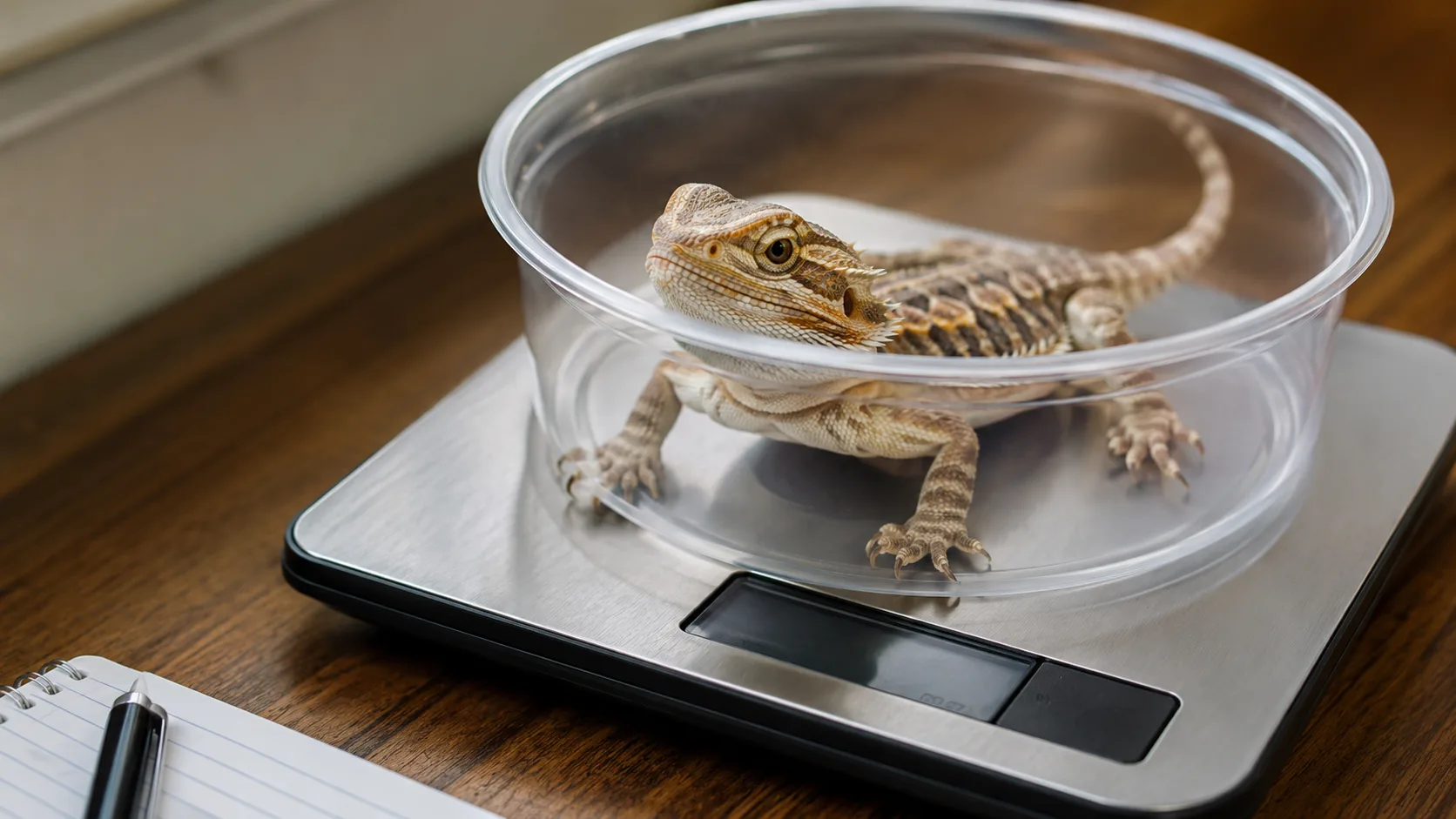
Weigh weekly on a flat digital kitchen scale (precision 0.1 g for hatchlings, 1 g for larger animals) at the same time of day. Log every reading — trends matter, individual numbers don't. Add a monthly photo from the same angle, log every shed and every defecation, and review the weight chart quarterly for slow drift. Sustained loss over 10 % of body weight is a vet visit.
- Author
- Reptimo Editorial
- Updated
- Updated
- Reading time
- 7 min read
Why weight is the headline signal
Across every common pet reptile species, the Merck Veterinary Manual makes the same point: reptiles hide illness until disease has progressed, and the keeper-side counter-measure is consistent monitoring. Of all the things a keeper can monitor, body weight is the single most diagnostically useful long-term signal. A stable weight during a known fast is reassuring; a sustained drop is often the earliest indicator of illness — usually visible weeks before behaviour changes.
The reason weight wins over almost any other metric: it's an integrated readout. It reflects feeding, digestion, hydration, parasite burden, metabolic rate, and underlying disease — all in one number that you can chart over months. Behaviour signals come and go; the weight chart is permanent record.
Choosing a scale
The right scale is determined by the animal's weight:
Care parameters
Scales by animal size
| Parameter | Recommended value | Notes |
|---|---|---|
| Hatchlings under 50 g | 0.1 g jewellery scale | Baby leopard geckos, juvenile crested geckos, neonate corn snakes |
| 50 g to 5 kg | 1 g digital kitchen scale | Most adult pet reptiles — bearded dragons, ball pythons, mid-sized turtles |
| Over 5 kg | Postal or pet scale (5–10 g precision) | Adult sulcata, Burmese python, large monitor |
A flat platform scale with a clear container (deli cup, clean food tub) makes weighing safe and repeatable. Tare with the container empty so the readout is the animal's true weight. Never lift a reptile onto an open scale pan — it will move and the reading will be wrong (or the animal will jump and injure itself).
How often to weigh
Cadence depends on context:
- First 1–2 months with a new reptile or after a husbandry change — weekly. You're building the baseline of what "normal" looks like.
- Healthy settled adult, established routine — monthly is enough.
- Hatchling or juvenile — weekly through fast-growth months.
- During a feeding refusal — weekly until it resolves.
- During and after brumation/winter slowdown — weekly to confirm the drop is gradual and self-correcting.
- Before any vet visit — always. Bring the chart.
Weigh at the same time of day, same conditions (pre-feeding works well), and in the same container if possible. Consistency is what makes trend-spotting possible.
What "normal" weight looks like
Healthy weight ranges by species and life stage are wide because they depend on body condition, not target weight alone:
Care parameters
Adult weight ranges — common pet reptiles
| Parameter | Recommended value | Notes |
|---|---|---|
| Leopard gecko (adult) | 45–90 g | Tail-fat reflects condition more than weight alone |
| Crested gecko (adult) | 35–60 g | Females larger than males |
| Bearded dragon (adult) | 300–550 g | Body length and tail-base width more telling than weight |
| Ball python (adult) | 1,200–2,500 g | Females larger; muscle tone matters |
| Corn snake (adult) | 400–900 g | 5–6 ft full-grown |
| Red-eared slider (adult) | 1,000–3,000 g | Females larger than males |
| Veiled chameleon (adult male) | 100–200 g | Body condition score is more useful than weight |
These are reference ranges, not targets. A 50 g leopard gecko with a full tail is healthy; a 90 g one with a thin tail might not be. Read body-condition cues alongside the number — tail-base width on geckos and lizards, dorsal-spine prominence on snakes, plastron-fat on turtles.
What else to track alongside weight
Weight is the headline; context comes from the rest:
- Feeding — every offering, accepted or refused, with prey item and size. The pattern of refusal explains a weight drop instantly.
- Defecation — frequency and any abnormalities. Skipped defecations point at temperature, hydration or impaction.
- Shed dates and completeness — shed cycle length is a slow stress signal; stuck shed points to humidity.
- Basking and cool-side temperatures — weekly IR-gun spot check.
- Humidity — especially for ball pythons, chameleons, sliders.
- UVB install date — replace at 12 months for a T5 HO tube; see our UVB guide.
- Behavioural notes — anything unusual, with date.
A weight drop with no other context is ambiguous. A weight drop in a ball python that refused 4 meals running in November with stable humidity and correct temperatures is a normal winter slowdown. A weight drop in the same snake with mucus around the mouth and audible wheezing is a respiratory emergency.
The monthly photo
One photo per month from the same angle, in the same light, makes slow drift visible that weekly weighings miss. Useful framings:
- Geckos and lizards — top-down with the body and tail in frame. Tail-base width, body condition, skin condition.
- Snakes — coiled from above and stretched along a known reference (a ruler). Muscle tone, body taper, scale condition.
- Turtles — plastron and carapace photographed straight-on. Shell colour, peeling, pyramiding, soft spots.
- Chameleons — side profile with body lit evenly. Casque shape, body fullness, dewlap and gular colour, eye fullness.
Save photos in date-named folders. A year later, "month 1 vs month 12" is more obvious than memory.
When weight change becomes a vet visit
Some patterns trigger a vet visit regardless of species:
- Sustained loss over 10 % of starting body weight. Not a single reading; a trend across multiple weighings.
- Loss that accelerates over consecutive weighings rather than stabilising.
- Any loss combined with another sign — lethargy, sunken eyes, mucus around the mouth, abnormal droppings, retained shed.
- Any loss in a hatchling or juvenile beyond a single shed cycle.
- Unexplained weight gain that doesn't match feeding — possible egg-binding in a gravid female.
For the full warning-signs checklist that pairs with the weight chart, see "is my reptile sick?".
Tracking format
A weight chart works in any format — paper, spreadsheet or app:
- Notebook. Weight + date in two columns; plot on graph paper if you want a visual.
- Spreadsheet. Date and weight columns; insert a line chart. Filter by date range. Free, owned by you forever.
- Dedicated reptile app (Reptimo, SnekLog, Reptile Scan). Automatic charting against species norms, reminders to weigh, vet export bundle. Reptimo specifically flags drift vs the species target range, which catches slow changes you'd otherwise miss.
The format that survives your real routine for years is the right one — see the format comparison. What matters is that the chart exists and you glance at it monthly.
A 60-second weekly routine
To make this stick, the routine has to be short. Suggested ritual, done once a week (Sunday before lights-on works well):
- Weigh (60 seconds incl. container).
- Log the number.
- Glance at last 8 weeks on the chart — is the trend flat, rising, falling?
- Note any shed, feeding refusal, or behavioural oddity from the week.
- Spot-check warm and cool temperatures with an IR gun.
Done. Five minutes once a week beats an ambitious 20-minute daily routine you abandon after a month. For the longer-form discussion of what else to log and why, see our husbandry-log primer.
Frequently asked questions
What's the right scale for weighing a reptile?
How often should I weigh my reptile?
How much weight loss in a reptile is normal?
How do I know if a weight drop is brumation or illness?
What else should I track besides weight?
How long do I need to keep weight records?
Should I take photos as part of tracking?
Do I need an app to track weight, or is a spreadsheet enough?
When does a weight change become a vet visit?
Sources
- Reptile Care for Beginners · PetMD
- Disorders and Diseases of Reptiles · Merck Veterinary Manual
- How to Tell If Your Lizard Is Sick · PetMD
Quick check
Test what you just learned
A short quiz, just for you. Pick an answer to get instant feedback — there's no pass mark, this is for your benefit.
Quiz questions and answers
What's the right cadence to weigh a healthy adult reptile?
Correct answer: Weekly for new or unwell animals; monthly is enough for settled healthy adults
Weekly is the right cadence for new reptiles, juveniles, or any animal under observation. Monthly is enough for stable, healthy adults — the trend matters, not the daily noise. Always weigh during a feeding refusal, during shed, before a vet visit.
Which of these weight changes warrants a vet visit?
Correct answer: Sustained loss over 10 % of starting body weight, or any drop combined with lethargy or sunken eyes
Shed-cycle and brumation drops are normal and self-correct. Sustained loss past 10 %, or any drop combined with another warning sign (lethargy, sunken eyes, abnormal droppings, mucus), is a vet visit. Pattern + context tells you which is which — that's why the chart matters.
What's the best scale for weighing a 30 g hatchling leopard gecko?
Correct answer: A 0.1 g precision jewellery scale, used with a deli cup as the container
Hatchlings under 50 g need 0.1 g precision — a 1 g kitchen scale rounds away the changes you're trying to see. Place the gecko in a deli cup, tare with the cup empty, weigh. Never lift a hatchling onto an open pan.